Would Expanding Official Clothing-Optional Areas Reduce Sexually Motivated Behaviour?
A Policy Analysis of Regulation Versus Informal Naturist Spaces
Audience Note
This white paper is intended for policymakers, local authorities, land managers, and naturist organisations examining governance models, recreational land use, and behavioural outcomes in clothing-optional environments.
Author: Vincent Marty, Founder of NaturismRE
Executive Summary
Clothing-optional recreation occurs in both officially designated locations and informal sites such as remote beaches, rivers, forests, and secluded natural areas. While naturism promotes non-sexual social nudity, some informal locations have occasionally been reported to attract individuals motivated by voyeurism or sexual activity.
This situation raises an important policy question:
If non-official clothing-optional locations attract more sexually motivated actors due to the absence of governance, would expanding officially designated clothing-optional areas help reduce such behaviour?
This white paper explores the relationship between governance structures, behavioural norms, and environmental design in naturist environments. The analysis examines whether formally recognized clothing-optional spaces may:
• clarify behavioural expectations
• reduce ambiguity regarding the intent of nudity
• discourage sexually motivated behaviour
• support healthier naturist recreation
• improve coexistence with the broader public.
Evidence from established naturist environments suggests that clear rules, visible social norms, and community oversight strongly influence visitor behaviour. In contrast, informal locations lacking governance may produce ambiguous social signals that allow individuals with conflicting motivations to occupy the same space.
The paper concludes that official designation, combined with behavioural guidelines and basic oversight, can significantly reduce ambiguity and may discourage inappropriate behaviour. Expanding official clothing-optional areas therefore represents a potential structural policy approach for managing naturist recreation more effectively.
This paper does not suggest that official designation alone eliminates inappropriate behaviour. It argues that governance structures significantly influence behavioural patterns and can reduce ambiguity that contributes to misconduct in informal environments.
Keywords
Naturism
Clothing-optional recreation
Public space governance
Informal recreation sites
Behavioural norms
Voyeurism prevention
Public policy
Environmental design
Abstract
Clothing-optional recreation occurs across both regulated and informal environments. While naturism promotes non-sexual social nudity, unregulated locations may attract a broader range of participant motivations due to the absence of governance structures.
This white paper evaluates whether expanding officially designated clothing-optional areas could reduce sexually motivated behaviour by introducing clearer norms, environmental design, and community oversight.
Drawing on sociological research, environmental design theory, and comparative observations of naturist environments, the analysis suggests that structured settings with clear behavioural expectations tend to produce more stable and respectful social outcomes.
1. Introduction
Naturist recreation has existed for more than a century and continues to grow globally. Many naturists prefer natural environments such as beaches, lakes, forests, and rivers rather than private clubs or enclosed resorts.
However, in many regions these locations remain informal and unofficial. Visitors often rely on word-of-mouth, online forums, or local knowledge to identify clothing-optional sites.
Because these areas lack formal recognition and governance, they may attract visitors with diverse and sometimes conflicting motivations. While most participants seek non-sexual recreation, some individuals may visit these locations for voyeuristic or sexually motivated purposes.
Authorities sometimes interpret such incidents as evidence that clothing-optional recreation itself creates sexualized environments.
This interpretation may overlook an important structural factor: the difference between regulated naturist environments and informal locations operating without governance or behavioural norms.
This white paper evaluates whether expanding officially designated clothing-optional areas could reduce such problems by creating clearer behavioural expectations and more structured environments.
2. Methodology
This analysis employs a multidisciplinary approach combining:
• sociological research on social norms
• environmental design principles
• governance models for recreational land use
• observational evidence from established naturist locations
• comparative analysis of regulated and unregulated spaces.
Rather than relying solely on statistical datasets—which remain limited for naturist environments—the study synthesizes research on behavioural norms, spatial regulation, and community governance to evaluate how environmental structure influences visitor behaviour.
Given the limited availability of large-scale quantitative data, this analysis should be understood as a qualitative and comparative assessment of governance structures and behavioural outcomes rather than a precise statistical evaluation.
3. Historical Context
The modern naturist movement developed in Europe during the early twentieth century, particularly in Germany and France. Early advocates promoted nude sun exposure, physical exercise, and outdoor living as part of a holistic approach to health and wellbeing.
Naturist communities often established designated spaces, including clubs, resorts, and beaches, where social norms emphasizing non-sexual nudity could develop.
Over time, certain public beaches and parks were officially recognized as clothing-optional areas in various countries, including:
• Germany
• France
• Spain
• Croatia
• Australia
• the United States.
In these locations, clearly defined boundaries and behavioural expectations helped establish social environments where nudity was understood as non-sexual recreation.
However, many naturists still seek more natural environments outside official locations. These informal spaces may lack the governance structures that help maintain behavioural standards.
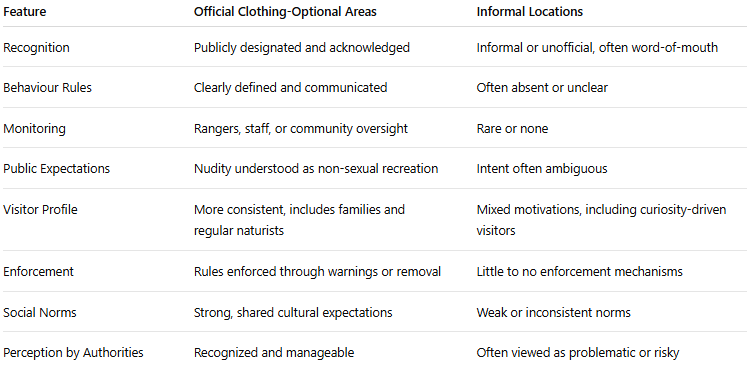
4. Structural Differences Between Official and Informal Locations
Visitor behaviour is strongly influenced by the level of governance present at a recreational site.
The absence of formal rules and supervision in informal locations can create uncertainty about acceptable behaviour.
Such ambiguity may attract individuals whose motivations differ from those of naturists.
These structural differences illustrate how governance, rather than nudity itself, plays a central role in shaping behavioural outcomes.
5. Why Informal Locations May Attract Sexually Motivated Actors
Several structural factors may explain why some informal clothing-optional locations experience higher levels of inappropriate behaviour.
These conditions do not inherently produce such behaviour but can increase the likelihood of its occurrence compared with regulated environments
5.1 Lack of Clear Norms
Without official recognition, visitors may not understand the principles of naturism.
Some individuals unfamiliar with naturist culture may assume that nudity signals sexual openness.
5.2 Anonymity and Isolation
Remote locations often provide privacy and limited oversight.
While this environment appeals to naturists seeking peaceful immersion in nature, it may also attract individuals seeking discreet encounters.
5.3 Absence of Enforcement
In regulated naturist environments, inappropriate behaviour can lead to removal or exclusion.
In informal settings, enforcement mechanisms rarely exist.
6. The Ambiguity Problem
Ambiguity of intent plays a significant role in shaping behaviour.
When nudity occurs outside clearly defined contexts, observers may interpret it in different ways:
• naturist recreation
• exhibitionism
• sexual signalling.
Such ambiguity can lead to misunderstandings between naturists, visitors, and authorities.
Officially designated clothing-optional areas reduce this ambiguity by clearly communicating that the location is intended for non-sexual recreation.
Reducing ambiguity is therefore a key factor in influencing both participant behaviour and public perception.
7. Evidence from Established Naturist Locations
Observations from organized naturist environments suggest that clear rules and social norms strongly influence behaviour.
Typical characteristics of successful clothing-optional environments include:
• posted behavioural guidelines
• visible signage explaining expectations
• presence of staff or volunteers
• strong community norms discouraging inappropriate conduct
• participation by diverse groups including families and couples.
These elements help create environments where sexually motivated behaviour becomes socially unacceptable.
These observations suggest that behavioural outcomes are strongly influenced by environmental structure and clearly communicated norms.
8. Potential Benefits of Official Designation
Expanding officially designated clothing-optional areas may produce several positive outcomes.
8.1 Behavioural Clarity
Clear signage and official recognition communicate that the area is intended for non-sexual naturist recreation.
8.2 Community Self-Regulation
Regular visitors often develop a sense of stewardship for official naturist locations.
Peer pressure and shared values discourage inappropriate conduct.
8.3 Reduced Ambiguity for Authorities
Law enforcement can more easily differentiate between legitimate naturist recreation and misconduct.
8.4 Greater Inclusivity
Official environments may attract a wider demographic including:
• couples
• families
• casual naturists.
These groups help maintain balanced social environments.
Taken together, these factors indicate that structured environments can support more predictable and stable social interactions.
9. Policy and Institutional Implications
For governments and municipalities considering clothing-optional areas, several policy principles may be useful.
Effective management may include:
• official designation of clothing-optional zones
• clear behavioural guidelines
• educational signage explaining naturist principles
• occasional monitoring by park authorities or rangers
• collaboration with naturist communities.
These measures can support responsible naturist recreation while discouraging inappropriate behaviour.
Such approaches align with broader principles of preventive governance, where environmental design and clear expectations reduce the likelihood of conflict before it occurs.
10. Limitations
Expanding official clothing-optional areas may present challenges.
Potential issues include:
• public resistance due to cultural attitudes toward nudity
• increased visitor numbers requiring infrastructure management
• political opposition from community groups.
Additionally, official designation alone cannot completely eliminate inappropriate behaviour. Effective management still requires clear rules and enforcement when necessary.
Further empirical research, including comparative studies of official and informal sites across regions, would strengthen understanding of the relationship between governance and behaviour.
11. Conclusion
Informal clothing-optional locations often attract visitors with diverse motivations. The absence of governance and behavioural norms can allow sexually motivated actors to appear more frequently than in regulated naturist environments.
Expanding official clothing-optional areas may help address this issue by:
• clarifying behavioural expectations
• establishing social norms
• enabling community self-regulation
• supporting responsible naturist recreation.
While official designation cannot eliminate inappropriate behaviour entirely, it can create conditions that significantly reduce ambiguity and discourage misconduct.
As societies continue to debate the role of naturist recreation in public spaces, policy approaches that combine clarity, education, and respectful regulation may provide the most effective path forward.
The available evidence therefore supports the view that behavioural outcomes are shaped primarily by structure, clarity, and governance rather than by the presence of nudity itself.
References
West, K. (2018). Naturism and Body Image. University of Brighton.
Grogan, S. (2016). Body Image: Understanding Body Dissatisfaction in Men, Women and Children. Routledge.
Clarke, R. V. (1997). Situational Crime Prevention.
European Naturist Federation. Reports on naturist tourism and behaviour standards.
World Health Organization. Outdoor Recreation and Wellbeing Reports.
Goffman, E. (1959). The Presentation of Self in Everyday Life.
Douglas, M. (1966). Purity and Danger.
Andressen, C. (2018). Naturism and Nudism in Modern Europe.