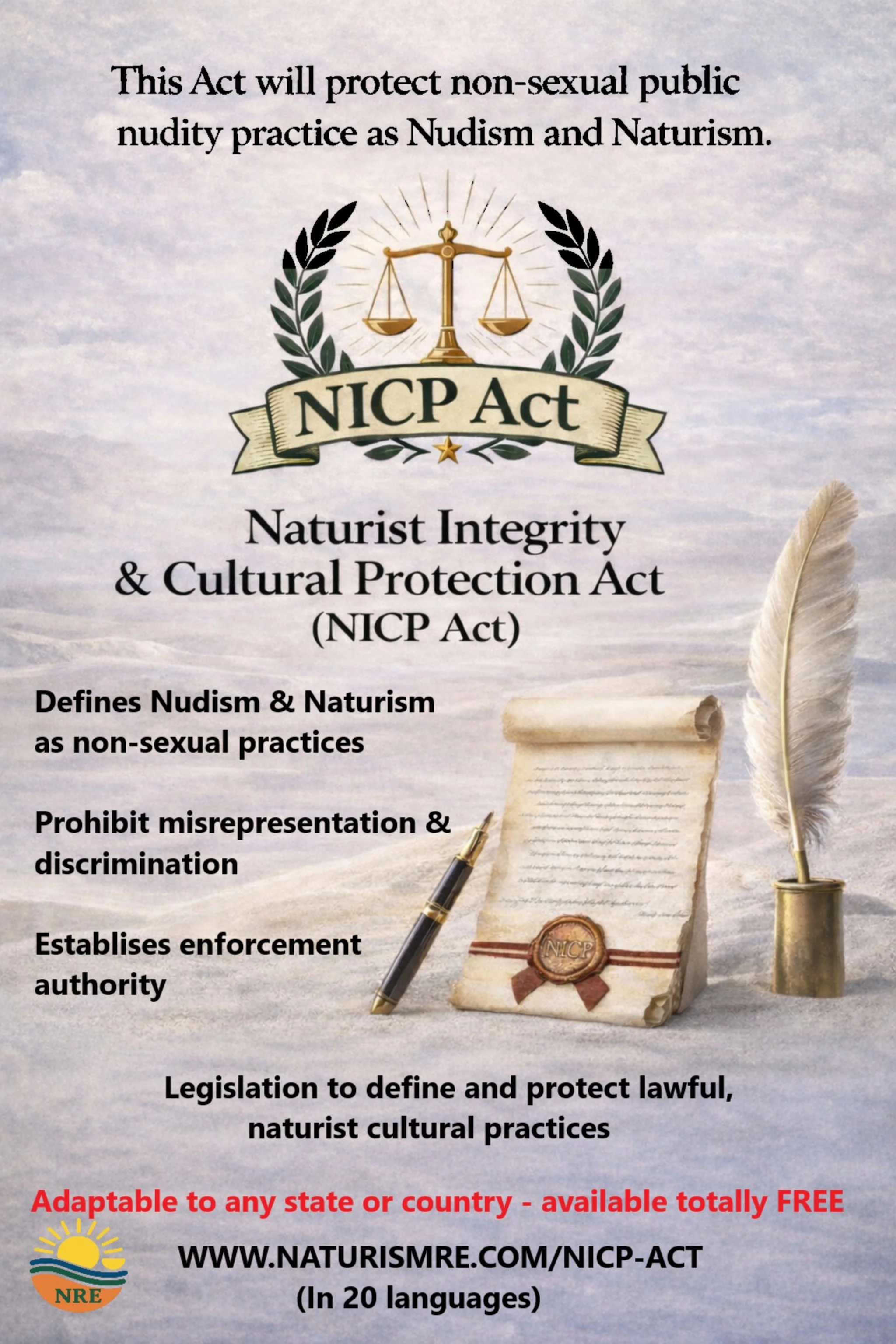
The Naturist Integrity & Cultural Protection Act
The Naturist Integrity & Cultural Protection Act, known as the NICP Act, is a legislative template created by NaturismRE to support the formal recognition, protection, and clarification of naturism and nudism as legitimate non-sexual lifestyles and cultural practices within modern legal and institutional systems.
1. Why the NICP Act Matters
For decades, many federations, clubs, and organisations have worked to support naturists, preserve spaces for naturist practice, and protect existing communities.
However, many traditional structures have operated under limitations that can restrict political or legislative advocacy. As a result, naturism and nudism have often remained confined to localised defensive battles rather than achieving broader formal recognition and protection in law.
That legal and institutional gap is one reason naturism and nudism remain poorly recognised in many jurisdictions as non-sexual lifestyles, cultural practices, and legitimate forms of recreational and social participation.
2. What the NICP Act Is
The NICP Act is a comprehensive legislative template framework designed to support jurisdictions seeking clearer recognition and protection of naturism and nudism.
Legislative Template
A model framework that can be adapted to different countries, states, regions, councils, and legal systems.
Non-Sexual Recognition
A structure designed to distinguish naturism and nudism from sexual conduct, indecency, or misconduct.
Cultural Protection
A framework supporting recognition of naturism and nudism as cultural, recreational, wellbeing, and lifestyle practices.
Policy Development Tool
A practical resource for individuals, organisations, venues, and policymakers seeking legislative reform.
3. What the NICP Act Is Not
The NICP Act is not designed to impose nudity, remove public standards, or create unrestricted public nudity.
Not Forced Nudity
It does not require anyone to participate in naturism, nudism, or clothing-optional environments.
Not Unlimited Public Nudity
It is not a licence to be unclothed anywhere, anytime, without context, rules, or lawful boundaries.
Not Anti-Clothing
It respects choice, privacy, comfort, clothing, and non-participation.
Not a Substitute for Safeguarding
It does not remove behavioural standards, consent requirements, privacy protections, or safeguarding obligations.
4. Core Objectives
The NICP Act was developed to support long-term legal and institutional reform in several key areas.
Protect Against Misrepresentation
Clarify that naturism and nudism are non-sexual practices when conducted within appropriate behavioural and legal frameworks.
Support Clothing-Optional Spaces
Encourage the creation and protection of respectful clothing-optional spaces where appropriate and lawful.
Improve Legal Clarity
Reduce confusion between non-sexual nudity, indecency, misconduct, and unlawful behaviour.
Strengthen Public Understanding
Support education, body neutrality, responsible communication, and evidence-aware discussion.
5. How It Works
The NICP Act is designed as a flexible template that can be reviewed, adapted, translated, and used by individuals, venues, organisations, councils, policymakers, and advocacy groups.
Its purpose is to provide a structured legislative starting point, not a one-size-fits-all final law for every jurisdiction.
Adaptable Framework
Jurisdictions can adapt the model to fit local legal systems, public policy settings, and community standards.
Advocacy Resource
Individuals and organisations can use the Act to support petitions, submissions, proposals, and public education.
Ripple Effect Potential
If even one government adopts a serious version of the framework, others may begin considering similar recognition.
Institutional Bridge
The Act helps connect naturist communities with legal, civic, health, tourism, and cultural policy systems.
6. NaturismRE Position
NaturismRE developed the NICP Act to complement existing federations, clubs, and naturist organisations by focusing on long-term systemic advocacy, legislative frameworks, public education, and institutional integration.
The objective is not division. The objective is stronger foundations for the future of naturism and nudism.
NaturismRE recognises that traditional organisations have often worked within structural limitations. The NICP Act provides an additional pathway focused specifically on legal clarity, formal recognition, and cultural protection.
7. Why This Is a Turning Point
The NICP Act represents more than a proposal. It is a blueprint for long-term recognition, stability, and cultural protection.
Legal Recognition
It gives naturism and nudism a formal framework for recognition as legitimate non-sexual lifestyles and cultural practices.
Public Understanding
It helps explain naturism and nudism through law, structure, education, and behavioural clarity.
Structural Stability
It moves the discussion beyond temporary defence of isolated spaces and toward lasting institutional protection.
Global Development
It provides a multilingual framework that can support international discussion and adaptation.
8. Legal and Policy Note
The NICP Act is a legislative template and public policy framework. It is not legal advice and does not replace jurisdiction-specific legal review.
Any government, organisation, venue, or individual seeking to use the NICP Act should obtain appropriate legal, policy, and regulatory advice within their own jurisdiction before relying on it for formal legislative or operational purposes.
9. Read or Download the NICP Act
Select your preferred language below to read or download the full document.
English Version
Read or download the English version of the NICP Act.
Open DocumentVersion Française
Lire ou télécharger la version française du NICP Act.
Ouvrir le documentVersión Española
Lea o descargue la versión en español del NICP Act.
Abrir documentoVersão Portuguesa
Leia ou descarregue a versão portuguesa do NICP Act.
Abrir documentoDeutsche Version
Lesen oder laden Sie die deutsche Version des NICP Act herunter.
Dokument öffnenVersione Italiana
Leggi o scarica la versione italiana del NICP Act.
Apri documentoNederlandse Versie
Lees of download de Nederlandse versie van de NICP Act.
Document openenWersja Polska
Przeczytaj lub pobierz polską wersję NICP Act.
Otwórz dokumentРусская версия
Прочитайте или скачайте русскую версию NICP Act.
Открыть документSvensk Version
Läs eller ladda ner den svenska versionen av NICP Act.
Öppna dokumentDansk Version
Læs eller download den danske version af NICP Act.
Åbn dokumentNorsk Versjon
Les eller last ned den norske versjonen av NICP Act.
Åpne dokument日本語版
NICP Actの日本語版を読む、またはダウンロードします。
文書を開く简体中文版
阅读或下载NICP Act简体中文版。
打开文件繁體中文版
閱讀或下載NICP Act繁體中文版。
開啟文件한국어 버전
NICP Act 한국어 버전을 읽거나 다운로드합니다.
문서 열기हिन्दी संस्करण
NICP Act का हिन्दी संस्करण पढ़ें या डाउनलोड करें।
दस्तावेज़ खोलेंবাংলা সংস্করণ
NICP Act-এর বাংলা সংস্করণ পড়ুন বা ডাউনলোড করুন।
নথি খুলুনTürkçe Sürüm
NICP Act Türkçe sürümünü okuyun veya indirin.
Belgeyi açالنسخة العربية
اقرأ أو حمّل النسخة العربية من NICP Act.
افتح المستندToleo la Kiswahili
Soma au pakua toleo la Kiswahili la NICP Act.
Fungua hati10. Related Documents
11. Conclusion
The Naturist Integrity & Cultural Protection Act is a major step toward long-term recognition, legal clarity, and institutional protection for naturism and nudism.
It does not seek to force nudity or remove public standards. It seeks to clarify, protect, and recognise non-sexual naturism and nudism within appropriate legal and cultural frameworks.
Authorised by Vincent Marty, Founder of NaturismRE, Sydney, Australia.


NaturismRE is built by a small, dedicated team spending countless hours researching, writing, and advocating for evidence-based health, dignity, and resilience.
If you would like to support that work, you can buy us a cup of coffee.