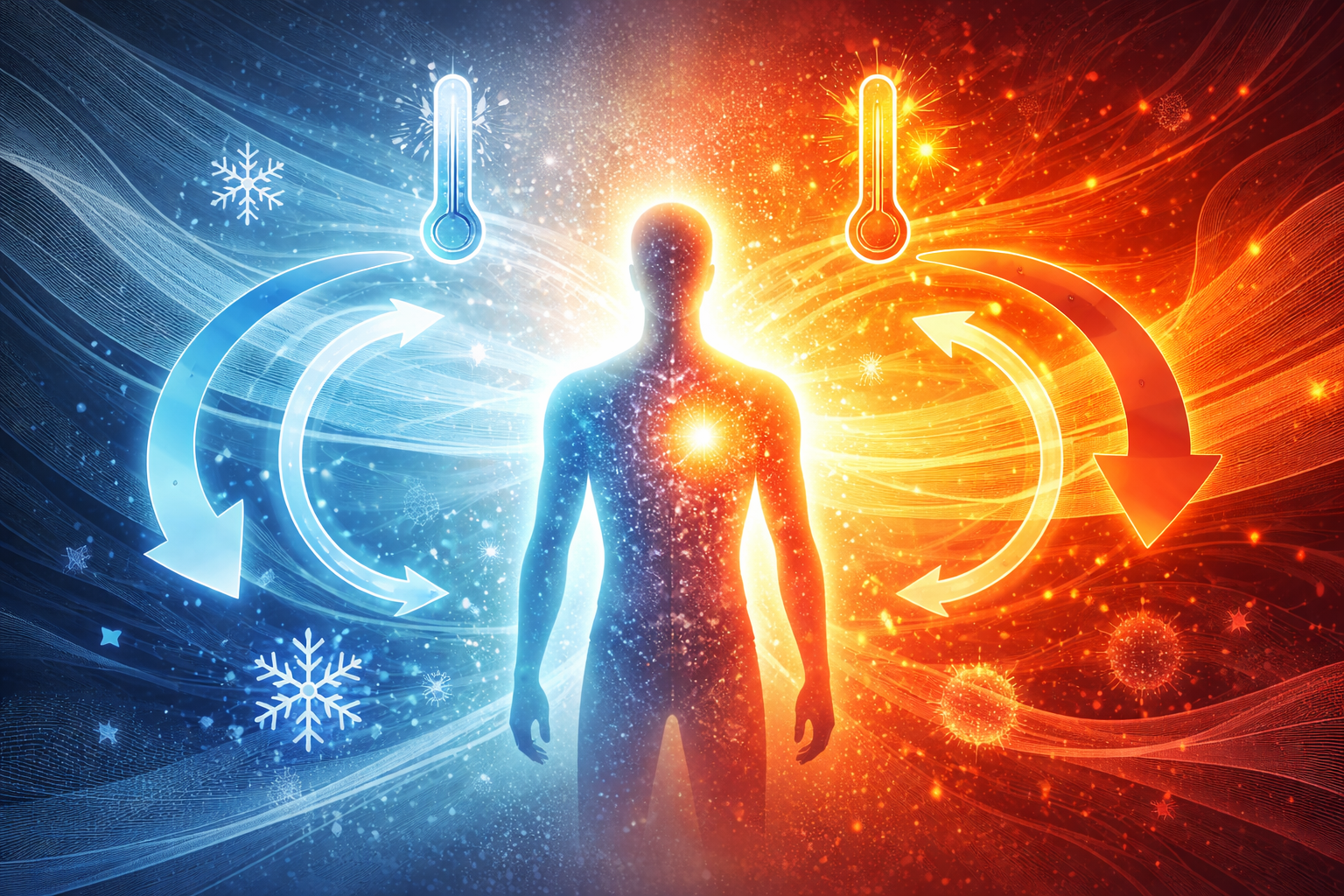
Thermoregulation & Heat Stress
How clothing interferes with the body’s temperature control systems, recovery capacity, and physiological efficiency.
Thermoregulation is a core survival function. Humans depend heavily on skin-based cooling systems evolved for airflow, evaporation, and direct environmental interaction.
How Clothing Interferes with the Body’s Temperature Control Systems
Humans must maintain internal body temperature within a narrow range to support brain function, cardiovascular stability, muscle performance, enzymatic activity, and metabolic regulation.
Even small deviations increase physiological strain and reduce performance efficiency.
Unlike many animals, humans rely heavily on skin-based cooling mechanisms. Clothing fundamentally alters these systems.
Thermoregulation as a Core Physiological Function
The human body regulates temperature primarily through:
- Sweat production and evaporation.
- Regulation of blood flow to and from the skin.
- Heat radiation and convection from the skin surface.
These mechanisms depend on efficient heat transfer between the skin and the surrounding environment.
How Clothing Alters Heat Exchange
Clothing creates a physical barrier between the skin and the environment.
Depending on fabric, fit, layering, and ventilation, clothing may:
- Reduce sweat evaporation.
- Trap heat close to the skin.
- Limit convective cooling from airflow.
- Delay heat dissipation after activity.
Even breathable fabrics reduce heat transfer compared to uncovered skin.
The effect becomes cumulative when clothing is worn continuously across large body areas.
Physiological Compensation
When heat loss is impaired, the body compensates by:
- Increasing heart rate.
- Increasing sweat production.
- Diverting blood from internal organs toward the skin.
These compensations maintain temperature, but increase cardiovascular strain, fatigue, fluid loss, and metabolic demand.
Heat Retention & Cognitive Effects
The brain is particularly sensitive to temperature.
Even mild elevations in body temperature may:
- Reduce attention and concentration.
- Impair working memory.
- Increase perceived effort.
- Worsen mood stability and irritability.
Heat retention has been linked to:
- Reduced task accuracy.
- Slower reaction times.
- Increased error rates.
These effects often occur before people consciously perceive themselves as overheated.
Cardiovascular Strain & Fatigue
Heat dissipation challenges increase cardiovascular demand.
Blood is redirected toward the skin to support cooling, reducing availability for muscles and internal organs.
- Elevated heart rate at lower workloads.
- Increased perceived exertion.
- Earlier onset of fatigue.
- Reduced endurance and recovery capacity.
Sweating, Dehydration & Electrolyte Imbalance
Sweating is the body’s primary cooling mechanism, but its effectiveness depends on evaporation.
Clothing that traps moisture:
- Reduces evaporation efficiency.
- Increases sweat loss without proportional cooling.
This contributes to dehydration, electrolyte imbalance, and reduced physical and cognitive performance.
Heat Stress & Sleep Disruption
Thermoregulation plays a critical role in sleep quality.
Clothing that retains heat during rest may:
- Delay sleep onset.
- Increase night awakenings.
- Reduce sleep depth and continuity.
Reducing clothing during rest supports nocturnal cooling and recovery.
Occupational Heat Stress & Safety
Heat stress is a recognised occupational hazard.
Clothing-related contributors include:
- Mandatory uniforms and dress codes.
- Protective gear worn beyond functional necessity.
- Synthetic or poorly ventilated fabrics.
- Enclosed indoor environments with limited airflow.
Heat stress increases the risk of:
- Accidents and injuries.
- Impaired judgement and decision-making.
- Fatigue-related errors.
Cumulative Effects of Chronic Heat Retention
- Persistent fatigue.
- Reduced exercise tolerance.
- Impaired recovery.
- Increased inflammatory load.
These effects often develop gradually and are frequently attributed to stress, workload, or ageing rather than thermal interference.
NaturismRE Position on Thermoregulation
The evidence-aligned position is this:
Clothing interferes with natural thermoregulation by limiting heat dissipation and sweat evaporation.
Reducing unnecessary clothing constraints, where safe and appropriate, may improve thermal efficiency and lower physiological strain.
Conclusion
Thermoregulation underpins cognitive function, physical endurance, sleep quality, and workplace safety.
When thermal balance is compromised, the body compensates at significant physiological cost.
Clothing is one of the most direct and modifiable factors influencing thermal load.
NaturismRE positions reduced clothing not as an aesthetic or ideological choice, but as a practical, evidence-aligned means of supporting the body’s regulatory systems.
Safe Health Zones (SHZ)
Learn how NRE health principles are applied within structured recovery and wellbeing environments.
Explore SHZNRE-HEALTH Radio™
Listen to calm, evidence-informed health briefings available anytime through the live stream.
Click Here to ListenEnglish Encyclopedia
Explore the English NRE Nudism & Naturism Encyclopedia ecosystem.
Open English EncyclopediaEncyclopédie Française
Découvrez l’écosystème encyclopédique français de NRE consacré au nudisme et au naturisme.
Ouvrir l’Encyclopédie FrançaiseNRE Health Institute Library
Access institutional-grade educational articles, frameworks, research, and wellbeing resources.
Open English LibraryBibliothèque Française du NRE Health Institute
Explore the French-language NRE Health Institute educational and institutional library.
Ouvrir la Bibliothèque Française