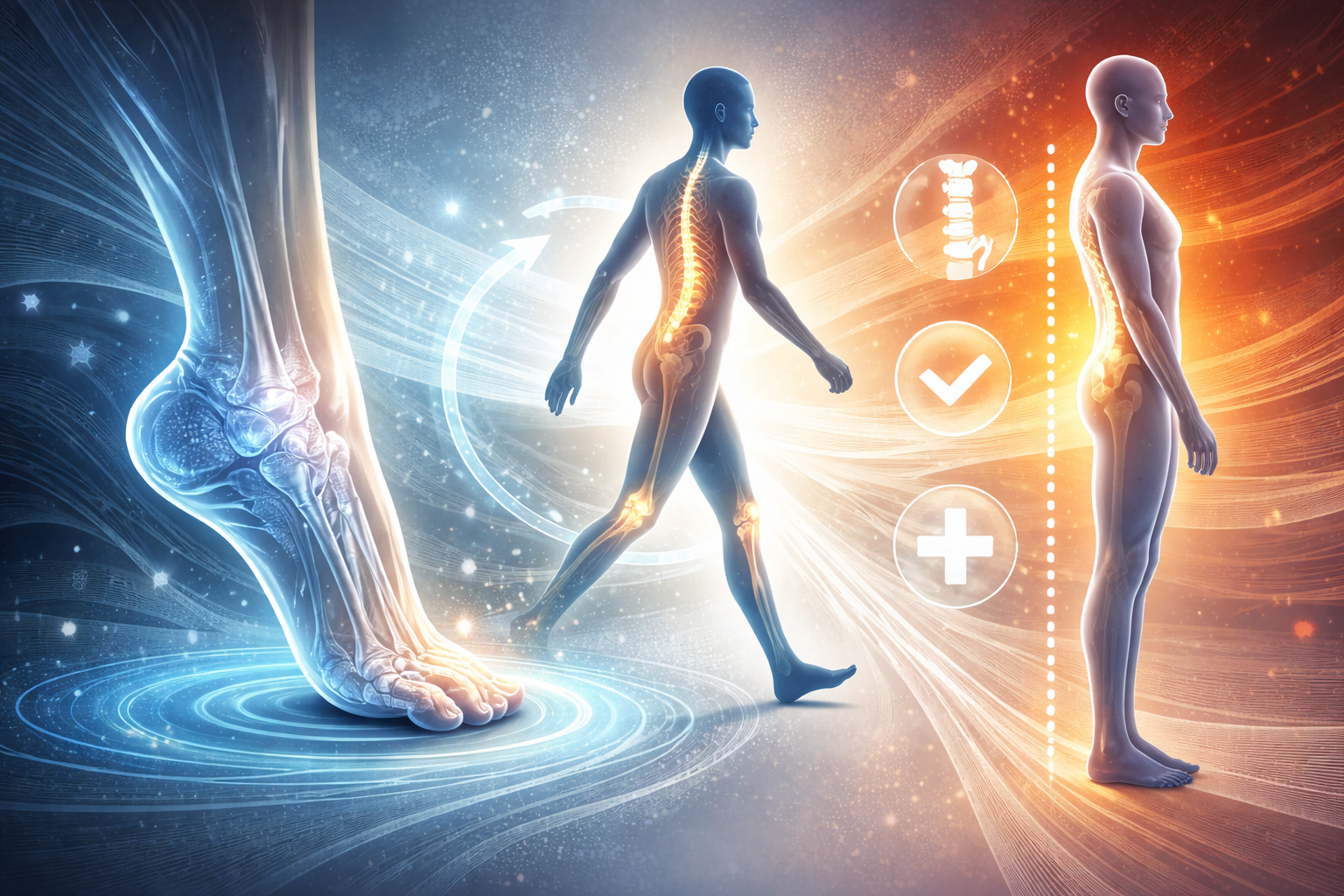
Foot, Movement & Postural Health
How clothing and footwear alter biomechanics, posture, sensory feedback, and long-term physical function.
Human movement begins at the ground. The way the body interacts with the surface beneath it determines balance, force transmission, posture, and movement efficiency.
The Foot as a Primary Sensory & Mechanical Organ
The human foot is a highly specialised structure composed of:
- 26 bones.
- 33 joints.
- Numerous muscles, tendons, and ligaments.
- Dense sensory nerve endings.
Its primary functions include:
- Load distribution during movement.
- Shock absorption and energy return.
- Balance and stability.
- Proprioceptive and tactile feedback.
Foot function directly influences how forces travel upward through the ankles, knees, hips, spine, and neck.
Footwear as a Form of Restrictive Clothing
Footwear is a specialised form of clothing with disproportionate biomechanical impact because it directly alters the body’s interface with the ground.
Common restrictive footwear characteristics include:
- Narrow or tapered toe boxes.
- Rigid or inflexible soles.
- Elevated heels.
- Excessive cushioning reducing sensory feedback.
While these features may provide short-term comfort or protection, they often restrict natural foot movement, toe splay, and proprioceptive input.
Effects on Gait & Movement Mechanics
Restrictive footwear may:
- Reduce toe splay and forefoot mobility.
- Alter foot strike patterns.
- Change ankle, knee, and hip loading.
- Reduce activation of intrinsic foot muscles.
These changes can propagate upward through the kinetic chain and influence:
- Knee alignment and joint loading.
- Hip mechanics and pelvic stability.
- Spinal posture and movement patterns.
Movement becomes increasingly compensatory rather than mechanically efficient.
Proprioception & Balance
Barefoot or minimally covered feet provide rich sensory information about surface texture, firmness, slope, and movement.
This supports:
- Rapid neuromuscular adjustment.
- Balance responsiveness.
- Movement adaptability.
Restrictive footwear reduces:
- Tactile input from the ground.
- Surface awareness.
- Balance responsiveness.
Posture & Load Distribution
Posture is shaped from the ground upward.
Altered foot mechanics may contribute to:
- Anterior or posterior pelvic tilt.
- Altered spinal curvature.
- Uneven load distribution across joints.
Over time this may increase:
- Muscle tension.
- Joint stress.
- Chronic discomfort.
- Compensatory movement patterns.
Sedentary Behaviour & Movement Restriction
Restrictive clothing and rigid footwear often reinforce sedentary behaviour and reduce natural movement variability.
- Reduced spontaneous movement.
- Reduced joint range variation.
- Reduced postural diversity.
This may contribute to:
- Stiffness and reduced mobility.
- Increased injury risk.
- Slower recovery from physical stress.
Occupational Implications
In occupational settings, footwear and clothing influence:
- Fatigue levels.
- Balance and stability.
- Injury risk.
- Recovery time.
Uniform requirements prioritising appearance over biomechanics may increase long-term musculoskeletal strain.
This applies across:
- Security.
- Healthcare.
- Retail.
- Hospitality.
- Industrial environments.
Ground Contact & Sensory Grounding
Direct contact between the feet and natural surfaces provides rich sensory input supporting balance, posture, and movement awareness.
Walking barefoot on varied textures:
- Enhances proprioceptive feedback.
- Encourages natural gait variation.
- Promotes subtle postural adjustment.
- Supports musculoskeletal resilience.
While electrical grounding theories remain under investigation, the mechanical and sensory benefits of ground contact are well established.
NaturismRE Position on Movement & Posture
NaturismRE does not claim that barefoot practices or reduced clothing eliminate injury risk or replace safety requirements.
The evidence-aligned position is this:
Clothing and footwear can alter natural biomechanics by restricting movement and sensory feedback.
Reducing unnecessary constraints, where safe and appropriate, may support more natural gait, posture, movement efficiency, and musculoskeletal resilience.
Conclusion
Movement quality shapes fatigue, injury risk, mobility, and long-term physical capability.
The feet form the foundation of this system.
Clothing and footwear continuously influence biomechanics, posture, and sensory feedback.
NaturismRE positions reduced clothing and, where appropriate, reduced footwear as rational, evidence-aligned responses to environments that unnecessarily constrain human movement.
Safe Health Zones (SHZ)
Learn how NRE health principles are applied within structured recovery and wellbeing environments.
Explore SHZNRE-HEALTH Radio™
Listen to calm, evidence-informed health briefings available anytime through the live stream.
Click Here to ListenEnglish Encyclopedia
Explore the English NRE Nudism & Naturism Encyclopedia ecosystem.
Open English EncyclopediaEncyclopédie Française
Découvrez l’écosystème encyclopédique français de NRE consacré au nudisme et au naturisme.
Ouvrir l’Encyclopédie FrançaiseNRE Health Institute Library
Access institutional-grade educational articles, frameworks, research, and wellbeing resources.
Open English LibraryBibliothèque Française du NRE Health Institute
Explore the French-language NRE Health Institute educational and institutional library.
Ouvrir la Bibliothèque Française