The Prevalence of Sexually Motivated Actors in Non-Official Clothing-Optional Areas
Sociological Dynamics at Unregulated Nude Recreation Sites
Author: Vincent Marty
Founder, NaturismRE
Audience Note
This white paper is intended for policymakers, local authorities, naturist organisations, and community stakeholders examining behavioural dynamics, public space governance, and recreational land use in clothing-optional environments.
Executive Summary
Non-official clothing-optional areas such as informal nude beaches, remote rivers, forest clearings, and secluded hiking locations have long existed alongside organized naturist clubs and resorts. These locations typically operate without formal governance, institutional oversight, or structured behavioural regulation.
While many visitors use these areas for non-sexual naturist recreation, critics and local authorities frequently claim that such sites attract individuals motivated by sexual intentions, voyeurism, or exhibitionism.
This white paper examines the sociological dynamics of unregulated clothing-optional environments in order to understand whether sexually motivated participation is prevalent and what structural factors influence behaviour in these locations.
The analysis identifies several key findings:
• non-official clothing-optional areas attract a broader range of motivations than organized naturist environments
• absence of governance and behavioural enforcement increases behavioural variability
• sexually motivated actors may be more visible in unregulated contexts
• the majority of participants continue to engage in non-sexual recreational use
• perception is strongly influenced by visibility bias and contextual ambiguity
• environmental design and governance structures significantly influence behavioural outcomes
The paper concludes that sexually motivated actors are not the defining characteristic of informal clothing-optional areas, but their visibility may disproportionately shape perception. Structural governance, rather than prohibition, is the primary determinant of behavioural stability.
Abstract
Informal clothing-optional areas operate without the structured governance frameworks found in organized naturist environments. As a result, these environments may attract a broader range of participant motivations, including both non-sexual recreation and, in some cases, sexually motivated behaviour.
This white paper examines the prevalence and dynamics of such behaviour through sociological, behavioural, and environmental analysis. It compares informal environments with regulated naturist institutions in order to identify structural determinants of participant conduct.
Findings indicate that sexually motivated actors may be more visible in unregulated areas due to lack of oversight and contextual ambiguity. However, available evidence suggests they typically represent a minority of participants.
The paper demonstrates that behavioural outcomes are shaped primarily by governance, environmental design, and social norms rather than by nudity itself.
1. Introduction
Organized naturist clubs and resorts typically operate under clearly defined behavioural frameworks. These environments maintain explicit codes of conduct prohibiting sexual activity, harassment, voyeurism, and disruptive behaviour.
Visitors are expected to respect a culture of non-sexual social nudity, reinforced through community oversight and institutional management.
In contrast, many clothing-optional locations around the world operate informally. These areas may include:
• unofficial nude beaches
• remote lakes or rivers
• secluded coastal sections
• forest clearings or wilderness areas
• clothing-optional hiking trails
Because these locations are rarely supervised or formally regulated, they attract visitors with diverse motivations and varying levels of familiarity with naturist culture.
This paper examines whether the absence of governance structures increases the presence of sexually motivated actors and how such dynamics influence public perception and policy interpretation.
2. Methodology
This study uses a multidisciplinary approach combining:
• sociological analysis of recreational behaviour
• studies of naturist environments and social norms
• observational reports from naturist communities
• comparative analysis between regulated and unregulated sites
• behavioural theory relating to anonymity and environmental influence
Due to the limited availability of large-scale quantitative studies, the analysis relies primarily on qualitative synthesis and comparative observation.
The objective is to identify structural conditions influencing behaviour rather than to quantify exact prevalence.
3. Historical Context and Development
Naturism developed in the early twentieth century through organized clubs and health movements. Alongside these structured environments, informal clothing-optional spaces emerged organically.
These locations formed through:
• local tradition
• informal knowledge networks
• tolerance by authorities
• geographic isolation
They demonstrate that naturist practices can emerge without formal institutions, but their behavioural stability is less consistent due to absence of governance structures.
4. Types of Non-Official Clothing-Optional Areas
4.1 Remote Natural Locations
Typically associated with:
• nature immersion
• privacy
• relaxation
4.2 Semi-Known Nude Beaches
Mixed populations including:
• naturists
• tourists
• observers
• occasional voyeuristic visitors
4.3 Urban Edge Zones
These may include:
• hidden park areas
• coastal bushland
• secluded urban margins
These environments show higher probability of behavioural variability due to accessibility and anonymity.
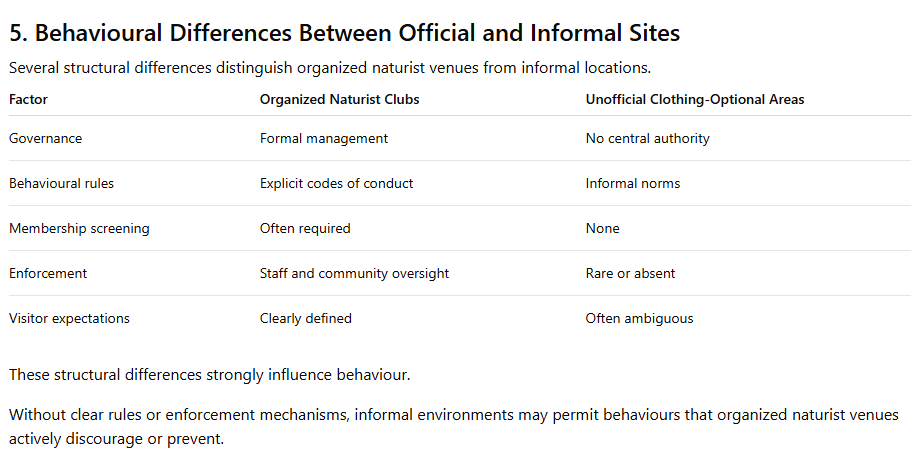
5. Behavioural Differences Between Official and Informal Sites
Compared with regulated naturist environments, informal sites lack:
• entry control
• behavioural enforcement
• clear communication of norms
This produces:
• higher variability
• reduced predictability
• increased interpretive ambiguity
From a governance perspective, predictability is a key determinant of behavioural stability.
6. Structural Drivers of Sexually Motivated Behaviour
6.1 Anonymity and Lack of Oversight
Unregulated environments allow anonymous access, lowering behavioural constraints.
This aligns with situational behaviour theory, where reduced accountability increases probability of rule deviation.
6.2 Cultural Association Between Nudity and Sexuality
In many societies:
nudity → sexuality
This learned association can attract individuals expecting sexual contexts.
6.3 Environmental Seclusion
Seclusion reduces perceived social risk and increases behavioural latitude.
This creates conditions where both legitimate and inappropriate behaviours may coexist.
7. Visibility Effect
Sexually motivated behaviour is highly visible relative to its frequency.
This produces:
• salience bias
• memory bias
• perception distortion
This aligns with cognitive bias frameworks described in behavioural psychology.
8. Observational Evidence
Observations indicate:
• majority behaviour is non-sexual
• inappropriate behaviour is often peripheral
• informal norms still exert some regulatory influence
This supports the distinction between minority behaviour and dominant use patterns.
9. Impact on Naturist Communities
9.1 Perception Distortion
Visible incidents influence:
• public opinion
• media representation
• regulatory response
9.2 Participation Filtering
Negative reputation leads to:
• reduced family participation
• self-selection of visitor types
• potential behavioural drift over time
10. Policy and Institutional Implications
Effective policy should:
• distinguish between behaviour and environment
• avoid conflating naturism with misconduct
• support structured clothing-optional zones
Recommended approaches:
• designated areas
• behavioural codes
• public education
• collaboration with naturist communities
11. Limitations
This analysis is based on:
• qualitative evidence
• observational patterns
• limited quantitative datasets
Further research is required for precise measurement.
12. Conclusion
Non-official clothing-optional areas represent complex social environments influenced by diverse motivations.
The absence of governance increases behavioural variability but does not define the environment.
Sexually motivated actors may be more visible, but they do not represent the dominant behavioural pattern.
Public perception is disproportionately influenced by visibility rather than prevalence.
The key determinant of behavioural outcomes is not nudity, but governance structure, environmental context, and clarity of norms.
Policy approaches should therefore focus on behaviour and structure rather than on prohibiting visibility.
References
Barcan, R. (2004). Anatomie culturelle de la nudité
West, K. (2018). Naturism and Body Image. University of Brighton
Grogan, S. (2016). Image corporelle
Clarke, R. V. (1997). Situational Crime Prevention
European Naturist Federation. Reports
Goffman, E. (1959). La mise en scène de la vie quotidienne
Douglas, M. (1966). De la souillure
Andressen, C. (2018). Naturism and Nudism in Modern Europe