

System Convergence, Future Trajectories, and Strategic Equilibrium
Examining how governance, economics, social acceptance, legal systems, and technological mediation converge to shape the long-term operational trajectory of structured naturist systems.
Naturism’s progression depends on its ability to transition from a loosely defined cultural practice into a systemically integrated, governance-capable, and resilience-driven model that can maintain equilibrium across legal, social, economic, and technological domains.
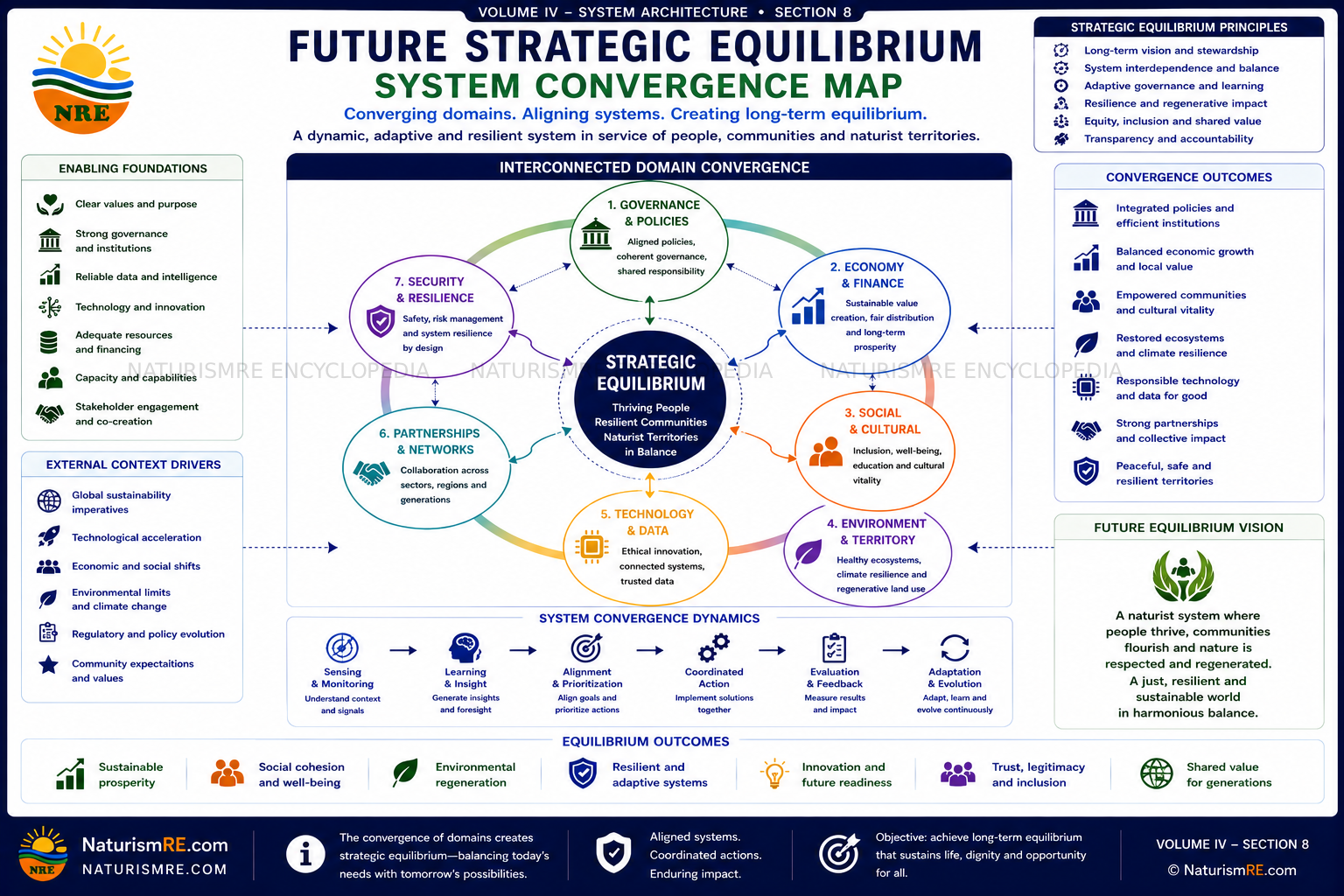
8.1 Convergence of Structural Variables
The preceding sections have examined naturism through distinct analytical dimensions, including structural systemisation, governance frameworks, risk and liability dynamics, economic constraints, social acceptance, technological mediation, and institutional integration.
While these variables can be analysed independently, they do not operate in isolation. They are converging toward an integrated system condition in which each dimension influences and constrains the others.
This convergence produces a new operational reality. Governance affects risk exposure. Risk perception influences social acceptance. Social acceptance shapes policy pathways. Policy frameworks determine economic viability. Economic structures influence scalability. Technological systems mediate external perception across all domains.
Naturism, in this context, is no longer a singular practice. It becomes a multi-variable system requiring coordinated alignment across all dimensions to function effectively.
8.2 The Shift from Expansion to Equilibrium
Traditional models of development often assume linear expansion, characterised by increased participation, increased visibility, and broader acceptance.
The system-based analysis presented in this volume indicates that naturism does not follow a purely expansionary trajectory. Instead, it moves toward a state of strategic equilibrium.
This equilibrium is defined by balance between visibility and acceptability, alignment between participation and governance capacity, and calibration between accessibility and risk tolerance.
Unchecked expansion introduces instability through increased incident probability, amplified reputational exposure, strain on governance systems, and heightened regulatory response.
Conversely, excessive restriction limits viability by reducing participation, diminishing relevance, and restricting system development.
Sustainable progression therefore depends on maintaining equilibrium within defined operational limits.
8.3 Scenario Mapping of Future Trajectories
The interaction of structural variables produces several plausible trajectories for the development of naturist systems.
Structured Integration
Gradual adoption of context-defined environments, governance frameworks, and policy-compatible operational systems.
Fragmented Expansion
Rapid decentralised participation without consistent governance, increasing instability and reputational exposure.
Containment
Continued restriction of naturist participation to private or highly controlled environments.
Technological Suppression
Increasing platform restrictions and surveillance pressures reducing digital visibility and public discoverability.
These trajectories are not mutually exclusive. Elements of each may coexist across different jurisdictions and conditions.
8.4 The Role of System Design in Trajectory Determination
Future trajectories are not predetermined. They are influenced by system design decisions.
Key design variables include clarity of environmental definition, robustness of governance frameworks, effectiveness of risk mitigation strategies, alignment with social acceptance thresholds, and adaptability to legal and technological constraints.
Well-designed systems reduce variability, increase predictability, and enhance resilience. Poorly designed systems introduce ambiguity, inconsistent behaviour, and increased exposure to external pressures.
System design therefore functions as a determinant of trajectory rather than as a passive component.
8.5 Integration Without Dilution
A central challenge in system convergence is achieving integration without loss of core identity.
Integration carries risks, including over-regulation that reduces participant autonomy, excessive standardisation that limits diversity of expression, and alignment with external systems that may weaken internal coherence.
Conversely, resistance to integration may result in continued marginalisation, limited access to broader environments, and reduced influence on policy and perception.
Effective systems maintain core principles of non-sexual, context-based participation, preserve behavioural integrity, and retain flexibility in implementation.
This enables integration into broader systems while preserving functional identity.
8.6 Resilience and Adaptive Capacity
The sustainability of naturist systems depends on their capacity to adapt to changing conditions.
Key factors influencing resilience include the ability to respond to incidents without systemic collapse, flexibility in governance and operational frameworks, adaptability to evolving legal and technological environments, and maintenance of participant alignment with system objectives.
Resilient systems do not avoid disruption. They absorb impact, adjust operational parameters, and continue functioning under modified conditions.
This adaptive capacity is essential in environments characterised by legal variability, social sensitivity, and technological change.
8.7 Long-Term System Characteristics
Based on current trajectories, future naturist systems are likely to exhibit consistent structural characteristics.
Context-Defined Operation
Participation will increasingly rely on clearly structured environments rather than unrestricted visibility.
Hybrid Governance Models
Institutional and framework-based governance systems will operate simultaneously across different contexts.
Integrated Risk Management
Risk mitigation will function as a core operational component rather than a secondary consideration.
Selective Digital Engagement
Communication strategies will adapt to platform constraints and technological limitations.
Incremental Institutional Integration
Policy recognition is more likely to emerge gradually through structured pilot and adaptation models.
These characteristics reflect a transition from informal practice to structured, adaptive systems embedded within broader societal frameworks.
8.8 Analytical Conclusion
The evolution of naturism in the twenty-first century culminates in a state of system convergence, in which multiple structural variables interact to define operational reality.
Naturism functions as a multi-dimensional system rather than as a singular activity. Sustainable development depends on achieving equilibrium across competing variables. Future trajectories are shaped by system design choices rather than external conditions alone. Integration into broader societal systems must occur without loss of functional identity. Resilience and adaptability are essential for long-term viability.
The analysis presented in this volume demonstrates that the future of naturism is not determined by ideological positioning, visibility alone, or participation scale.
It is determined by the capacity to operate as a coherent, structured system within complex and interdependent environments.
This establishes the overarching principle of Volume IV:
Naturism’s progression depends on its ability to transition from a loosely defined cultural practice into a systemically integrated, governance-capable, and resilience-driven model that can maintain equilibrium across legal, social, economic, and technological domains.
Primary Supporting Articles
The Convergence Question, Can Naturism Ever Become a Unified System
The Global Integration Problem, Why Naturism Remains Fragmented Across Countries
Why Fragmentation Persists Even When Conditions Improve
Why Partial Integration Produces Persistent Instability
Why Systems That Rely on Interpretation Cannot Stabilise at Scale