

Institutional Integration, Policy Pathways, and Multi-Level Adoption Dynamics
Examining how structured naturist systems transition from marginal social activity toward institutional consideration through governance alignment, policy integration, and incremental adoption pathways.
The long-term integration of naturism into societal systems depends on its ability to translate abstract concepts into structured, policy-compatible environments that can be evaluated, tested, and adapted within existing institutional frameworks.
7.1 The Transition from Marginal Practice to Institutional Consideration
The progression of naturism into structured, context-defined systems creates the conditions for institutional consideration.
Historically, naturism has operated at the margins of public policy, urban planning, and public health frameworks. This marginal positioning was sustainable under conditions of limited visibility, informal participation, and containment within private or remote environments.
The emergence of structured systems introduces definable operational models, observable behavioural standards, and measurable patterns of social interaction. These characteristics allow naturism to be evaluated within institutional frameworks rather than dismissed as a purely cultural or recreational activity.
Institutional integration does not imply endorsement. It enables formal consideration within existing systems of governance.
7.2 Policy Entry Points and Framing Mechanisms
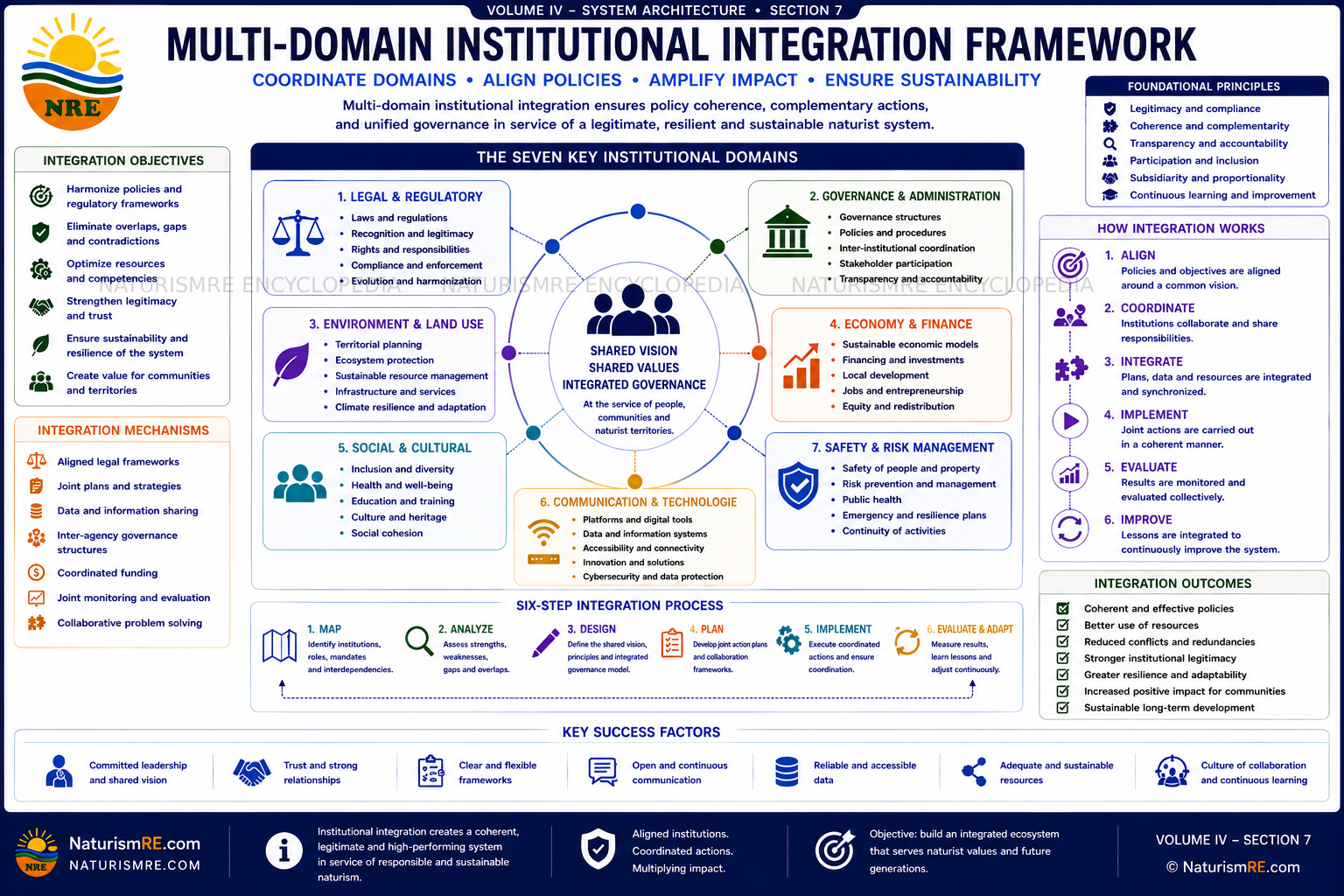
For naturist systems to be considered within policy environments, they must align with recognised policy domains.
Public Health and Wellbeing
Naturist environments may align with preventative health, outdoor activity, and wellbeing-oriented frameworks.
Urban and Recreational Planning
Structured environments may integrate into park systems, coastal management, and designated recreational zones.
Tourism and Economic Development
Participation may contribute to niche tourism sectors and indirect local economic activity.
Environmental Engagement
Interaction with natural environments may align with sustainability-oriented and low-impact recreation frameworks.
Framing naturism within these domains allows it to be assessed based on functional outcomes rather than abstract perception.
7.3 Multi-Level Governance and Jurisdictional Complexity
Institutional integration is shaped by the multi-level structure of governance systems.
Naturist environments may be subject to local regulations, state or regional legislation, and national legal frameworks. Each level may apply different definitions of acceptable conduct, varying tolerance thresholds, and independent decision-making authority.
This produces jurisdictional fragmentation in which approval in one area does not guarantee acceptance elsewhere, and system replication requires adaptation.
Structured naturist systems must therefore be designed to operate within specific jurisdictional constraints, allowing for localised modification while maintaining core principles.
7.4 Pilot Models and Incremental Adoption Pathways
Given the variability of acceptance and regulatory sensitivity, institutional integration is more likely to occur through incremental adoption rather than immediate large-scale implementation.
Pilot models represent a primary pathway. These involve limited-scope environments, defined operational periods, and controlled conditions for evaluation.
Pilot approaches reduce perceived risk for authorities, enable the collection of observational data, and allow frameworks to be adjusted based on outcomes.
Such environments function as evidence-generating mechanisms, supporting assessment of behavioural compliance, evaluation of public response, and identification of operational challenges.
Successful pilots may lead to continuation, expansion, replication, and eventual integration into formal policy frameworks.
7.5 Institutional Risk Aversion and Decision-Making Constraints
Public institutions typically operate within risk-averse decision-making models.
Factors influencing institutional behaviour include the potential for public complaint, political sensitivity, media exposure, and the absence of precedent.
As a result, well-structured proposals may encounter resistance not due to opposition, but due to uncertainty and perceived imbalance between risk and benefit.
To address these constraints, structured naturist systems must minimise uncertainty through clear operational frameworks, demonstrate alignment with existing policy objectives, and provide evidence of risk mitigation.
Institutional acceptance is therefore determined by predictability and controllability rather than by advocacy intensity.
7.6 Standardisation Versus Local Adaptation
A key challenge in institutional integration is balancing standardisation with local adaptation.
Standardisation provides consistency and recognisability, while local adaptation allows alignment with jurisdiction-specific conditions.
Over-standardisation may reduce flexibility and create misalignment with local norms or regulations. Excessive localisation may result in fragmentation, reduced system coherence, and difficulty in broader recognition.
Effective systems adopt a modular approach in which core principles remain consistent, while implementation details are adapted to local conditions.
This enables scalability across jurisdictions while preserving behavioural and operational integrity.
7.7 Stakeholder Interaction and Alignment Requirements
Institutional integration requires interaction with multiple stakeholder groups, including public authorities, local communities, regulatory bodies, and adjacent users of shared spaces.
Each group has distinct concerns related to safety, equitable use of space, reputational implications, and operational feasibility.
Structured naturist systems must address these concerns through transparent communication, clearly defined operational parameters, and mechanisms for feedback and adjustment.
Alignment does not require unanimous support. It requires sufficient compatibility to enable coexistence within shared systems.
7.8 Analytical Conclusion
Institutional integration represents a critical stage in the evolution of structured naturist systems.
Naturism becomes eligible for policy consideration when defined as a structured system. Effective integration depends on alignment with recognised policy domains. Multi-level governance introduces complexity requiring adaptable frameworks. Incremental adoption through pilot models represents the most viable pathway. Institutional decision-making is driven by risk perception and predictability. Successful systems balance standardisation with local adaptation, and stakeholder alignment is essential for sustainable operation.
The transition from marginal practice to institutional consideration does not occur through advocacy alone. It requires operational clarity, demonstrable governance, and alignment with broader societal and policy objectives.
This establishes a defining principle:
The long-term integration of naturism into societal systems depends on its ability to translate abstract concepts into structured, policy-compatible environments that can be evaluated, tested, and adapted within existing institutional frameworks.
Primary Supporting Articles
From Zones to Systems, How Structured Environments Scale Across Jurisdictions
From Policy Avoidance to Policy Design, The Case for Structured Clothing-Optional Zones
From Risk to Regulation, The Structural Logic Behind Controlled Clothing-Optional Environments