

Australia and Oceania: Conditional Legality and Localised Regulatory Systems
Examining Australia and Oceania as decentralised legal systems in which nudity is interpreted through localised regulation, social perception, and discretionary enforcement.
In decentralised and perception-driven systems, naturism persists not through formal legal recognition, but through the ability to operate within accepted contextual and social limits.
7.1 Purpose
This section analyses the legal treatment of nudity in Australia and Oceania as a case study of conditional legality within decentralised regulatory systems.
Its purpose is to identify the structural mechanisms governing legal interpretation, to examine how statutory law, local regulation, and enforcement interact, and to define the operational conditions under which naturist activity occurs.
This section positions the region as a representative model of perception-driven and enforcement-dependent legality.
7.2 Structural Characteristics of the Regional Legal System
Legal regulation in Australia and Oceania is characterised by multi-layered decentralisation.
Authority is distributed across state or territory-based statutory frameworks, local government control over public spaces, and the absence of a unified national standard governing nudity.
In Australia, each state and territory independently defines offences such as indecent exposure, offensive behaviour, and public decency thresholds. In New Zealand and parts of Oceania, national statutes provide baseline definitions, but interpretation and enforcement remain context-dependent.
This produces a system defined by regional variability combined with localised enforcement authority. The result is not inconsistency in principle, but distributed interpretative control.
7.3 General Legal Position
Across the region, nudity is not categorically criminalised as a physical state.
Regulation is instead applied through behaviour-based offences such as offensive behaviour, indecent exposure, or disorderly conduct. Legal thresholds are typically activated when conduct is interpreted as offensive to a reasonable observer, disruptive within a given context, or inconsistent with expected social norms.
This establishes a core principle:
Nudity becomes legally relevant only when it is interpreted as offensive within a specific context.
This reinforces the distinction between physical condition and legal classification.
7.4 The “Reasonable Person” Standard as a Regulatory Mechanism
A defining feature of the regional legal system is the use of the “reasonable person” standard.
Under this model, conduct is evaluated based on how it would be perceived by an ordinary member of the public. Legality is determined by perceived impact rather than solely by demonstrable intent.
This introduces a critical dynamic in which interpretation becomes socially mediated and legal thresholds shift according to context.
As a result, identical conduct may produce different outcomes depending on location, audience, and circumstances. Enforcement decisions reflect perceived acceptability rather than fixed legal boundaries.
7.5 Designated Environments as Stabilisation Mechanisms
Across Australia and parts of Oceania, designated or recognised environments play a central role in stabilising legality.
Clothing-Optional Beaches
Designated beach environments reduce ambiguity through established expectations and recognised participation conditions.
Isolated Coastal Areas
Remote or low-density environments reduce involuntary exposure and enforcement activation.
Private Clubs and Resorts
Controlled participation environments provide governance, behavioural stability, and reduced interpretative risk.
Spatial Definition
Legality is often stabilised through clearly defined physical boundaries rather than formal legal exemption.
These conditions reduce ambiguity, limit the likelihood of complaint, and decrease enforcement variability.
Such environments function as practical legal stabilisers rather than formal legal exemptions. They demonstrate that legality is often achieved through spatial definition rather than through general permission.
7.6 Intra-Jurisdictional Variability
Within Australia, significant variation exists between states and territories due to differences in statutory wording, definitions of offensive conduct, and enforcement priorities.
Some jurisdictions apply stricter interpretations of public decency, while others rely more heavily on contextual evaluation.
This confirms that there is no unified national legal position on nudity. The system operates as a collection of locally interpreted frameworks unified only by underlying legal principles.
7.7 Enforcement as the Determining Layer
Enforcement practices across the region are characterised by complaint-driven activation, discretionary assessment by authorities, and context-sensitive decision-making.
Authorities typically consider location, behaviour, the response of others present, and willingness to comply with direction.
This produces a defining operational condition:
Statutory law establishes potential boundaries. Enforcement determines whether those boundaries are activated.
This reinforces the distinction between theoretical legality and practical permissibility.
7.8 Legal Risk and Operational Uncertainty
The interaction of decentralised regulation, perception-based standards, and discretionary enforcement creates a condition of structural legal uncertainty.
Risk factors include unclear environmental boundaries, absence of designated areas, and variability in observer perception.
Possible outcomes may include warnings, fines, temporary detention, or no action, depending on context.
Even in the absence of formal charges, interaction with enforcement may result in operational disruption, reputational exposure, and participant uncertainty.
This reflects a system in which legality is conditional and outcomes are probabilistic rather than deterministic.
7.9 Social Context as a Determinant Variable
Legal interpretation in the region is strongly influenced by cultural attitudes toward public behaviour, expectations of modesty, and tolerance for ambiguity in shared spaces.
Regional variation includes areas with established acceptance of clothing-optional environments and areas where nudity is strongly associated with indecency.
These differences directly affect complaint likelihood, enforcement intensity, and legal outcomes.
This confirms that legal frameworks operate in continuous interaction with social context.
7.10 Position Within Global Legal Models
In comparative terms, the United Kingdom demonstrates a stronger emphasis on intent, the United States reflects fragmented hybrid systems, and European jurisdictions operate through structured context-based tolerance.
Australia and Oceania exhibit a combination of intent-based elements, strong reliance on perception thresholds, dependence on spatial designation, and high levels of enforcement discretion.
This places the region within a hybrid regulatory model combining restriction, conditional tolerance, and interpretative enforcement.
7.11 Analytical Implications
The regional system demonstrates several critical characteristics.
Location Dependency
Legal outcomes are strongly influenced by geographic and environmental context.
Perception-Based Thresholds
Social interpretation functions as a primary determinant of enforcement activation.
Spatial Stabilisation
Designated environments provide operational stability and increased predictability.
Discretionary Enforcement
Practical legal boundaries are shaped through enforcement discretion rather than rigid statutory certainty.
These characteristics define the operational reality of naturism in decentralised systems.
7.12 Conclusion
Australia and Oceania illustrate a legal model in which nudity is neither broadly permitted nor categorically prohibited.
Instead, it is regulated through the interaction of statutory thresholds, perception-based interpretation, and discretionary enforcement.
This produces a defining system characteristic:
Legality is not determined solely by law, but by the interaction of law, context, and social perception in real-world conditions.
Consequently, nudity may be tolerated within established or isolated environments, while identical conduct may trigger enforcement in different contexts. Legal certainty remains inherently limited.
This is not a system defined by ambiguity alone. It is a system of conditional interpretation in which boundaries are maintained through enforcement and stability is achieved through controlled coexistence.
The sustainability of naturist activity within this model does not depend on explicit legal permission, but on alignment with spatial conditions, consistency of behaviour, and compatibility with social expectations.
This establishes a critical principle:
In decentralised and perception-driven systems, naturism persists not through formal legal recognition, but through the ability to operate within accepted contextual and social limits.
Primary Supporting Articles
Why Risk Becomes Perception When Context Is Unclear
Visibility Management and Its Role in Perception Stability
Why Cities Require Defined Clothing-Optional Zones to Achieve Stability
From Risk to Regulation, The Structural Logic Behind Controlled Clothing-Optional Environments
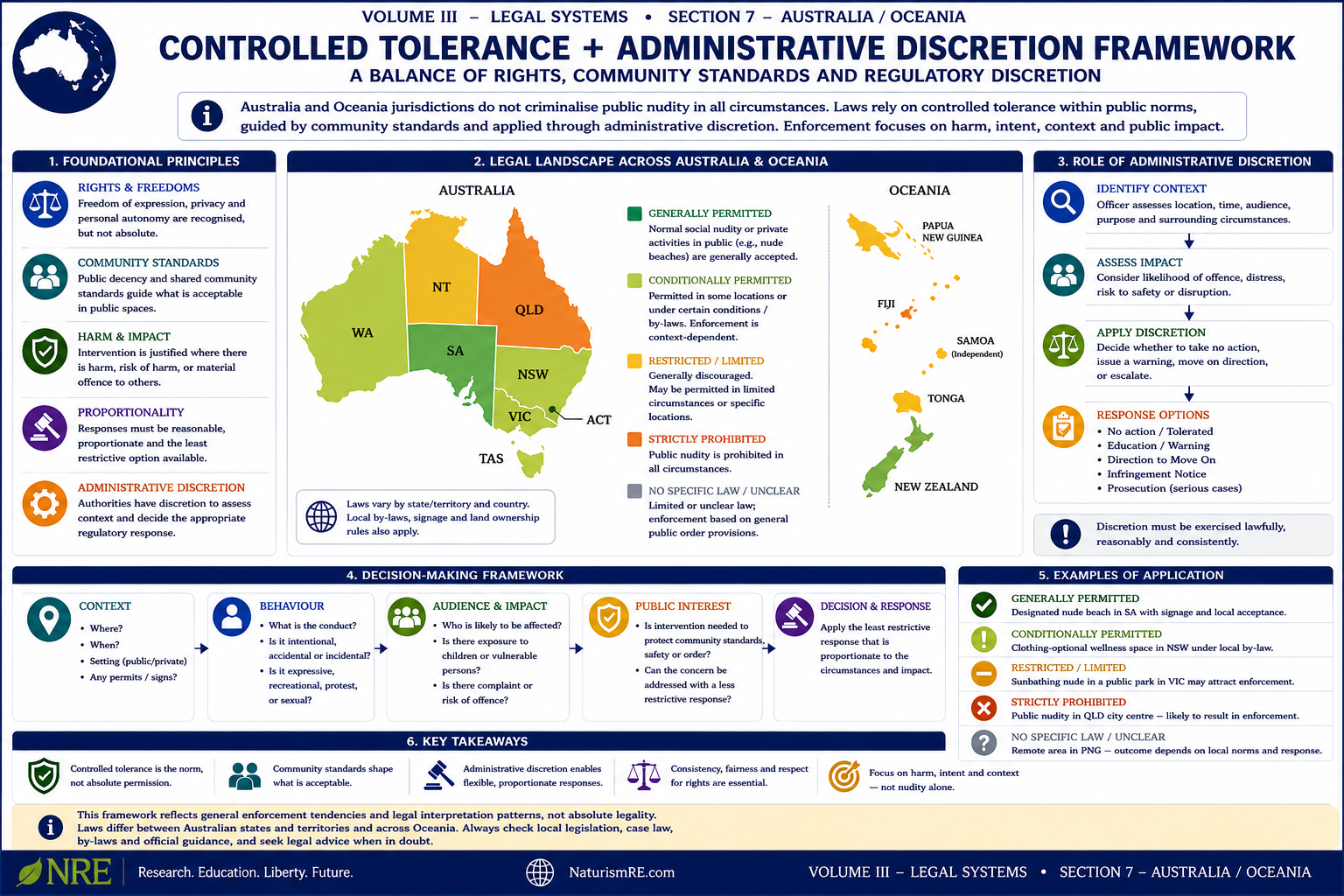
AUSTRALIA & OCEANIA
Controlled Tolerance and Administrative Discretion
Public nudity is not treated identically across Australia and Oceania.
In many jurisdictions, enforcement relies less on absolute prohibition and more on:
• context
• intent
• public impact
• community standards
• administrative discretion
This analytical framework explores how some regions apply:
• controlled tolerance
• designated areas
• contextual enforcement
• proportionate responses
• public regulatory mechanisms
This is not a map of “absolute legality,” but a general model of enforcement tendencies and regulatory interpretation patterns.
Non-sexual public nudity remains highly dependent on:
• location
• local by-laws
• community norms
• surrounding circumstances
• administrative decisions
Always verify:
• local legislation
• municipal regulations
• court decisions
• official policies
NRE Nudism & Naturism Encyclopedia
Volume III – Legal Systems