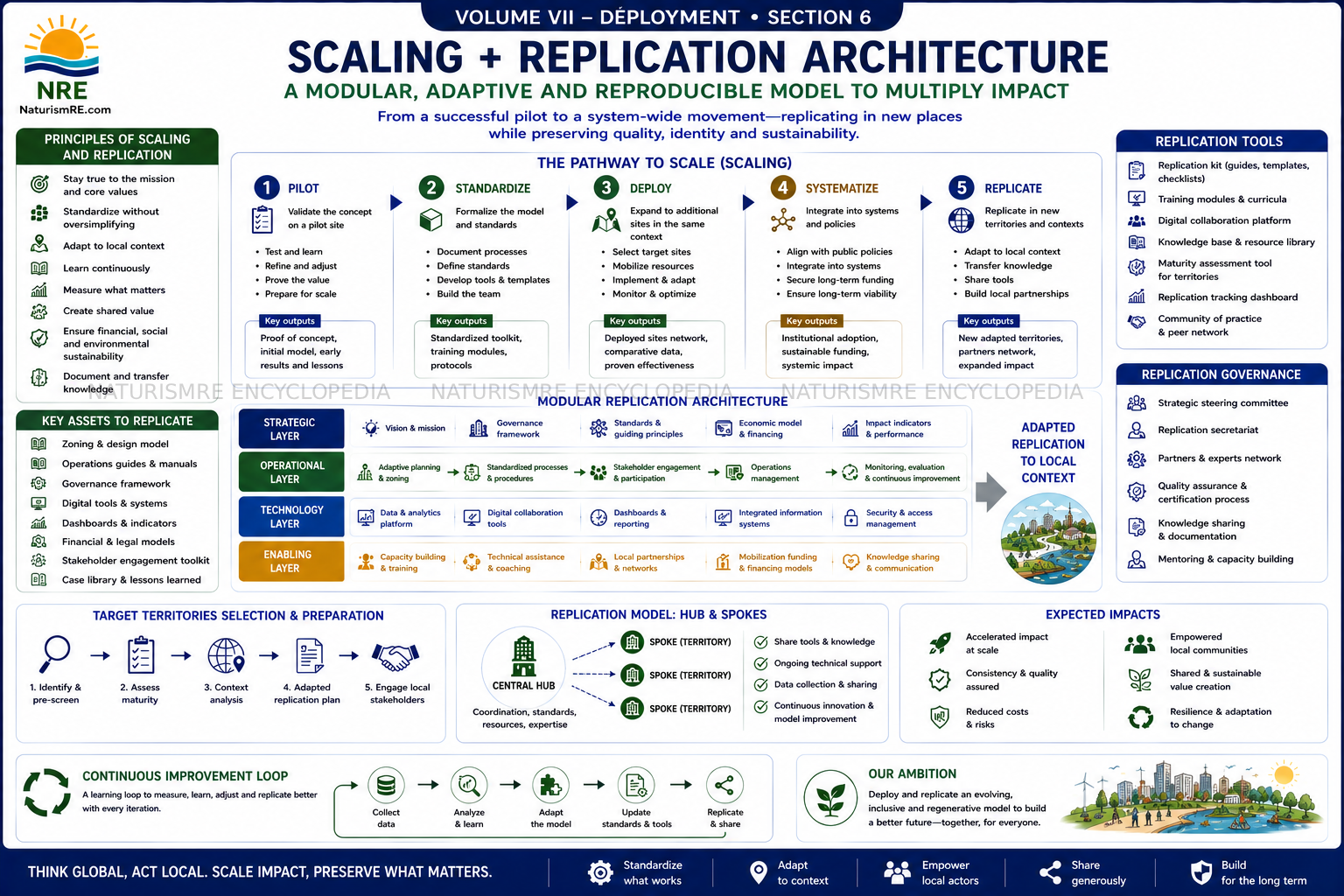
Scaling Mechanics, Replication Models, and System Expansion Controls
Examining how naturist systems scale through controlled replication, adaptive governance, and phased expansion while maintaining operational stability and contextual alignment.
The scalability of naturist environments depends on their ability to replicate stable, context-aligned systems across multiple locations while maintaining governance integrity, managing network effects, and ensuring that expansion remains within environmental, legal, and social capacity limits.
6.1 Scaling as a Controlled Process
Scaling naturist systems is not a linear increase in participation or visibility. It is a controlled process of extending stable operational conditions across larger or multiple environments.
Uncontrolled scaling introduces increased behavioural variability, reduced governance effectiveness, and heightened legal and reputational exposure.
Effective scaling therefore requires preservation of core system integrity, controlled expansion of operational scope, and alignment between growth and governance capacity.
Scaling is successful only when stability is maintained at each stage.
6.2 Distinction Between Growth and Scalability
A critical distinction exists between growth and scalability.
Growth refers to increased participation or activity. Scalability refers to the ability to sustain performance under increased operational load.
Naturist systems may experience growth without scalability, resulting in breakdown of behavioural norms, insufficient monitoring capacity, and increased risk of incidents.
Scalability requires systems capable of absorbing increased participation, governance structures that adapt to higher density, and maintenance of interpretability and predictability.
This distinction is essential to prevent premature or unstable expansion.
6.3 Replication Models Across Locations
Scaling across locations requires replication of operational models rather than expansion within a single environment.
Replication involves identification of suitable sites, adaptation to local legal and social conditions, and transfer of governance and compliance frameworks.
Direct Replication
Applies a model with minimal modification across comparable operational environments.
Adapted Replication
Retains core principles while adjusting operational elements to local conditions and constraints.
Modular Deployment
Uses standardised operational components assembled according to site-specific requirements.
Contextual Alignment
Ensures replication remains legally, socially, and environmentally interpretable within each jurisdiction.
Adapted and modular approaches are generally more effective due to jurisdictional and contextual variability.
6.4 Scaling Constraints and Limiting Factors
Scaling capacity is constrained by multiple factors.
Environmental capacity includes physical space limitations and suitability of terrain and conditions.
Governance capacity relates to the ability to monitor behaviour and provide adequate oversight.
Legal and regulatory constraints arise from jurisdiction-specific rules and variability in enforcement.
Social acceptance thresholds determine community tolerance and perception of impact.
Exceeding these constraints leads to instability, increased risk exposure, and potential regulatory intervention.
Scaling must therefore be bounded by system capacity rather than driven solely by demand.
6.5 Phase-Based Expansion Models
Structured scaling follows a phased progression.
Initial stabilisation involves consistent operation with low variability and minimal incidents.
Capacity testing introduces gradual increases in participation or frequency to assess system response.
Controlled expansion extends operations to additional environments or larger scales with adapted governance mechanisms.
Distributed networks involve multiple operational sites operating under aligned principles.
Each phase requires evaluation before progression, confirmation of stability, and adjustment of operational parameters.
Skipping phases increases the likelihood of failure.
6.6 Network Effects and Inter-System Interaction
As multiple environments are established, network effects emerge.
These include shared perception across locations, reputational linkage between environments, and transfer of behavioural norms.
Positive effects include reinforcement of consistent standards and increased recognition.
Negative effects may occur when incidents in one location influence perception elsewhere or when variability between environments creates inconsistency.
Managing network effects requires alignment of core principles and consistency in communication and governance.
6.7 Scaling Governance and Decentralisation Balance
Scaling introduces the need to balance centralised coordination with decentralised operation.
Centralisation supports uniform standards, coherent messaging, and shared frameworks.
Decentralisation enables adaptation to local conditions, flexibility in implementation, and resilience to local disruption.
Effective scaling achieves alignment without rigidity and flexibility without fragmentation.
Maintaining this balance is critical for system coherence across multiple environments.
6.8 Analytical Conclusion
Scaling naturist systems is a multi-variable process requiring controlled expansion, adaptive replication, and responsive governance.
Scaling must preserve system stability rather than prioritise growth. The distinction between growth and scalability is essential. Replication requires adaptation to local conditions. Environmental, governance, legal, and social factors define operational limits. Phase-based models provide structured pathways. Network effects influence perception across locations. Balance between centralised coordination and decentralised operation is necessary.
Naturist systems that scale successfully are those that expand within defined limits, maintain behavioural and operational consistency, and adapt without losing core structure.
This establishes a defining principle for Volume VII:
The scalability of naturist environments depends on their ability to replicate stable, context-aligned systems across multiple locations while maintaining governance integrity, managing network effects, and ensuring that expansion remains within environmental, legal, and social capacity limits.