

Risk Exposure, Safety Protocols, and Health Protection Mechanisms
Examining how structured naturist systems identify, regulate, and mitigate environmental, behavioural, physiological, and psychological risk within controlled participation environments.
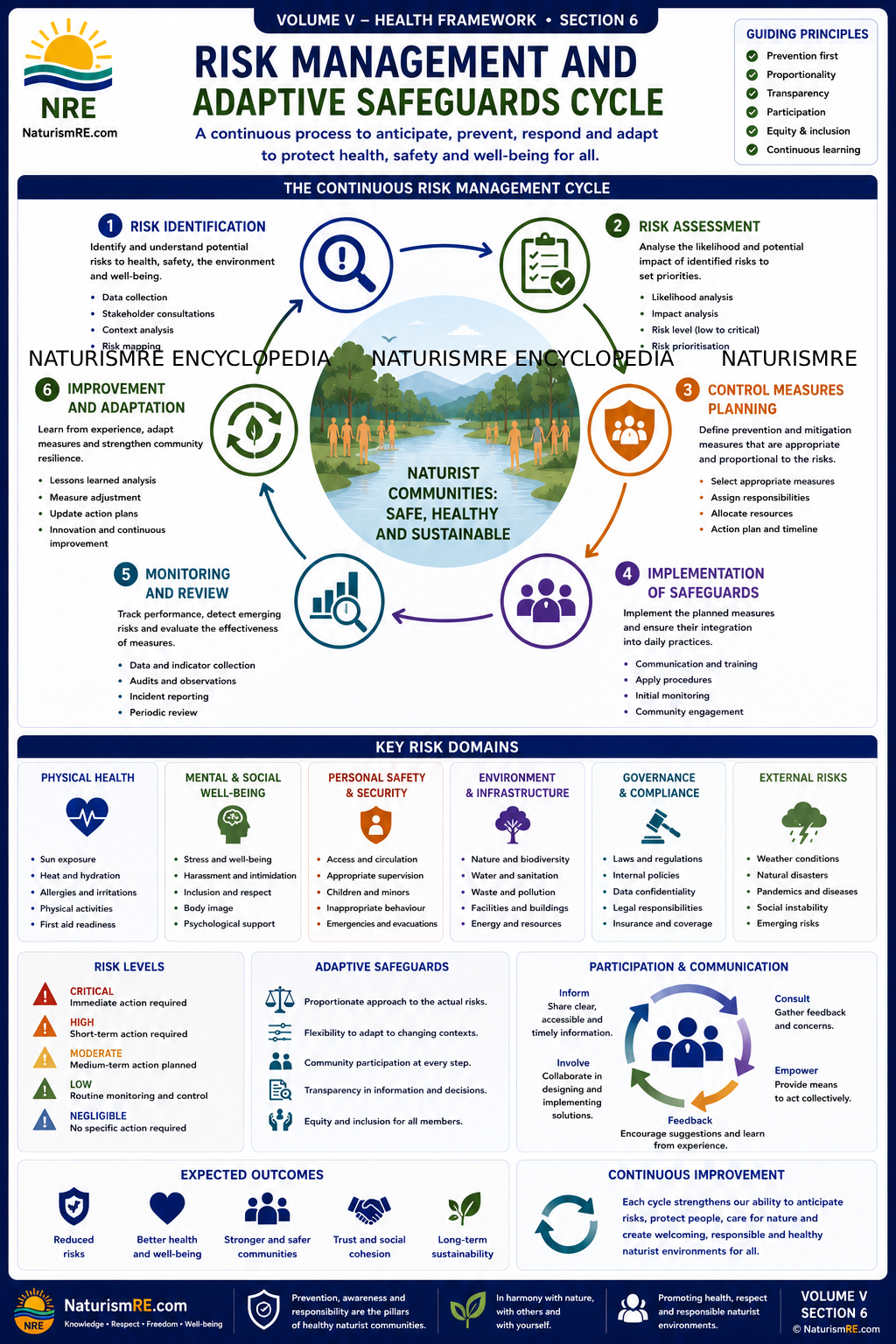
The safety and health viability of naturist environments depend on their ability to define, communicate, and manage risk within clearly bounded parameters, ensuring that exposure remains aligned with human adaptive capacity and behavioural consistency.
6.1 Positioning Risk Within Health-Oriented Naturist Systems
Within a biopsychosocial framework, naturist environments must be evaluated not only for potential pathways of benefit, but for structured risk exposure and mitigation capacity.
Risk in this context is not incidental. It is a predictable component of environmental interaction arising from direct exposure to natural elements, variability in participant behaviour, interaction within shared social spaces, and differences in individual tolerance and preparedness.
Health-oriented naturist systems are therefore defined not by the absence of risk, but by the presence of identifiable, manageable, and bounded risk conditions.
6.2 Categories of Health-Related Risk
Risk exposure in naturist environments can be understood across four primary domains.
Environmental Risk
Includes temperature extremes, ultraviolet exposure, terrain hazards, and weather variability associated with outdoor conditions.
Physiological Risk
Includes thermal stress, dehydration, fatigue, and skin-related responses linked to environmental interaction.
Behavioural Risk
Includes deviation from behavioural norms, ambiguity in conduct, and reduced awareness of environmental or social conditions.
Psychological and Perception Risk
Includes discomfort, perceived lack of safety, and stress arising from unfamiliarity or interpretative uncertainty.
These domains are interrelated, and changes in one may influence outcomes in others.
6.3 Principles of Risk Mitigation
Effective risk mitigation in naturist systems is based on proactive design rather than reactive response.
Core principles include predictability, where environments operate under consistent and clearly defined conditions; clarity, where environmental risks and behavioural expectations are identifiable; participant awareness, where individuals are informed and participation is voluntary; and proportionality, where exposure remains aligned with the intended purpose of the environment.
These principles allow environments to transition from unmanaged exposure to controlled interaction.
6.4 Environmental Safety Protocols
Structured naturist environments typically incorporate environmental safety measures such as selection of locations with manageable terrain, provision of shaded or sheltered areas where appropriate, access to hydration and rest areas, and monitoring of weather conditions.
These measures reduce the likelihood of heat-related stress, overexposure to environmental elements, and injury associated with terrain.
Environmental protocols do not eliminate risk. They align exposure with safe operational parameters.
6.5 Behavioural Safety and Group Regulation
Behavioural consistency is a critical component of safety in naturist environments.
Safety-oriented behavioural frameworks emphasise non-ambiguous, non-disruptive conduct, respect for personal and spatial boundaries, and responsiveness to environmental and situational conditions.
Structured environments support behavioural safety through visible expectations, supervisory or stewardship roles where appropriate, and mechanisms for addressing deviation.
Behavioural safety contributes to physical safety by reducing unpredictability and to psychological safety by maintaining a stable and interpretable environment.
6.6 Personal Responsibility and Adaptive Behaviour
Risk management in naturist environments operates through a shared responsibility model.
Participants are expected to assess their tolerance to environmental conditions, adjust behaviour according to changing circumstances, and apply protective measures where necessary.
Adaptive behaviour may include managing exposure duration, maintaining hydration, and responding to environmental changes.
Structured systems rely on participants who are informed, responsive, and aligned with environmental conditions.
This reflects broader public health principles in which individual behaviour interacts with environmental design.
6.7 Incident Response and Containment Mechanisms
Despite preventive measures, incidents may occur.
Effective systems incorporate response mechanisms that include recognition of early indicators of discomfort or risk, defined escalation pathways for intervention, and the capacity to remove or isolate disruptive elements.
Rapid and proportionate response serves to contain escalation, maintain environmental stability, and preserve participant confidence.
The ability to respond effectively is a key determinant of system resilience.
6.8 Analytical Conclusion
Risk exposure in naturist environments is an inherent and manageable component of human-environment interaction.
Risks arise across environmental, physiological, behavioural, and psychological domains. Effective systems prioritise proactive design and predictability. Environmental and behavioural protocols reduce variability and exposure. Participant awareness and adaptive behaviour are essential for safety. Incident response mechanisms support system resilience.
Structured naturist environments do not eliminate risk. They transform unmanaged exposure into controlled, interpretable, and proportionate conditions.
This establishes a defining principle for Volume V:
The safety and health viability of naturist environments depend on their ability to define, communicate, and manage risk within clearly bounded parameters, ensuring that exposure remains aligned with human adaptive capacity and behavioural consistency.
Primary Supporting Articles
Risk Exposure as a System Variable, From Environmental Interaction to Managed Conditions
Safety Protocols and Operational Controls in Exposure-Based Systems
Protective Mechanisms and Adaptive Safeguards in Structured Naturist Environments
Incident Response, System Resilience, and Recovery Protocols in Structured Naturist Environments
Why Risk Is Lower in Structured Environments Than in Unregulated Contexts