

Compliance Architectures, Operational Protocols, and Legal Defensibility
Examining how structured compliance systems transform abstract legal principles into predictable, auditable, and operationally defensible naturist environments.
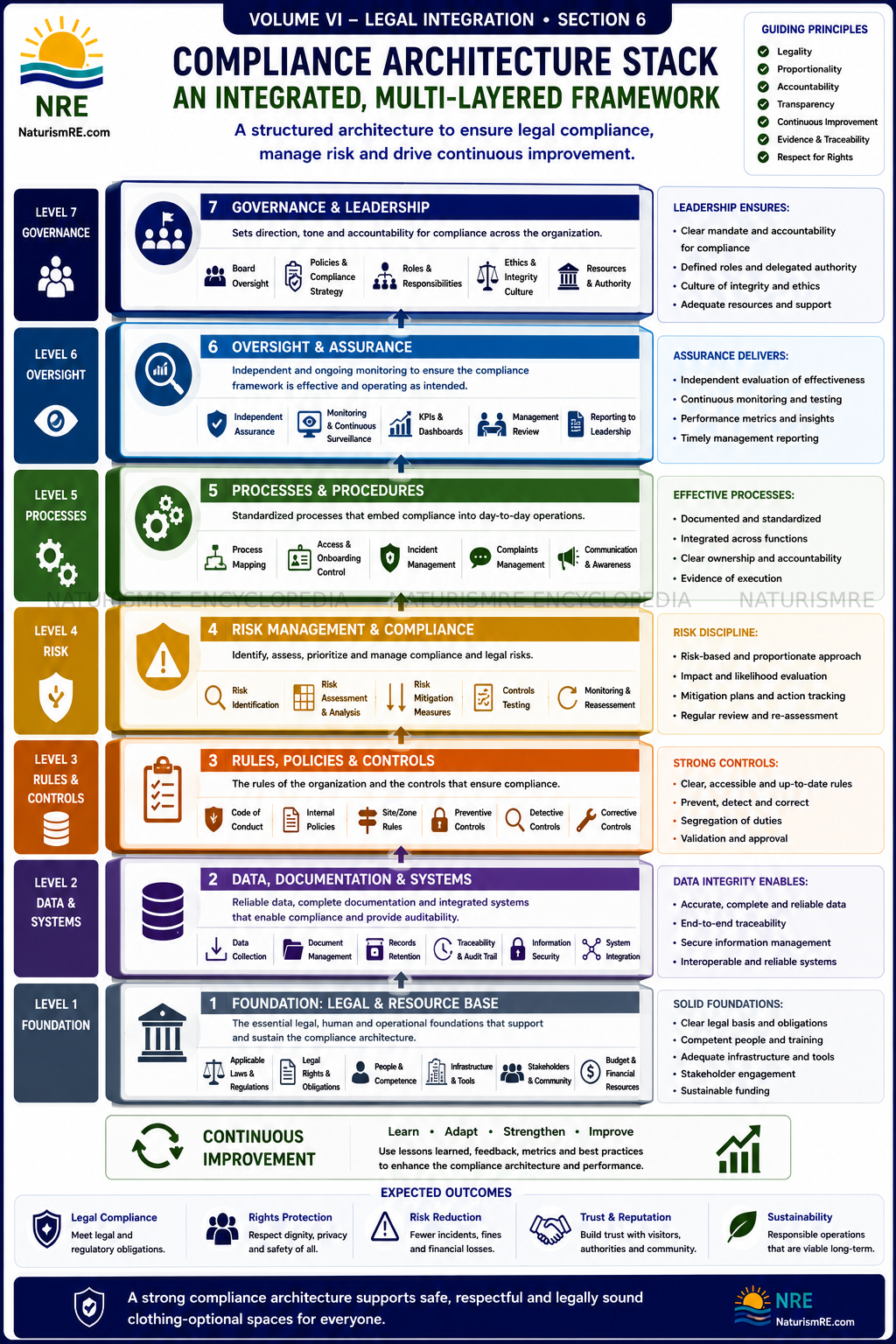
The transition from tolerated activity to legally defensible system requires coherent compliance architectures that embed legal alignment into daily operations, ensuring that behaviour, context, and response mechanisms remain consistently within the bounds of reasonable and foreseeable conduct.
6.1 From Legal Awareness to Compliance Architecture
Understanding statutes and case law is insufficient for operational viability. Naturist systems require formalised compliance architectures that translate legal principles into repeatable and auditable operational practices.
A compliance architecture is defined by clear operational rules aligned with legal thresholds, defined roles and responsibilities, documented procedures for both routine and non-routine conditions, and evidence pathways demonstrating adherence.
The objective is not to eliminate legal risk, but to render conduct predictable, interpretable, and defensible within existing legal frameworks.
6.2 Core Components of a Compliance Architecture
An effective compliance architecture for structured naturist environments consists of five interrelated components.
Context Definition Layer
Establishes precise delineation of space, purpose, and conditions of use aligned with local regulations and designation mechanisms.
Behavioural Standard Layer
Defines explicit expectations of non-ambiguous and non-disruptive conduct consistent with reasonable interpretation standards.
Operational Control Layer
Governs day-to-day procedures related to access, supervision, environmental conditions, and operational oversight.
Risk Management Layer
Identifies foreseeable environmental, behavioural, and interactional risks and integrates proportional mitigation measures.
Evidence and Documentation Layer
Provides records demonstrating communication, monitoring, and response, supporting due diligence and defensibility.
These components function collectively to reduce ambiguity and stabilise interpretation.
6.3 Standard Operating Procedures (SOPs) and Consistency
Compliance is operationalised through Standard Operating Procedures.
SOPs define procedures for opening and closing conditions, participant entry and awareness cues, environmental monitoring, behavioural oversight, and incident response.
Consistency in application is essential. Inconsistent procedures weaken legal defensibility, increase perception of negligence, and introduce variability in participant expectations.
Effective SOPs are concise, implementable, aligned with local legal thresholds, and adaptable without compromising core structure.
6.4 Communication Protocols and Notice Mechanisms
Legal defensibility is strengthened when participants and observers can reasonably understand the nature of the environment.
Communication protocols include clear on-site notice of context and expected conduct, pre-engagement information where applicable, and visible cues reinforcing non-ambiguous use.
Effective communication supports informed participation, reduces likelihood of complaint, and assists authorities in interpreting context.
Communication must remain consistent with actual practice, proportionate to the environment, and maintained over time.
6.5 Monitoring, Supervision, and Density Management
Operational compliance requires active monitoring calibrated to the scale and density of the environment.
This includes periodic observation of behavioural consistency, identification of early indicators of deviation, and scalable supervisory presence in higher-density conditions.
Density is a critical factor. Low-density environments may operate with minimal oversight, while higher-density environments require visible supervision to maintain predictability.
Monitoring functions as a stability mechanism rather than a control system, ensuring that conditions remain within defined parameters.
6.6 Incident Response and Legal Containment
Structured systems must assume the possibility of incidents and incorporate response mechanisms.
These include predefined categories of incidents, immediate response actions such as direction or de-escalation, and escalation pathways where conditions require intervention.
Post-incident processes include factual recording, analysis of contributing factors, and adjustment of procedures.
Effective response provides both operational containment and legal containment by demonstrating reasonable and timely action.
6.7 Auditability and Continuous Improvement
Compliance architectures must be auditable, allowing external evaluation of whether procedures exist, are followed, and are effective.
Auditability is supported by documented procedures, records of communication and monitoring, and maintained incident logs.
Continuous improvement involves reviewing procedures against observed conditions, incorporating lessons from incidents, and adapting to evolving legal expectations.
This ensures that compliance remains dynamic and aligned with operational realities.
6.8 Analytical Conclusion
Compliance architectures translate abstract legal principles into operational systems capable of consistent application.
Legal defensibility depends on predictable and documented conduct. Effective systems integrate context definition, behavioural standards, operational control, risk management, and evidence mechanisms. SOPs ensure consistency, communication reduces ambiguity, monitoring supports stability, and incident response demonstrates due diligence.
Auditability and continuous improvement sustain long-term alignment with legal expectations.
Naturist environments that lack structured compliance remain dependent on discretionary tolerance. Those that implement defined architectures operate within interpretable and defensible conditions.
This establishes a defining principle for Volume VI:
The transition from tolerated activity to legally defensible system requires coherent compliance architectures that embed legal alignment into daily operations, ensuring that behaviour, context, and response mechanisms remain consistently within the bounds of reasonable and foreseeable conduct.
Primary Supporting Articles
Safety Protocols and Operational Controls in Exposure-Based Systems
Controlled Entry Systems and Their Role in Stabilisation
Governance Without Constant Intervention, Passive Control Systems in Naturist Contexts
Incident Response Protocols and System Resilience
Why Behavioural Standards Function as Operational Infrastructure