

Regulatory Instruments, Local Governance, and Designation Mechanisms
Examining how sub-legislative regulation, designation systems, permits, and local governance mechanisms operationalise naturist environments within jurisdiction-specific conditions.
The operational viability of naturist environments depends on their ability to engage with and align to sub-legislative regulatory instruments, using designation, conditional authorisation, and local governance processes to reduce ambiguity and establish legally interpretable conditions within specific jurisdictions.
4.1 The Role of Sub-Legislative Regulation
Beyond primary statutes and case law, naturist practice is significantly shaped by sub-legislative regulatory instruments.
These include local council bylaws, park and land-use regulations, administrative policies, and permit or licensing systems.
Such instruments operate at a granular, location-specific level, enabling authorities to define acceptable uses of space, impose conditions on activities, and respond to local community expectations.
Unlike statutory law, which is typically broad, sub-legislative regulation provides operational specificity. It therefore represents a critical layer in the practical governance of naturist environments.
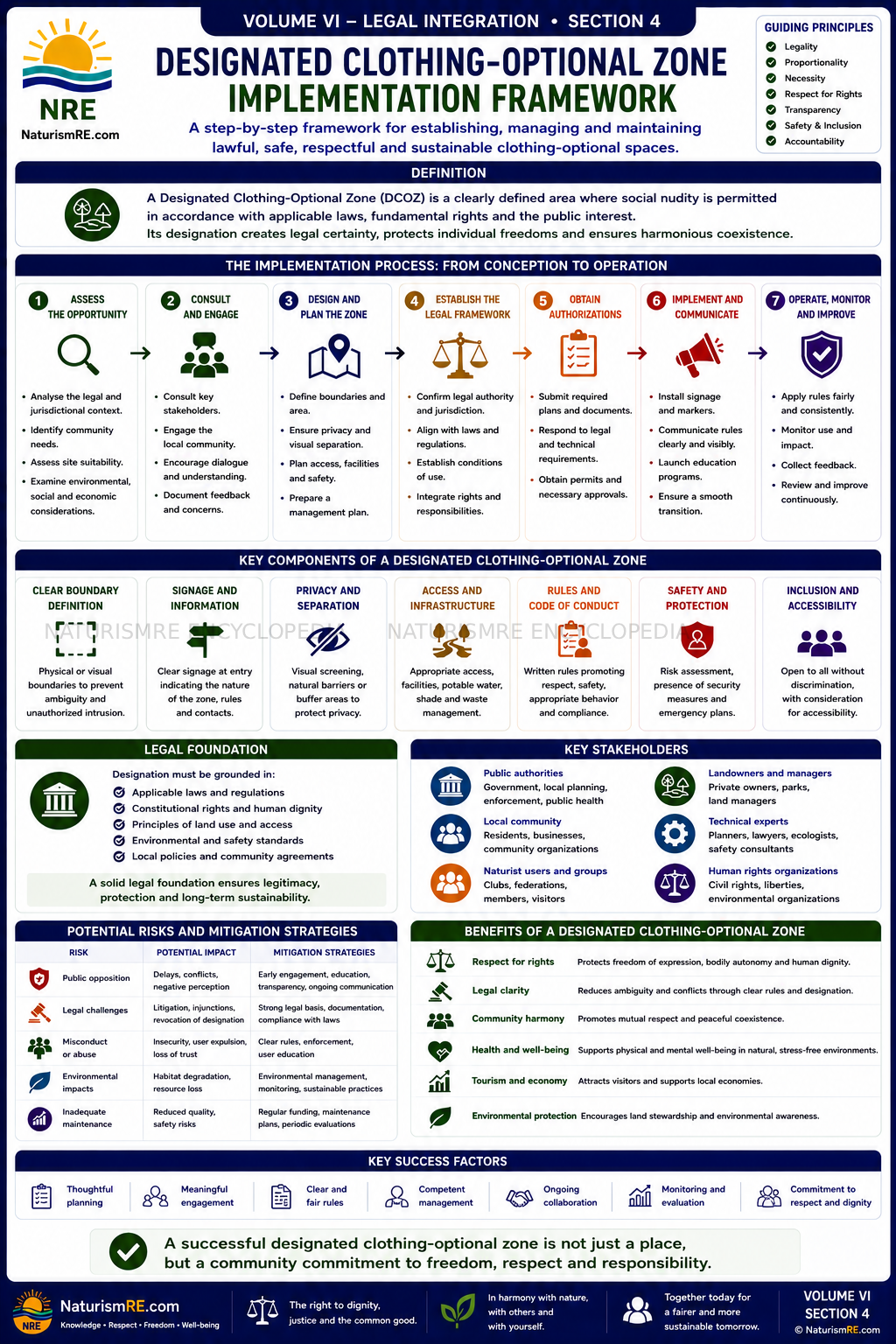
4.2 Designation of Context-Specific Zones
One of the most effective regulatory mechanisms is the designation of specific zones where particular activities are permitted or tolerated under defined conditions.
Formally Authorised Areas
Zones established through government or council decisions with explicit recognition and operational conditions.
Administratively Recognised Zones
Areas operating under conditional acceptance or practical tolerance within existing governance systems.
Historically Tolerated Areas
Locations functioning through informal recognition and long-term behavioural consistency.
Contextual Boundary Systems
Clearly defined spatial limits and communicated expectations that reduce ambiguity and support interpretation.
Designation reduces ambiguity for participants and observers, aligns activity with contextual expectations, and provides a reference point for enforcement and interpretation.
However, designation does not necessarily provide full legal immunity. Its effectiveness depends on alignment with overarching legal frameworks, clarity of conditions, and the level of formal recognition.
4.3 Permit Systems and Conditional Authorisation
In some jurisdictions, permit-based systems are used to regulate activities involving nudity.
These systems typically involve application and approval processes, defined operational conditions, and time-limited or event-specific authorisation.
Conditions may include restrictions on duration, behavioural requirements, and provisions for oversight or supervision.
Permit systems provide controlled pathways for introducing activities into public or semi-public environments, enable authorities to assess outcomes before broader adoption, and formalise responsibilities.
However, they also introduce administrative complexity, limit scalability, and create dependence on regulatory approval.
Permit-based approaches are therefore often used as transitional mechanisms rather than permanent regulatory solutions.
4.4 Local Governance and Community Influence
Local governance plays a central role in determining regulatory outcomes.
Decision-making at this level is influenced by community attitudes, historical precedent, perceived impact on shared spaces, and political or reputational considerations.
Authorities must balance competing uses of public space, interests of different population groups, and risk management requirements.
As a result, identical proposals may produce different outcomes across jurisdictions. Community engagement can influence decisions, and local context becomes a decisive factor in approval or restriction.
Structured naturist systems must therefore be adaptable to local governance dynamics rather than relying on uniform approaches.
4.5 Enforcement Through Administrative Mechanisms
Sub-legislative frameworks enable enforcement through administrative mechanisms.
These include the issuance of directions or notices, fines for bylaw breaches, revocation of permits or permissions, and restrictions on the use of specific areas.
Such mechanisms operate alongside statutory enforcement but often allow faster response, lower thresholds for action, and greater flexibility.
Administrative enforcement is particularly relevant where conduct does not meet criminal thresholds but is considered inconsistent with local regulations.
This reinforces the need for alignment with local rules, even where statutory law does not explicitly prohibit conduct.
4.6 Temporary Versus Permanent Regulatory Models
Regulatory approaches may distinguish between temporary and permanent models.
Temporary models include trial zones or event-based permissions that allow authorities to evaluate feasibility, assess community response, and adjust operational conditions.
Permanent models involve ongoing designation of areas, providing greater predictability, stability in interpretation, and integration into local planning frameworks.
The transition from temporary to permanent status typically depends on absence of significant incidents, manageable community impact, and demonstrated effectiveness of governance mechanisms.
4.7 Interaction with Broader Planning and Land-Use Systems
Naturist environments intersect with planning and land-use frameworks, particularly in public or semi-public contexts.
Relevant considerations include zoning classifications, compatibility with surrounding land uses, environmental protection requirements, and infrastructure or access conditions.
Integration within planning systems allows naturist environments to be assessed alongside other land uses, incorporated into recreational strategies, and aligned with long-term development plans.
At the same time, it introduces additional regulatory layers and constraints that require alignment with existing frameworks.
4.8 Analytical Conclusion
Sub-legislative regulatory instruments provide the primary mechanisms through which naturist environments are operationalised in practice.
They enable location-specific control and flexibility, support contextual interpretation through designation, and provide conditional pathways through permit systems.
Local governance dynamics significantly influence outcomes, administrative enforcement operates alongside statutory law, and planning systems introduce both opportunities and constraints.
Naturist systems are therefore shaped not only by high-level legal principles but by practical regulatory mechanisms that determine how, where, and under what conditions activity may occur.
This establishes a defining principle for Volume VI:
The operational viability of naturist environments depends on their ability to engage with and align to sub-legislative regulatory instruments, using designation, conditional authorisation, and local governance processes to reduce ambiguity and establish legally interpretable conditions within specific jurisdictions.
Primary Supporting Articles
From Policy Avoidance to Policy Design, The Case for Structured Clothing-Optional Zones
From Risk to Regulation, The Structural Logic Behind Controlled Clothing-Optional Environments
From Zones to Systems, How Structured Environments Scale Across Jurisdictions
Micro-Zoning Models for Urban Integration
Temporal Zoning, Time-Based Context Definition in Shared Environments