Nudity, Body Odour, and Social Perception
Reassessing Hygiene, Physiology, and Cultural Conditioning in Naturist Contexts
Author: Vincent Marty
Institution: NRE Health Institute
Date: March 2026
Audience Note
This publication is intended for policymakers, public health observers, researchers, and operators of clothing-optional environments. It provides a behaviour-based analysis of hygiene, odour formation, and perception in contexts where clothing is absent or reduced. It does not promote participation and does not prescribe behavioural outcomes. All observations are contextual, conditional, and subject to environmental and individual variation.
Executive Summary
Body odour is frequently cited as a practical concern in discussions surrounding public nudity and naturism. This concern is often framed as a hygiene issue, yet it is commonly shaped by cultural expectations rather than direct physiological mechanisms.
This paper examines the relationship between nudity, human skin biology, hygiene practices, clothing systems, and odour perception through a multidisciplinary framework. Evidence from dermatology and microbiology indicates that sweat itself is odourless and that odour formation is associated with bacterial activity influenced by moisture, heat, and environmental conditions. Clothing systems may contribute to these conditions by retaining moisture and limiting airflow, while unclothed conditions may alter these dynamics depending on context.
The analysis further explores how perception of odour is shaped by cognitive bias, expectation, and cultural conditioning. In many cases, associations between nudity and poor hygiene are not derived from measurable conditions but from socially constructed interpretations.
The paper concludes that odour outcomes are primarily determined by behavioural practices, environmental management, and physiological processes rather than by clothing presence alone. It proposes that structured environments with defined hygiene standards and environmental controls may manage odour effectively irrespective of clothing status.
Abstract
This paper examines the relationship between nudity, body odour, and social perception through a multidisciplinary analysis integrating dermatology, microbiology, textile science, and behavioural research. It evaluates the mechanisms of odour production, the role of clothing systems, and the influence of environmental and behavioural factors.
The analysis indicates that human sweat is inherently odourless and that odour is produced through bacterial metabolism under conditions influenced by moisture retention, heat, and airflow limitation. Clothing systems may contribute to these conditions, while unclothed environments may modify them depending on ventilation and hygiene practices.
The paper further analyses how perception of odour is influenced by cultural norms, expectation effects, and cognitive bias. It proposes that associations between nudity and poor hygiene are not consistently supported by physiological evidence and are often shaped by social conditioning.
Findings are presented as context-dependent and non-causal. The paper contributes to a behaviour-based understanding of hygiene in clothing-optional environments and provides a structured framework for analysing odour perception within public health and policy discussions.
Methodology
This publication applies a qualitative, multidisciplinary methodology based on synthesis of existing research rather than primary experimental data conducted within naturist environments.
The approach includes:
Integration of dermatological and microbiological literature on sweat composition and skin microbiota
Analysis of textile science research regarding moisture retention and odour persistence
Behavioural interpretation of hygiene practices and environmental conditions
Sociological analysis of perception, stigma, and cultural conditioning
Contextual evaluation of environmental variables including ventilation, density, and sanitation
The analysis is non-causal and context-dependent. It does not assume uniform conditions across all environments and does not establish universal outcomes.
1. Introduction
Concerns about body odour represent a persistent barrier to the social acceptance of naturism. Unlike legal or moral objections, this concern is typically framed as practical and hygiene-related, which increases its perceived legitimacy.
This raises a central analytical question: whether odour outcomes are directly influenced by nudity itself, or whether they are shaped by broader physiological, environmental, and behavioural variables.
This paper addresses this question by separating biological mechanisms from perception and by examining how clothing systems, environmental conditions, and social interpretation interact to shape outcomes.
2. Human Physiology of Body Odour
2.1 Sweat Composition
Human sweat, produced primarily by eccrine glands, consists largely of water and electrolytes and is generally odourless.
2.2 Role of Skin Microbiota
Body odour may emerge when sweat interacts with bacteria naturally present on the skin. These microorganisms metabolise components of sweat and produce volatile compounds associated with odour. This process is more pronounced in areas with higher concentrations of apocrine glands.
2.3 Determinants of Odour Formation
Body odour is influenced by multiple factors, including:
Microbial activity on the skin
Moisture accumulation
Temperature and heat retention
Airflow and ventilation
Nudity is not identified as a direct causal factor in odour production based on current physiological understanding.
3. Clothing as a Contributor to Odour
3.1 Moisture Retention
Clothing may trap sweat against the skin, creating conditions that support bacterial activity.
3.2 Fabric Characteristics
Different fabrics may influence odour development:
Synthetic fibres may retain odour compounds
Tight garments may reduce airflow
Repeated wear without adequate washing may increase bacterial load
3.3 Thermal and Friction Effects
Clothing may increase localised heat and friction, which can influence sweat production and microbial activity.
3.4 Textile–Microbiome Interaction
Clothing may influence the composition and behaviour of the skin microbiome. Worn textiles can act as reservoirs for bacteria, allowing reintroduction to the skin. Certain fibres may retain odour compounds even after washing.
Under these conditions, clothing may contribute to odour persistence depending on context.
4. Nudity and Odour Dynamics
4.1 Ventilation and Evaporation
In environments where clothing is absent, increased airflow may allow faster evaporation of sweat, which can reduce moisture available for bacterial activity.
4.2 Environmental Exposure
Outdoor environments may influence odour dynamics through airflow and environmental exposure. Sunlight may have mild antibacterial effects, although outcomes vary.
4.3 Behavioural Hygiene Norms
Naturist environments are often described as operating under shared hygiene expectations, including regular washing and the use of personal barriers such as towels on shared surfaces.
4.4 Contextual Limitations
Outcomes remain dependent on environmental conditions. In poorly ventilated, high-density, or high-humidity settings, odour may develop regardless of clothing status.
5. Olfactory Perception and Social Conditioning
5.1 Perception and Expectation
Human perception of odour may be influenced by cognitive and contextual factors. Expectations about hygiene can affect how odours are interpreted.
5.2 Cultural Associations
In many societies, clothing is associated with cleanliness, while nudity may be associated with disorder. These associations are culturally constructed and not inherently biological.
5.3 Cognitive Bias and Interpretation
Pre-existing beliefs may influence sensory interpretation. Individuals who associate nudity with poor hygiene may be more likely to perceive odour regardless of measurable conditions.
6. Comparative Environmental Analysis
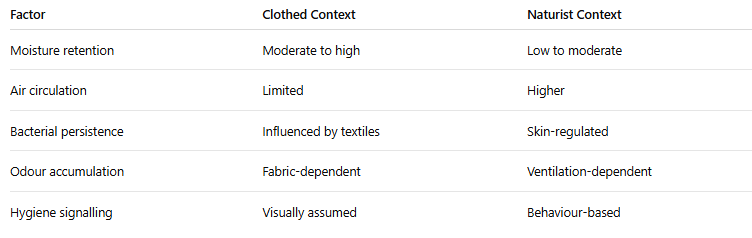
Odour outcomes in both clothed and unclothed environments are influenced by shared variables, including:
Hygiene practices
Population density
Temperature and humidity
Ventilation and airflow
Access to sanitation facilities
Clothed environments may create conditions for moisture retention and microbial persistence. Unclothed environments may alter these conditions through increased ventilation, although this is not uniform.
The analysis indicates that environmental management and behaviour are more influential than clothing status alone in determining odour outcomes.
7. Public Health Implications
7.1 Reframing Hygiene
Hygiene may be more accurately assessed based on measurable conditions such as cleanliness, sanitation, and environmental management rather than clothing presence.
7.2 Education and Awareness
Improved understanding of odour formation mechanisms may reduce misconceptions and support more effective hygiene practices.
7.3 Structured Environments
Structured environments, including controlled clothing-optional settings, may incorporate hygiene standards and environmental design to maintain consistent conditions.
8. Risk Factors and Limitations
Body odour outcomes are influenced by multiple variables, including:
Individual hygiene practices
Environmental conditions such as heat and humidity
Population density
Access to sanitation facilities
Neither clothed nor unclothed environments are inherently superior without appropriate management.
9. Operational Considerations
9.1 Hygiene Practices
Consideration of personal cleanliness standards prior to participation is commonly observed in managed environments.
9.2 Surface Interaction
Use of personal barriers such as towels on shared surfaces is frequently reported.
9.3 Environmental Design
Ventilation, airflow, and material selection are identified as contributing factors in odour management.
9.4 Communication
Clear articulation of hygiene expectations and evidence-based explanations may support consistent behavioural outcomes.
10. Conclusion
The association between nudity and body odour is not supported by physiological mechanisms alone. Odour formation is primarily influenced by microbial activity, moisture, environmental conditions, and hygiene practices.
Clothing systems may contribute to odour persistence under certain conditions, while unclothed environments may modify these dynamics depending on context. Outcomes remain variable and environment-dependent.
A behaviour-based and environment-focused understanding supports a more accurate assessment of hygiene and may inform structured approaches to managing odour in both clothed and unclothed settings.
11. Key Principle
Hygiene outcomes are determined by behavioural practices, environmental conditions, and microbial processes rather than by clothing presence alone.
12. Limitations
This paper is based on a multidisciplinary synthesis of existing research rather than controlled experimental studies conducted specifically within naturist environments.
Body odour is influenced by a wide range of individual variables, including genetics, diet, health status, medication use, and personal hygiene routines.
Environmental conditions such as temperature, humidity, ventilation, and population density significantly affect outcomes and may vary across settings.
Behavioural norms described in naturist environments are based on commonly reported practices and are not universally standardised.
Perception of odour is influenced by psychological and cultural factors, which are difficult to quantify objectively.
Further research, including controlled observational and experimental studies, would strengthen the evidence base.
References
James, A. G., et al. (2013). Microbiological and biochemical origins of human body odour.
Callewaert, C., et al. (2014). Skin microbiome and its role in odour production.
McQueen, R. H., et al. (2007). Odour retention in textiles.
Wilke, K., et al. (2007). Physiology of sweat glands.
Roberts, S. C., et al. (2005). Human odour perception and psychological factors.
Goffman, E. (1963). Stigma: Notes on the Management of Spoiled Identity.
Douglas, M. (1966). Purity and Danger.
Festinger, L. (1957). A Theory of Cognitive Dissonance.
NRE Frameworks
Behaviour vs Perception Model
Environmental and Behavioural Hygiene Framework
Safe Health Zones (SHZ) – Structured Environmental Management Model
Validation
This document follows a behaviour-based, non-ideological analytical framework. It separates physiological mechanisms from perception and avoids prescriptive or causal claims. The analysis is structured for compatibility with public health, regulatory, and institutional review contexts.