Incentivising Government Support for Naturist Spaces as a Public Health and Wellbeing Initiative
Author: Vincent Marty
Founder of NaturismRE
Audience Note
This white paper is intended for public health institutions, policymakers, urban planners, environmental agencies, and government stakeholders responsible for health system sustainability, infrastructure planning, and community wellbeing.
It is designed as a policy-ready analytical framework to support decision-making regarding the integration of regulated naturist environments within public infrastructure.
This document does not advocate naturism as a lifestyle or ideological position. It evaluates naturist environments strictly through the lens of:
• public health efficiency
• economic optimisation
• policy feasibility
• risk-managed implementation
Executive Summary
Modern governments face increasing pressure across multiple systems, including healthcare, mental health services, urban planning, and environmental sustainability. Despite substantial financial investment, outcomes remain constrained by structural inefficiencies, reactive policy models, and limited integration of low-cost preventative approaches.
This paper examines the conditions under which governments would be incentivised to support the integration of regulated naturist spaces within urban parks, nature strips, and national parks as part of a preventative public health strategy.
The analysis identifies that government support is not primarily driven by cultural acceptance or ideological alignment. Instead, it depends on the presence of clear, measurable incentives that align with core governmental priorities.
These incentives include:
• reduction in long-term healthcare expenditure
• mitigation of mental health system pressure
• optimisation of underutilised urban land
• stimulation of tourism and regional economies
• alignment with environmental sustainability objectives
• improvement in social cohesion and inclusion metrics
The paper demonstrates that naturist environments, when structured and regulated appropriately, can align with all of these incentive categories.
However, current policy resistance is not due to lack of potential benefit, but due to:
• inadequate framing
• perceived political risk
• regulatory ambiguity
• absence of structured implementation models
The central conclusion is that naturist spaces will only be adopted when they are positioned not as lifestyle accommodation, but as evidence-based, low-cost public health infrastructure.
This shift in positioning transforms naturism from a cultural issue into a policy opportunity.
Abstract
Public policy responses to health system pressures increasingly prioritise preventative, low-cost, and scalable interventions. However, environmental and behavioural frameworks that operate outside conventional clinical models remain underutilised.
Naturist environments, defined as structured, regulated spaces enabling non-sexual social nudity within recreational and natural contexts, represent one such framework.
This white paper examines the conditions under which governments would be incentivised to support the integration of naturist zones within public infrastructure. Rather than evaluating naturism as a cultural or lifestyle phenomenon, the analysis positions it as a potential component of preventative health and wellbeing systems.
Drawing on interdisciplinary insights from public health, environmental psychology, urban planning, and policy analysis, the paper identifies that adoption is contingent on alignment with government incentive structures, including healthcare cost reduction, mental health system relief, economic development, and administrative efficiency.
The analysis concludes that naturist environments are unlikely to be adopted through advocacy alone. Instead, their integration depends on their positioning as measurable, low-cost infrastructure aligned with existing policy frameworks.
Methodology
This paper is based on a qualitative policy analysis integrating insights from:
• public health research
• environmental psychology
• urban planning frameworks
• behavioural policy and governance models
The analysis combines:
• conceptual evaluation of naturist environments as behavioural and environmental systems
• review of international implementation patterns
• policy incentive modelling aligned with government decision frameworks
Where quantitative data specific to naturism is limited, the paper draws on established evidence related to:
• nature exposure
• physical activity
• social interaction
• body image and psychological wellbeing
The objective is not to establish direct causation, but to evaluate policy feasibility based on convergence of evidence and alignment with government priorities.
Findings should therefore be interpreted as:
• indicative
• policy-relevant
• suitable for pilot-based validation
Keywords
Naturism, public health policy, preventative healthcare, urban planning, mental health, wellbeing infrastructure, social integration, environmental exposure, policy incentives
1. Introduction
Governments globally are confronting a convergence of systemic pressures that are increasingly difficult to manage within existing policy frameworks.
These pressures include:
• rising prevalence of chronic diseases
• saturation of mental health services
• escalating healthcare expenditure
• growing disconnection from natural environments
• increasing social fragmentation and isolation
These issues are interconnected.
Chronic disease is often linked to:
• sedentary lifestyles
• stress
• environmental disconnection
Mental health challenges are influenced by:
• social isolation
• body image pressure
• lack of community engagement
Urban environments frequently exacerbate these conditions through:
• limited access to natural spaces
• high-density living
• reduced opportunities for low-cost recreational activity
1.1 Limitations of Current Policy Approaches
Conventional policy responses rely heavily on:
• pharmaceutical intervention
• expansion of clinical services
• behavioural campaigns with limited long-term adherence
These approaches share several limitations:
• high cost
• reactive rather than preventative
• dependency on sustained individual compliance
• limited scalability without significant investment
As a result, governments face increasing difficulty in maintaining system sustainability.
1.2 The Preventative Health Gap
Preventative health strategies aim to reduce long-term system burden by addressing underlying causes rather than symptoms.
However, current preventative approaches are often limited to:
• awareness campaigns
• educational programs
• targeted behavioural interventions
These strategies do not always modify the environmental and social conditions that drive behaviour.
This creates a gap:
individual behaviour is targeted, but environmental context is underutilised.
1.3 Naturism as an Environmental Intervention
Naturism, when structured within appropriate regulatory frameworks, represents an environmental and behavioural context that can influence multiple determinants of health simultaneously.
It aligns with:
• increased exposure to natural environments
• reduction of social stressors linked to body image
• promotion of physical activity
• enhancement of social interaction
• simplification of social environments
Unlike many interventions, naturist environments:
• do not require complex infrastructure
• do not rely on pharmaceutical support
• can be implemented within existing public spaces
1.4 Core Policy Question
Despite these characteristics, naturism remains largely absent from policy discussions.
This paper examines why.
It reframes the discussion from:
“Should naturism be allowed?”
to:
“Under what conditions would governments be incentivised to support naturist environments?”
This shift is critical.
Government action is not driven by philosophical alignment, but by:
• measurable outcomes
• economic efficiency
• political feasibility
1.5 Naturist Environments as Policy-Relevant Systems
Before examining government incentives, it is necessary to clarify the analytical positioning of naturist environments.
Within this paper, naturism is not approached as:
• a lifestyle identity
• a cultural movement
• a philosophical position
It is instead considered as:
• a structured environmental condition
• a behavioural context
• a potential public health interface
This distinction is essential.
Government decision-making frameworks do not operate on cultural alignment. They operate on:
• measurable outcomes
• cost efficiency
• risk management
• system compatibility
By repositioning naturist environments as functional components within these systems, the analysis shifts from:
“whether naturism should be supported”
to:
“under what conditions naturist environments become policy-relevant.”
2. Government Decision Framework
Government adoption of any initiative typically depends on a structured evaluation process.
This process is not formally identical across jurisdictions, but it consistently reflects four core criteria:
• cost-benefit efficiency
• political risk management
• administrative feasibility
• public acceptance potential
Naturist integration must satisfy all four simultaneously.
2.1 Cost-Benefit Efficiency
Policies must demonstrate:
• measurable return on investment (ROI)
• reduction in long-term expenditure
• efficiency compared to existing alternatives
High-cost interventions face increasing scrutiny.
Low-cost interventions with multi-layered benefits are prioritised.
Naturist environments can potentially contribute to:
• reduced healthcare utilisation
• improved preventative health outcomes
• optimisation of existing assets
However, these benefits must be clearly articulated and measurable.
2.2 Political Risk Management
Governments operate within political constraints.
Policies must:
• avoid generating significant controversy
• be defensible within media narratives
• not create reputational risk for decision-makers
Perception plays a critical role.
Even beneficial policies may be rejected if perceived as politically risky.
Naturism currently falls into this category due to:
• misunderstanding of its nature
• association with inappropriate behaviour
• lack of clear public framing
2.3 Administrative Feasibility
Policies must be implementable within existing systems.
This requires:
• minimal structural disruption
• compatibility with current regulations
• manageable enforcement requirements
Complex or resource-intensive policies are less likely to be adopted.
Naturist environments offer an advantage in this area:
• low infrastructure requirements
• compatibility with existing park systems
• potential for phased implementation
2.4 Public Acceptance Potential
Policies must demonstrate:
• public support
• or at minimum, public neutrality
Strong opposition from even a minority group can prevent adoption.
Public perception is therefore a critical factor.
Naturist integration requires:
• clear communication
• distinction between nudity and behaviour
• demonstration of controlled environments
2.5 Structural Insight
Naturist integration does not fail because it lacks potential benefit.
It fails because it does not currently satisfy all four criteria simultaneously.
The issue is not viability.
The issue is alignment with decision frameworks.
3. Core Incentives Required for Government Support
Before examining individual incentive categories, it is important to recognise that government adoption is not triggered by a single factor.
Policy decisions emerge from the convergence of:
• economic benefit
• operational feasibility
• political acceptability
• measurable outcomes
The following sections therefore analyse each incentive not in isolation, but as part of an integrated decision framework.
Government support for any new policy or infrastructure initiative is not driven by conceptual merit alone. It is driven by the presence of clear, measurable incentives aligned with strategic priorities.
Naturist environments must therefore be evaluated through the lens of incentive alignment rather than cultural acceptance.
This section outlines the primary incentive categories required to trigger governmental interest and eventual adoption.
3.1 Healthcare Cost Reduction
This represents the most powerful and decisive incentive.
Healthcare systems in developed nations are experiencing sustained pressure due to:
• increasing prevalence of chronic diseases
• ageing populations
• rising treatment costs
• expanding demand for long-term care
A significant proportion of healthcare expenditure is associated with conditions that are influenced by lifestyle and environmental factors, including:
• cardiovascular disease
• obesity
• stress-related disorders
• depression and anxiety
Preventative strategies that can reduce incidence or severity of these conditions are of high strategic value.
3.1.1 Mechanisms of Potential Impact
Naturist environments may contribute to healthcare cost reduction through several pathways:
• increased physical activity in natural settings
• reduction in chronic stress levels
• improved mental wellbeing
• enhanced body acceptance reducing harmful behaviours
• increased exposure to sunlight supporting vitamin D levels
Each of these factors is independently associated with improved health outcomes.
When combined within a single environment, they may produce cumulative effects.
3.1.2 Cost Efficiency Advantage
Unlike many health interventions, naturist environments:
• do not require specialised medical personnel
• do not involve pharmaceutical costs
• rely on existing infrastructure
• have low operational overhead
This positions naturist zones as high-efficiency preventative environments.
3.1.3 Policy Leverage Point
To activate this incentive, naturist spaces must be framed as:
• preventative health infrastructure
• comparable to walking tracks, green spaces, and outdoor fitness areas
• measurable in terms of impact on health indicators
Without measurable framing, this incentive remains theoretical.
3.2 Mental Health System Relief
Mental health services are currently under significant strain in most developed nations.
Common issues include:
• long waiting times
• limited access to care
• increasing prevalence of anxiety and depression
• resource constraints
Governments are actively seeking complementary approaches to reduce system pressure.
3.2.1 Mechanisms of Impact
Naturist environments may contribute to mental health outcomes through:
• reduction of appearance-based anxiety
• increased sense of acceptance
• exposure to non-competitive social environments
• enhanced connection with nature
• reduced social comparison pressures
These mechanisms target several root contributors to psychological distress.
3.2.2 System-Level Implications
If naturist environments can contribute to:
• reduced demand for clinical services
• improved baseline mental wellbeing
• earlier intervention at community level
they become relevant as a system support tool, not a replacement for care.
3.2.3 Incentive Trigger
Government interest increases significantly when:
• interventions reduce system load
• measurable improvements can be demonstrated
• cost savings can be projected
Mental health relief is therefore a critical incentive pathway.
3.3 Economic and Tourism Benefits
Governments respond strongly to initiatives that generate economic activity.
Naturist environments can contribute to economic outcomes through:
• tourism attraction
• extended visitor stays
• repeat visitation
• niche market development
3.3.1 Tourism Characteristics
Naturist tourism tends to exhibit:
• higher per-visitor spending
• longer average stays
• strong repeat visitation rates
• international travel patterns
These characteristics are valuable for regional economies.
3.3.2 Regional Development Potential
Naturist zones can be positioned as:
• controlled tourism assets
• regional economic drivers
• diversification tools for local economies
This is particularly relevant for:
• rural areas
• coastal regions
• underutilised tourism zones
3.3.3 Economic Incentive Trigger
Government engagement increases when naturist environments are framed as:
• revenue-generating infrastructure
• economic development tools
• tourism expansion strategies
Economic framing significantly reduces resistance.
3.4 Urban Land Optimisation
Urban environments contain significant areas of underutilised public space.
This includes:
• low-traffic park zones
• marginal recreational areas
• spaces with limited engagement
Optimising these spaces is a priority in urban planning.
3.4.1 Functional Activation
Naturist zones can:
• activate underused areas
• diversify park usage
• distribute visitor flow
• increase overall utilisation
This improves the efficiency of existing infrastructure.
3.4.2 Cost Advantage
Key advantage:
• minimal construction required
• low capital investment
• rapid implementation potential
Compared to other urban projects, naturist zones are:
• low-cost
• low-risk
• reversible if needed
3.4.3 Planning Incentive
Urban planners are incentivised to:
• maximise land use efficiency
• increase accessibility
• improve community engagement
Naturist environments align with these objectives when appropriately zoned.
3.5 Environmental Policy Alignment
Environmental sustainability is an increasing priority for governments.
Naturist environments align with environmental objectives through:
• reduced textile consumption
• lower material usage
• minimal infrastructure requirements
• increased engagement with natural ecosystems
3.5.1 Behavioural Alignment
Naturist practices encourage:
• low-impact recreation
• reduced consumption
• awareness of natural environments
These behaviours support sustainability goals.
3.5.2 Policy Integration
Naturism can be integrated within:
• environmental education programs
• conservation initiatives
• low-impact recreation policies
This strengthens its policy relevance.
3.6 Regulatory Simplification
Current legal frameworks around public nudity are often:
• inconsistent
• ambiguous
• difficult to enforce
This creates:
• confusion for the public
• inefficiencies for law enforcement
• legal uncertainty
3.6.1 Opportunity for Reform
Governments are incentivised to:
• clarify legislation
• reduce ambiguity
• streamline enforcement
Naturist zones provide a structured context for achieving this.
3.6.2 Administrative Efficiency
Clear zoning reduces:
• enforcement complexity
• legal disputes
• administrative burden
This creates a direct incentive for regulatory improvement.
3.7 Social Cohesion and Inclusion Metrics
Governments increasingly track:
• social inclusion
• equality indicators
• community wellbeing
These metrics influence policy development.
3.7.1 Social Impact Mechanisms
Naturist environments may contribute to:
• body neutrality
• reduced judgement based on appearance
• inclusive participation
• equalised social interaction
3.7.2 Policy Relevance
Environments that support:
• inclusion
• acceptance
• community interaction
align with broader social policy objectives.
3.7.3 Measurement Potential
If naturist environments can demonstrate:
• improved wellbeing indicators
• increased participation
• reduced social isolation
they become measurable contributors to policy targets.
3.8 Structural Conclusion of Incentives
Government support is not driven by a single factor.
It requires convergence of multiple incentives.
Naturist environments are uniquely positioned in that they can align with:
• health
• economic
• environmental
• social
• urban planning
objectives simultaneously.
The challenge is not the absence of incentives.
The challenge is their articulation and measurement within policy frameworks.
4. Barriers That Must Be Offset
Even when strong incentives exist, governments will not proceed with policy adoption unless key risks are clearly identified and effectively mitigated.
Naturist integration is not limited by lack of potential benefit. It is constrained by a set of structural barriers that must be addressed directly.
These barriers operate across political, social, regulatory, and institutional dimensions.
4.1 Perceived Political Risk
Political risk is the primary limiting factor.
Government decision-makers are highly sensitive to:
• media reaction
• public perception
• opposition narratives
• electoral consequences
Naturism is frequently perceived as controversial due to:
• misunderstanding of its non-sexual nature
• association with inappropriate behaviour
• lack of familiarity among the general public
This creates a disproportionate risk profile.
Even if actual risk is low, perceived risk remains high.
4.1.1 Media Amplification Effect
Media representation can significantly influence public perception.
Sensationalised or inaccurate portrayals may:
• distort the nature of naturist environments
• increase perceived risk
• generate public concern
This amplification effect discourages policymakers from engaging with the topic.
4.1.2 Risk Asymmetry
The political cost of supporting naturist initiatives is immediate and visible.
The benefits are:
• gradual
• diffuse
• less visible in the short term
This imbalance encourages inaction.
4.2 Safeguarding Concerns
Safeguarding represents a critical barrier.
Concerns typically focus on:
• appropriateness in public spaces
• protection of vulnerable individuals
• presence of children in shared environments
These concerns are often based on assumptions rather than empirical evidence.
However, they must be addressed explicitly.
4.2.1 Requirement for Clear Behavioural Standards
To mitigate safeguarding concerns, naturist environments must operate under:
• explicit codes of conduct
• clearly defined acceptable behaviour
• zero tolerance for misconduct
This ensures that:
• behaviour is regulated independently of nudity
• enforcement is consistent
• public confidence is maintained
4.2.2 Visibility and Governance
Effective safeguarding requires:
• visible governance structures
• defined oversight mechanisms
• clear reporting pathways
These elements are standard in other public recreational environments and can be adapted to naturist contexts.
4.3 Cultural Resistance
Cultural resistance is driven by long-standing associations between nudity and:
• sexuality
• indecency
• moral judgement
These associations are deeply embedded and not easily changed through policy alone.
4.3.1 Misclassification of Naturism
Naturism is often misinterpreted as:
• exhibitionism
• inappropriate public behaviour
This misclassification creates resistance independent of actual practice.
4.3.2 Role of Social Norms
Social norms influence acceptance.
Practices that deviate from perceived norms may be rejected regardless of their benefits.
However, norms are not fixed.
They evolve through:
• exposure
• education
• structured implementation
4.4 Institutional Inertia
Institutional systems tend to favour:
• existing policies
• familiar approaches
• low-risk decisions
New approaches face resistance due to:
• lack of precedent
• uncertainty of outcomes
• administrative complexity
4.4.1 Absence of Policy Templates
One of the key challenges is the lack of established models for naturist integration within public systems.
Without clear templates, decision-makers face:
• increased uncertainty
• higher perceived risk
• slower decision processes
4.4.2 Preference for Incremental Change
Governments often prefer incremental modifications to existing systems rather than introducing new categories.
Naturist integration requires:
• new classification
• new regulatory clarity
• new communication frameworks
This increases resistance.
4.5 Structural Barrier Summary
The barriers to naturist integration are not primarily operational.
They are:
• perceptual
• political
• institutional
To enable adoption, these barriers must be addressed through structured policy design.
5. Required Policy Packaging
To overcome the identified barriers and activate government incentives, naturist integration must be presented as a complete, structured, and risk-mitigated policy package.
Fragmented or informal proposals are unlikely to succeed.
The policy must be:
• clearly defined
• operationally simple
• defensible
• measurable
5.1 Designated Zones Only
Naturist environments must be limited to clearly defined areas.
These areas should be:
• geographically bounded
• visibly marked
• separated from general-use zones
5.1.1 Clarity of Boundaries
Clear boundaries are essential to:
• avoid ambiguity
• reduce conflict
• support enforcement
Users must be able to understand:
• where naturist activity is permitted
• where it is not
5.1.2 Spatial Planning Considerations
Zone selection should consider:
• low-conflict areas
• existing recreational patterns
• accessibility without central exposure
This reduces friction with other users.
5.2 Code of Conduct
A formal code of conduct is essential.
This code must include:
• non-sexual behaviour requirements
• respect for personal boundaries
• prohibition of harassment
• rules regarding photography and consent
5.2.1 Enforcement Mechanisms
Rules must be enforceable.
This may involve:
• park authorities
• local enforcement agencies
• community-based oversight
Clear consequences for violations must be defined.
5.2.2 Behaviour-Based Regulation
Regulation should focus on:
• behaviour
• interaction
• conduct
rather than the presence of nudity itself.
This distinction is critical for legal clarity.
5.3 Time-Based or Pilot Programs
Pilot programs reduce perceived risk and allow controlled evaluation.
5.3.1 Pilot Design
Pilots may include:
• limited hours
• specific days
• temporary designations
This approach allows gradual introduction.
5.3.2 Risk Reduction
Pilots provide:
• reversibility
• controlled exposure
• opportunity for adjustment
This significantly lowers political and administrative risk.
5.4 Data-Driven Evaluation
Data collection is essential for policy validation.
5.4.1 Key Metrics
Evaluation should include:
• usage rates
• health and wellbeing indicators
• incident reports
• public sentiment
5.4.2 Evidence Generation
Data supports:
• policy expansion
• risk mitigation
• public communication
Without data, policy remains speculative.
5.5 Stakeholder Engagement
Successful implementation requires coordination between:
• local councils
• health agencies
• law enforcement
• community groups
5.5.1 Multi-Agency Coordination
Each stakeholder has a role:
• councils manage space
• health agencies evaluate outcomes
• law enforcement ensures compliance
5.5.2 Community Inclusion
Engaging local communities helps:
• reduce resistance
• increase understanding
• build acceptance
5.6 Communication Strategy
Clear communication is critical.
Messaging must emphasise:
• structure
• safety
• health benefits
Messaging must avoid:
• ideological framing
• confrontation
• ambiguity
5.7 Structural Integrity of the Policy Package
For adoption, the proposal must function as a complete system.
It must demonstrate:
• low risk
• clear governance
• measurable outcomes
• alignment with existing priorities
Partial proposals will not succeed.
6. Strategic Framing for Adoption
Government adoption of any initiative is highly dependent on how it is framed.
Framing determines:
• perceived legitimacy
• political acceptability
• alignment with policy priorities
• public interpretation
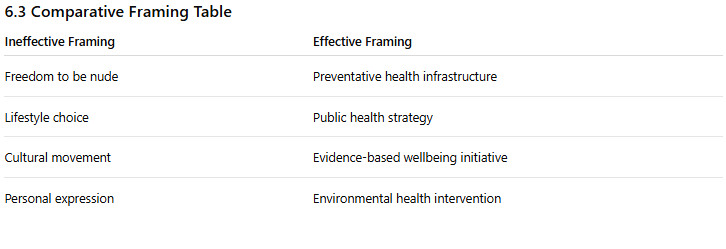
Naturist environments currently suffer from ineffective framing.
They are often presented as:
• lifestyle choices
• cultural movements
• individual freedoms
These framings do not align with government decision-making criteria.
6.1 Framing Misalignment
When naturism is presented as:
• a personal freedom issue
• a cultural or ideological position
• a niche community interest
it creates several challenges:
• increased political sensitivity
• reduced perceived policy relevance
• higher risk of public misunderstanding
This leads to immediate rejection or avoidance by policymakers.
6.2 Required Reframing
For successful adoption, naturist environments must be reframed as:
• public health infrastructure
• preventative health environments
• low-cost wellbeing systems
This shifts the discussion from ideology to utility.
6.4 Alignment with Government Language
Government policy operates within specific language frameworks.
Successful proposals align with terms such as:
• preventative health
• system efficiency
• wellbeing indicators
• infrastructure optimisation
• environmental engagement
Naturist integration must be expressed within this vocabulary.
6.5 Risk Reduction Through Framing
Effective framing reduces perceived risk by:
• clarifying purpose
• removing ambiguity
• aligning with established policy categories
When naturism is framed as infrastructure rather than ideology:
• political resistance decreases
• administrative pathways become clearer
• public understanding improves
6.6 Strategic Positioning Principle
The central principle is:
Naturism should not be positioned as something new.
It should be positioned as:
an extension of existing public health and environmental strategies.
6.7 Communication Hierarchy
All communication should follow a structured hierarchy:
Identify the public health problem
Highlight gaps in current approaches
Introduce naturist environments as a complementary solution
Emphasise low cost and scalability
Present structured implementation model
This sequence ensures clarity and reduces resistance.
7. Implementation Pathway
Even when incentives are clear and barriers are addressed, governments require a defined pathway for implementation.
Adoption does not occur instantly.
It progresses through structured phases.
7.1 Phase 1: Pilot Programs
Initial implementation should be limited in scope.
7.1.1 Pilot Characteristics
Pilot programs should include:
• small, clearly defined zones
• limited operating hours or days
• controlled access if required
7.1.2 Objectives of Pilot Phase
The pilot phase is designed to:
• test feasibility
• evaluate public response
• identify operational challenges
• generate data
7.1.3 Risk Containment
Pilots reduce perceived risk by:
• limiting scale
• allowing reversibility
• providing clear boundaries
This makes initial approval more likely.
7.2 Phase 2: Data Collection
Data collection is essential for validating the initiative.
7.2.1 Key Data Categories
Data should include:
• usage patterns
• demographic information
• health and wellbeing indicators
• incident reports
• public sentiment
7.2.2 Measurement Objectives
The objective is to demonstrate:
• safety
• demand
• positive outcomes
• minimal disruption
7.2.3 Evidence-Based Expansion
Without data, expansion is unlikely.
With data, the initiative becomes:
• defensible
• scalable
• policy-relevant
7.3 Phase 3: Policy Expansion
Once pilot data supports viability, expansion can begin.
7.3.1 Expansion Criteria
Expansion should be based on:
• positive usage trends
• low incident rates
• acceptable public response
7.3.2 Gradual Scaling
Scaling should remain controlled:
• additional zones
• expanded hours
• integration into more locations
This maintains stability while increasing impact.
7.4 Phase 4: Integration into Urban Planning Frameworks
At this stage, naturist environments become part of standard planning processes.
7.4.1 Planning Integration
Integration may include:
• inclusion in park design
• zoning within urban development plans
• alignment with recreation strategies
7.4.2 Institutional Normalisation
Naturist environments transition from:
• experimental initiatives
to
• recognised infrastructure
This reduces long-term resistance.
7.5 Phase 5: National Framework Development
The final stage involves standardisation.
7.5.1 Legislative Clarity
Governments may develop:
• clear legal definitions
• consistent regulatory frameworks
• national guidelines
7.5.2 Policy Integration
Naturist environments may be incorporated into:
• public health strategies
• environmental policies
• urban planning standards
7.5.3 System-Level Impact
At this stage, naturist integration contributes to:
• national wellbeing indicators
• long-term healthcare efficiency
• improved urban liveability
7.6 Implementation Summary
Successful implementation requires:
• phased approach
• data-driven decision-making
• controlled risk
• alignment with existing systems
Rapid or unstructured implementation increases the likelihood of failure.
8. Policy Implications
If implemented effectively, naturist zones have the potential to generate multi-layered impacts across public health, economic systems, urban planning, and social cohesion.
These implications extend beyond the immediate scope of recreational policy and influence broader governmental priorities.
8.1 Healthcare System Impact
Naturist environments, when integrated as part of a preventative health strategy, may contribute to:
• reduction in long-term healthcare expenditure
• decreased incidence of stress-related conditions
• improved baseline mental health indicators
• increased physical activity across populations
These effects are cumulative rather than immediate.
Over time, even marginal improvements in preventative health can result in significant system-level savings.
8.2 Mental Wellbeing Outcomes
The integration of naturist environments may support:
• reduction in anxiety linked to body image
• increased social acceptance and inclusion
• improved psychological relaxation
• enhanced connection to natural environments
These outcomes align with current priorities in mental health policy.
8.3 Urban Liveability
Urban environments are increasingly evaluated based on:
• accessibility
• diversity of use
• quality of public space
• community engagement
Naturist zones can contribute to:
• activation of underutilised areas
• diversification of recreational offerings
• improved distribution of park usage
This enhances the functional value of urban spaces.
8.4 Environmental Engagement
Naturist environments promote:
• direct interaction with natural ecosystems
• low-impact recreation
• increased awareness of environmental conditions
These factors support environmental policy objectives related to:
• sustainability
• conservation
• responsible land use
8.5 Economic Effects
Naturist zones may contribute to:
• tourism growth
• regional economic development
• increased local spending
These effects are particularly relevant for areas seeking:
• economic diversification
• sustainable tourism models
8.6 Social Cohesion
Naturist environments may support:
• inclusive participation
• reduced social comparison
• increased community interaction
These elements contribute to broader social cohesion indicators used in policy evaluation.
8.7 System-Level Efficiency
The most significant implication is system-level efficiency.
Naturist environments offer:
• low-cost implementation
• multi-dimensional benefits
• scalability within existing infrastructure
This combination is rare within public policy.
9. Limitations
Despite the potential benefits outlined, several limitations must be acknowledged.
9.1 Limited Longitudinal Data
There is a lack of large-scale, long-term studies specifically examining naturism as a structured public health intervention.
Existing evidence is often:
• interdisciplinary
• observational
• context-specific
This limits the ability to draw definitive causal conclusions.
9.2 Cultural Variability
Acceptance of naturism varies significantly across regions.
Factors influencing variability include:
• cultural norms
• legal frameworks
• historical context
This affects:
• feasibility
• public acceptance
• policy implementation
9.3 Dependence on Regulation
The success of naturist environments depends heavily on:
• clear governance
• enforcement of behavioural standards
• effective communication
Poor implementation may lead to:
• misunderstanding
• resistance
• reputational risk
9.4 Public Perception Challenges
Public perception remains a critical variable.
Misunderstanding of naturism may:
• increase perceived risk
• generate opposition
• influence political decision-making
Addressing perception requires structured communication strategies.
9.5 Implementation Variability
Outcomes may vary depending on:
• location
• design of the zones
• level of oversight
• stakeholder engagement
This variability must be considered in policy planning.
10. Conclusion
Government adoption of new policy initiatives is not driven by ideology.
It is driven by:
• measurable impact
• cost efficiency
• political defensibility
• operational feasibility
Naturist environments align with these criteria when properly structured.
They offer:
• low-cost implementation
• multi-dimensional health benefits
• compatibility with existing infrastructure
• scalability through phased deployment
However, their adoption is not currently limited by lack of value.
It is limited by:
• ineffective framing
• perceived political risk
• absence of structured policy models
The pathway forward is therefore not based on advocacy alone.
It requires strategic alignment with government priorities.
10.1 Core Conclusion
Naturist spaces will be adopted when they are:
• measurable in impact
• low in cost
• politically defensible
• operationally simple
10.2 Strategic Insight
The success of naturist integration depends on a single critical factor:
positioning
Naturism must be presented as:
• infrastructure
• a public health tool
• a system efficiency measure
not as:
• a lifestyle
• a cultural movement
• an ideological proposition
10.3 Final Policy Perspective
Governments do not require persuasion based on belief.
They require:
• incentives
• structure
• clarity
• evidence
When naturist environments are aligned with these requirements, they transition from:
• optional consideration
to
• strategic opportunity
References and Contextual Sources
Public Health and Policy
World Health Organization. (2021). Urban green spaces and health: A review of evidence.
OECD. (2021). A New Benchmark for Mental Health Systems.
Marmot, M. (2015). The Health Gap. Bloomsbury.
Environmental Psychology and Nature Exposure
Kaplan, R., & Kaplan, S. (1989). The Experience of Nature. Cambridge University Press.
Kaplan, S. (1995). The restorative benefits of nature. Journal of Environmental Psychology, 15(3), 169–182.
Ulrich, R. (1984). View through a window may influence recovery from surgery. Science, 224, 420–421.
Twohig-Bennett, C., & Jones, A. (2018). The health benefits of the great outdoors. Environmental Research, 166, 628–637.
Mental Health and Behaviour
Thaler, R., & Sunstein, C. (2008). Nudge. Yale University Press.
Sunstein, C. (2017). The Ethics of Influence. Cambridge University Press.
Body Image and Social Psychology
Cash, T. F., & Pruzinsky, T. (2002). Body Image Handbook. Guilford Press.
Fredrickson, B. L., & Roberts, T. (1997). Objectification theory.
Grabe, S., Ward, L., & Hyde, J. (2008). Body image and media.
Grogan, S. (2016). Body Image. Routledge.
Sociology and Cultural Perception
Cohen, S. (1972). Folk Devils and Moral Panics.
Douglas, M. (1966). Purity and Danger.
Urban Planning
Gehl, J. (2011). Life Between Buildings. Island Press.
UN-Habitat. (2020). Public Space and Urban Health.
Naturism and Cultural Context
Barthe-Deloizy, F. (2003). Géographie de la nudité.
Douglas, J. et al. (1977). The Nude Beach.
Institutional Frameworks
NaturismRE Health Institute. (2026). Public Health and Naturism Framework.
NaturismRE. (2026). Standardised Stigma Measure (SSM).