Clothing-Optional Environments: Coexistence, Autonomy, and Mutual Respect
Author: Vincent Marty
Founder, NaturismRE
Institution: NRE Health Institute
Date: March 2026
Abstract
Clothing-optional environments are frequently misunderstood as spaces requiring nudity, leading to social friction, exclusion, and misaligned expectations. This paper clarifies that such environments are defined by individual autonomy rather than conformity, allowing both clothed and unclothed participants to coexist within a structured framework of mutual respect.
It examines the behavioural, social, and governance dynamics that influence participation and perception, and proposes a coexistence model grounded in neutrality of dress state, non-interference, and consistent conduct. The objective is to support inclusive participation, reduce stigma, and strengthen the integration of non-sexual nudity within broader public and health-oriented contexts.
Executive Summary
Clothing-optional environments are frequently misinterpreted as spaces reserved exclusively for nudity. This misunderstanding generates social tension, exclusion, and behavioural inconsistency.
In practice, clothing-optional environments are defined by individual autonomy, where both clothed and unclothed participants coexist within a shared framework of mutual respect.
This paper establishes that:
Clothing-optional does not mean nude-only
Participation is based on personal choice, not conformity
Mutual respect between clothed and unclothed individuals is essential
Social friction arises primarily from misaligned expectations, not from nudity itself
A structured coexistence model is proposed to ensure these environments remain inclusive, stable, and aligned with public health and social integration objectives.
Keywords
Clothing-optional environments, bodily autonomy, coexistence, naturism governance, social norms, inclusion, stigma reduction, behavioural frameworks
1. Introduction
Clothing-optional environments represent a controlled social framework in which individuals are free to determine their level of bodily exposure without coercion or obligation.
This paper addresses internal social dynamics within clothing-optional environments and should be read alongside governance frameworks defining legal and spatial boundaries.
Ambiguity surrounding the term “clothing-optional” often results in:
Perceived pressure to undress
Misinterpretation as a nude-only space
Discomfort among first-time participants
Friction between differing expectations
These misunderstandings limit participation and undermine the broader objective of normalising non-sexual nudity within a structured and inclusive environment.
Core principle:
Clothing-optional environments are not defined by nudity, but by freedom of choice without social penalty.
2. Conceptual Clarification
2.1 Definition
A clothing-optional environment is a designated setting in which:
Individuals may be nude or clothed
No participant is required to undress
No participant should be encouraged or pressured to alter their state of dress
The defining characteristic is autonomy without judgement.
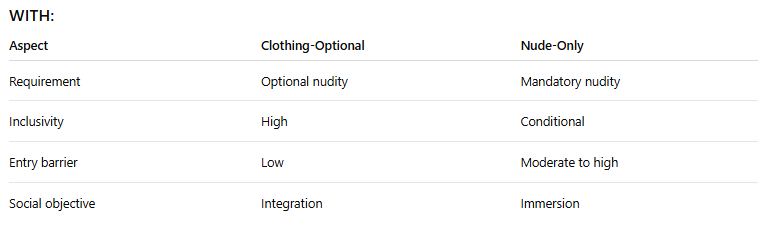
2.2 Distinction from Nude-Only Environments
Failure to clearly distinguish these models creates confusion, reduces accessibility, and increases reputational risk.
3. The Principle of Bodily Autonomy
Bodily autonomy is the foundational principle of clothing-optional environments.
This includes:
The right to be nude
The right to remain clothed
The right to change one’s level of exposure at any time
Any attempt to influence, pressure, or judge another individual’s choice constitutes a breach of this principle and undermines the integrity of the environment.
4. Sources of Social Friction
4.1 Pressure to Conform
New participants may experience direct or indirect pressure to undress through:
Social expectations
Normalisation framed as obligation
Perceived judgement
This behaviour reduces accessibility and discourages participation.
4.2 Reverse Judgement
Clothed participants may be:
Perceived as outsiders
Considered non-compliant
Subject to subtle exclusion
This creates division and contradicts the core principle of autonomy.
4.3 External Misinterpretation
Clothing-optional environments are often perceived externally as:
Exclusively nudist spaces
Sexually permissive environments
Socially marginal or deviant
These perceptions reinforce stigma and hinder policy acceptance.
5. Behavioural Framework for Coexistence
5.1 Core Principles
Neutrality of Dress State
Nudity and clothing must carry no social hierarchy.
Non-Interference
No individual should attempt to influence another’s choice.
Respectful Conduct
Behaviour must remain consistent regardless of dress state.
5.2 Operational Guidelines
No commentary on another person’s choice to be clothed or nude
No encouragement or pressure to undress
No exclusion based on dress state
Equal access to all shared facilities
6. Governance and Policy Implications
6.1 Explicit Communication
Operators should:
Clearly state that nudity is optional
Define behavioural expectations at entry points
Use visible signage reinforcing coexistence principles
Clarity reduces conflict and improves compliance.
6.2 Legal and Risk Considerations
Ambiguity in expectations can increase exposure to:
Harassment claims
Discrimination complaints
Misinterpretation of participant intent
Clear behavioural frameworks reduce liability and support regulatory acceptance.
Participants remain responsible for complying with applicable local laws and regulations.
6.3 Public Health Alignment
Clothing-optional environments:
Lower barriers to participation
Support gradual exposure to naturist practices
Increase inclusivity across demographics
These characteristics align with structured health and wellbeing models, including SHZ.
7. Social Integration Function
Clothing-optional environments serve as transitional spaces between:
Fully clothed public environments
Fully nude environments
They provide:
A low-threshold entry point
A non-coercive participation model
A platform for normalising body diversity
This makes them essential for long-term societal integration.
8. Limitations
Cultural norms influence acceptance levels
Some participants prefer fully nude environments
Effective coexistence requires active management and communication
9. Conclusion
Clothing-optional environments are not defined by nudity, but by autonomy and mutual respect.
Their effectiveness depends on maintaining a balance where:
Nudity is normalised but not imposed
Clothing is accepted but not stigmatised
Without this balance, these environments risk becoming exclusionary, undermining their role as inclusive and transitional spaces.
The successful integration of naturism into mainstream society depends in part on the correct implementation and communication of clothing-optional principles.
References (Indicative)
British Naturism. Code of Conduct and Participation Guidelines
World Health Organization. Mental Wellbeing Frameworks
Goffman, E. (1963). Stigma: Notes on the Management of Spoiled Identity
Freud, A. (1936). The Ego and the Mechanisms of Defence
Recent behavioural and social perception studies on body image and public norms