GLOBAL LEGAL RECOGNITION OF NATURISM AND PUBLIC NUDITY
International Legal Framework and Recognition Record
Prepared for NaturismRE
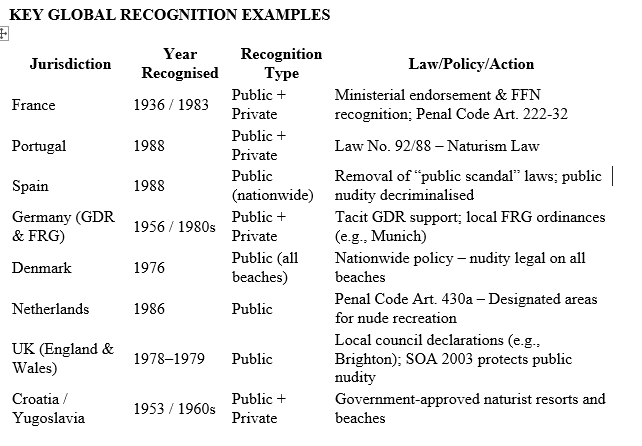
Naturism and non-sexual nudism are recognised in many countries across Europe, Oceania, North America, and South America. Public nudity, when non-sexual, is affirmed through national laws, court decisions, municipal rules, and tourism policies. This page is an authoritative resource that documents how naturism is legally accepted and practiced worldwide.
This evidence base strengthens NaturismRE’s advocacy, supports public education, and provides credibility for petitions, policy submissions, and government engagement.
PURPOSE OF THIS PAGE
This page explains where and how naturism is legally recognised. It provides:
Global examples of public nudity acceptance
Legal precedents and court decisions that protect naturists
Countries with official naturist beaches and naturist zones
Government policies that support naturist tourism
Historical milestones that established naturism worldwide
It is designed to help readers understand that naturism is legal, safe, respected, and widely accepted in modern societies.
1. PUBLIC NUDITY RECOGNITION BY COUNTRY
International examples where non-sexual public nudity is lawful or officially supported
Germany
Public nudity is legal when non-sexual. German states support extensive naturist beaches known as FKK areas. There are also official naturist hiking trails that have operated peacefully for more than ten years.
Spain
Public nudity is legal throughout Spain. Dozens of official nude beaches exist. Naturist tourism is supported by municipalities in regions such as Catalonia, Andalusia, and the Canary Islands.
France
France has official naturist parks, including the Paris Naturist Park. Many coastal regions designate naturist beaches. The French tourism sector actively promotes naturist destinations such as Cap d Agde Naturiste.
Portugal
Portugal formally recognises naturism under national law (Decreto-Lei 53/2010). The law authorises official naturist beaches and regulates clothing-optional areas.
Croatia
Croatia is one of the most active naturist tourism destinations in Europe. Government tourism bodies recognise naturist resorts and official naturist beaches.
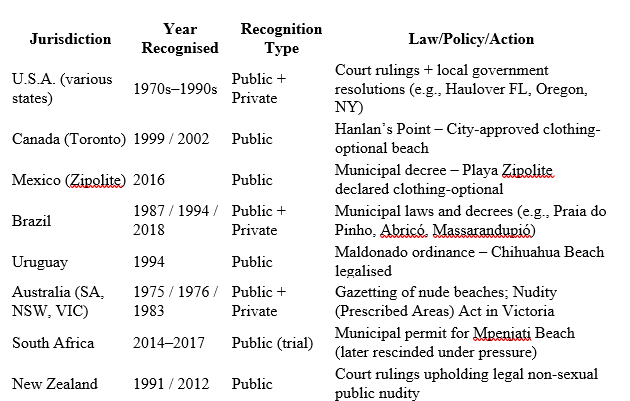
New Zealand
Non-sexual nudity is legal unless specifically offensive in context. Court decisions have repeatedly confirmed that simple nudity is not a crime. Naturist beaches are well established.
Canada
Canadian courts interpret nudity laws based on context. Non-sexual nudity is protected in many circumstances. Toronto and Vancouver both have official or legally protected naturist beaches.
Brazil
Brazil recognises official naturist territories through federal rulings. Praia do Pinho and several other beaches operate under legal naturist status.
United States
Recognition varies by state. Florida, California, and Oregon have significant naturist case law and recognised beaches. Haulover Beach is one of the most successful legally sanctioned naturist beaches in the world.
Scandinavia (Sweden, Denmark, Norway)
Non-sexual nudity is widely tolerated. Many naturist beaches operate with municipal support.
United Kingdom
Non-sexual nudity is not a criminal offence. National policing guidance instructs officers to treat simple nudity as lawful unless sexual or aggressive. Numerous naturist beaches and clubs operate with official recognition.
More countries can be added in the extended legal database if required.
2. PRIVATE NATURIST CLUBS AND LEGAL LICENSING
Many nations regulate and license naturist clubs as official recreational or tourism facilities. This includes:
France
Germany
the United Kingdom
Canada
Portugal
Brazil
Several US states
These clubs operate under zoning approvals, safety regulations, and recognised naturist associations. This reinforces naturism as a lawful and legitimate social practice.
3. GOVERNMENT LAWS, POLICIES, AND ADMINISTRATIVE ACTIONS
Examples of formal legal instruments that recognise naturism:
Portugal Decreto-Lei 53/2010 authorises naturist beaches and creates a national naturist framework.
Brazil federal rulings recognise designated naturist territories.
France municipal councils approve naturist parks and beaches.
Germany municipalities designate FKK zones and trails.
United States counties approve official clothing-optional beaches.
United Kingdom Home Office guidance confirms non-sexual nudity is lawful.
These examples demonstrate that naturism is compatible with public administration, safety, and community wellbeing.
4. HISTORICAL DEVELOPMENT OF LEGAL NATURISM
A simplified timeline showing naturism’s long-established presence:
Late 1800s: Naturist philosophy begins in Germany.
Early 1900s: Naturist clubs appear in France, Germany, and the United Kingdom.
Mid 20th century: Growth of naturist resorts and private clubs.
1960s to 1990s: Courts in Canada, New Zealand, and the United States protect non-sexual nudity.
2000s: Rapid expansion of official naturist beaches in Europe.
2010s: Urban naturism gains recognition in Paris and other major cities.
2020s: Continued growth of naturist parks and government-approved naturist tourism.
This timeline confirms that naturism has deep historical roots and strong social legitimacy.
SUMMARY
Naturism is a legally recognised and respected practice in many countries. The global evidence proves:
Non-sexual nudity can coexist with public order and public safety.
Where naturism is recognised, there is no rise in crime or antisocial behaviour.
Naturist tourism delivers economic and wellness benefits.
Governments, courts, and tourism bodies already support naturism around the world.
NaturismRE affirms that naturism is lawful, legitimate, and a natural part of modern democratic societies.

NaturismRE is built by a small, dedicated team spending countless hours researching, writing, and advocating for evidence-based health, dignity, and resilience.
If you would like to support that work, you can buy us a cup of coffee.