

System Convergence, Long-Term Trajectories, and Strategic Equilibrium
Examining how naturist systems evolve through convergence of technological, spatial, legal, economic, social, and ethical drivers toward long-term strategic equilibrium.
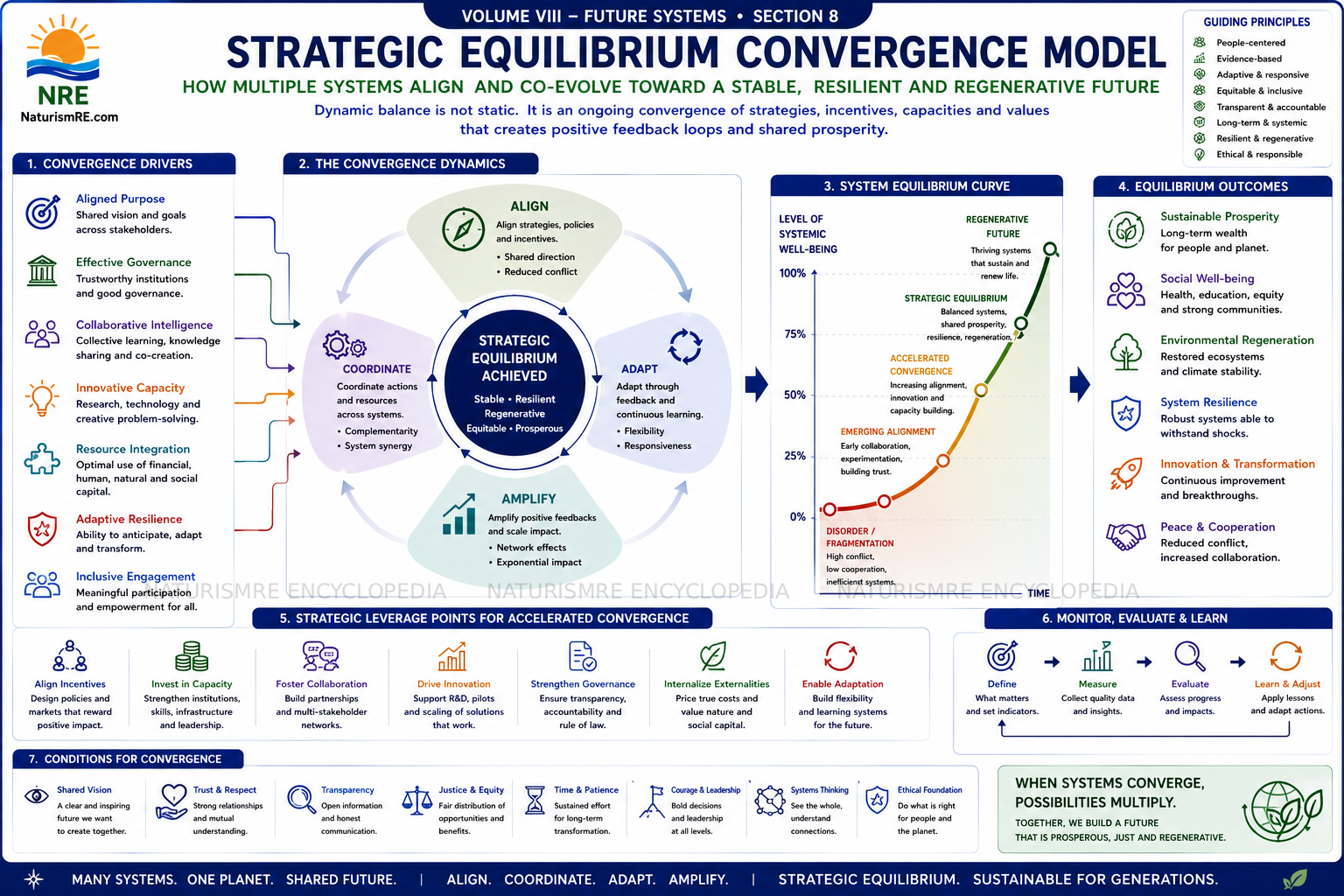
The long-term evolution of naturist systems depends on their ability to achieve and maintain strategic equilibrium across converging drivers, ensuring that innovation, adaptation, and integration occur within stable, resilient, and context-aligned frameworks capable of sustaining operation in complex and changing environments.
8.1 Convergence of Evolutionary Drivers
Across Volume VIII, naturist systems have been examined through forward-oriented dimensions including technological integration, urban adaptation, policy evolution, economic sustainability, social normalisation, and ethical frameworks.
These drivers do not evolve independently. They converge into a single adaptive system in which technology shapes communication and coordination, urban environments define spatial constraints, policy frameworks determine operational boundaries, economic models influence scalability, social perception affects acceptance thresholds, and ethical principles define legitimacy.
The future of naturist systems is therefore determined by the interaction and alignment of these drivers rather than by any single factor.
8.2 From Expansion to Strategic Equilibrium
Early phases of development often prioritise growth, visibility, and expansion of environments.
Long-term viability requires a transition toward strategic equilibrium defined by balance between accessibility and control, alignment between scale and governance capacity, and consistency between perception and operational reality.
Unbalanced expansion leads to increased variability, heightened risk exposure, and potential regulatory or social resistance.
Excessive restriction limits participation, reduces system relevance, and constrains long-term integration.
Sustainable systems maintain equilibrium by operating within defined limits, adapting to external conditions, and prioritising stability over rapid growth.
8.3 Long-Term Trajectory Scenarios
Future development can be understood through multiple trajectory scenarios.
Integrated System Scenario
Naturist environments become incorporated into planning, health, and recreational systems through stable governance and predictable acceptance.
Fragmented Development Scenario
Uneven implementation and inconsistent standards produce variable integration across regions and jurisdictions.
Contained System Scenario
Activity remains restricted to private or highly controlled environments with limited scalability.
Regressive Scenario
Increased restriction emerges following negative perception shifts, incidents, or regulatory contraction.
These scenarios may occur simultaneously across different jurisdictions.
8.4 Determinants of Future Outcomes
System trajectory depends on several key determinants.
These include consistency of operational performance, effectiveness of governance and compliance systems, alignment with legal and regulatory frameworks, ability to manage social perception and stakeholder expectations, and adaptation to technological and environmental change.
Alignment across these determinants supports stable integration and long-term sustainability.
Misalignment increases the likelihood of instability, resistance, and contraction.
8.5 System Resilience and Adaptive Capacity
Resilience is a defining feature of successful systems.
Resilient naturist systems absorb minor disruptions, adapt to changes in regulation or perception, and maintain core operational principles under varying conditions.
Adaptive capacity includes flexibility in governance frameworks, responsiveness to monitoring and feedback, and the ability to adjust spatial and operational design.
Resilience ensures continued functionality, interpretability, and alignment with evolving conditions.
8.6 Strategic Constraints and Boundary Conditions
All systems operate within structural constraints.
These include legal limits, social tolerance thresholds, environmental capacity, and economic viability.
Future systems must recognise that expansion has limits, not all contexts are suitable, and equilibrium must be maintained.
Boundary conditions define the parameters within which systems can operate sustainably.
8.7 Integration Without System Dilution
A central challenge is achieving integration into broader systems without loss of core identity.
Risks include dilution of behavioural standards, excessive regulation reducing flexibility, and misalignment with foundational principles.
Effective integration maintains behavioural integrity, contextual clarity, and alignment with core operational frameworks.
This ensures that naturist systems remain coherent, recognisable, and functionally stable.
8.8 Analytical Conclusion
The future of naturist systems is defined by convergence and equilibrium across multiple interacting variables.
Long-term trajectories are shaped by technological, spatial, legal, economic, social, and ethical drivers. Sustainable systems transition from expansion to equilibrium. Multiple scenarios may coexist across jurisdictions. Resilience and adaptive capacity are essential. Structural constraints define operational limits. Integration must occur without loss of coherence.
Naturist systems that endure are those that maintain alignment across operational dimensions, adapt to evolving conditions, and operate within defined limits while supporting gradual integration.
This establishes the overarching principle of Volume VIII:
The long-term evolution of naturist systems depends on their ability to achieve and maintain strategic equilibrium across converging drivers, ensuring that innovation, adaptation, and integration occur within stable, resilient, and context-aligned frameworks capable of sustaining operation in complex and changing environments.
Primary Supporting Articles
The Convergence Question, Can Naturism Ever Become a Unified System
The Global Integration Problem, Why Naturism Remains Fragmented Across Countries
Why Systems That Rely on Interpretation Cannot Stabilise at Scale
Why Systems Without Defined Continuity Mechanisms Cannot Sustain Growth