

Public Health Framing, Population-Level Effects, and Preventive Health Alignment
Examining how structured naturist environments may interact with preventive health systems through behavioural, environmental, and population-level pathways.
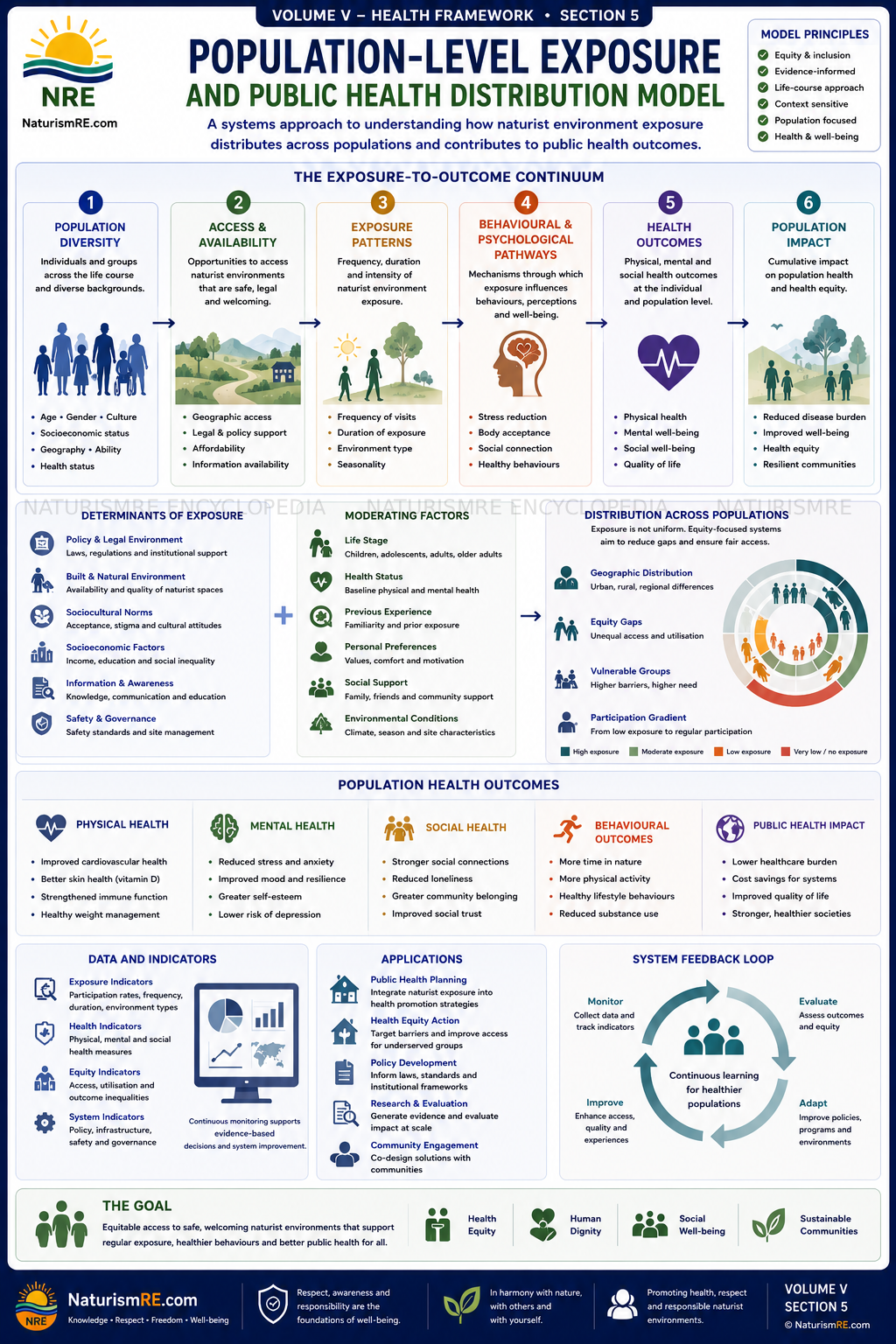
The public health relevance of naturist environments depends not on ideological positioning, but on their capacity to operate as structured, low-risk, and behaviourally consistent settings that may support specific preventive health pathways within defined populations and contexts.
5.1 Positioning Naturist Contexts Within Public Health Frameworks
Public health systems operate at the population level, focusing on prevention rather than treatment, behavioural patterns rather than isolated actions, and environmental conditions that influence health.
Within this framework, naturist environments are not assessed as individual lifestyle choices, but as contextual settings that may influence population-level variables.
For inclusion within public health discourse, such environments must demonstrate alignment with defined objectives, present observable or measurable effects, maintain manageable risk profiles, and remain compatible with broader health strategies.
This requires a shift in interpretation from cultural expression toward recognition as a contextual modifier within health systems.
5.2 Behavioural Pathways Relevant to Public Health
Public health outcomes are influenced by behavioural determinants, including physical activity, time spent outdoors, social interaction, stress regulation, and lifestyle patterns.
Structured naturist environments may intersect with these pathways by facilitating outdoor exposure, supporting non-competitive forms of activity, reducing appearance-driven social pressure in some contexts, and encouraging engagement with natural environments.
These interactions do not ensure specific outcomes, but they may contribute to conditions associated with positive health behaviours, depending on context and participation patterns.
5.3 Preventive Health and Environmental Design
Preventive health strategies increasingly recognise the role of environmental design in shaping behaviour.
Walkable and Recreational Spaces
Public health systems increasingly integrate accessible outdoor environments into preventive health strategies.
Context-Defined Behavioural Settings
Structured naturist environments may function as specialised recreational contexts with clearly defined operational conditions.
Low-Infrastructure Engagement
Certain naturist participation models may operate with relatively limited infrastructure requirements.
Behavioural Diversity Pathways
Naturist settings may contribute to broader diversity in recreational and environmental participation patterns.
Their relevance to preventive health lies in enabling alternative forms of outdoor engagement, supporting behavioural diversity within populations, and offering participation models that may operate outside purely commercial frameworks.
However, inclusion within preventive health systems depends on demonstrable safety, consistency of behavioural standards, and alignment with established public health priorities.
5.4 Population Variability and Inclusion Considerations
Public health systems must address diverse populations with varying levels of comfort, cultural background, and personal preference.
Naturist environments do not inherently accommodate all groups equally. Participation is influenced by cultural norms, individual comfort with body exposure, perceived safety, and accessibility.
From a public health perspective, participation must remain voluntary, environments must not assume universal acceptance, and alternative pathways for engagement must remain available.
This ensures that naturist systems function as optional components within a broader health ecosystem rather than as prescriptive models.
5.5 Risk Considerations in Public Health Context
Public health evaluation requires balanced consideration of risk alongside potential benefit.
Relevant risks include environmental exposure, behavioural variability, perception-related discomfort, and the potential for social friction arising from misinterpretation.
These risks must be identified, mitigated through structured design, and monitored where appropriate.
Public health frameworks require evidence that risks are understood, proportionate, and controlled within acceptable limits.
Structured naturist environments can meet these conditions when governance systems are clearly defined, environmental parameters are appropriate, and participation remains informed and voluntary.
5.6 Measurement Challenges and Data Limitations
A significant constraint in evaluating naturist environments within public health frameworks is the limited availability of consistent and comparable data.
Challenges include variability in participation patterns, absence of standardised measurement tools across jurisdictions, and difficulty isolating variables within complex social environments.
As a result, causal relationships are difficult to establish, observational findings may remain context-specific, and generalisation across populations is limited.
This necessitates a cautious approach in which conclusions remain proportionate to available evidence, emphasis is placed on observed patterns rather than definitive claims, and further research is recognised as necessary.
5.7 Integration Within Broader Health Systems
Integration of naturist environments into public health systems requires compatibility with existing frameworks.
Such integration is more likely where naturist environments are recognised as niche or optional recreational settings, incorporated within broader outdoor activity initiatives, and aligned with wellbeing-focused community programs.
Effective integration depends on clear operational definitions, adherence to regulatory and safety standards, and the ability to coexist with other health interventions.
Naturist systems are therefore positioned as complementary elements within broader health strategies rather than as central components.
5.8 Analytical Conclusion
Structured naturist environments can be analysed within public health frameworks as environmental settings that influence behavioural and social variables.
Their relevance lies in their interaction with pathways associated with preventive health. Outcomes remain context-dependent and are not universally applicable. Inclusion must account for population variability and voluntary participation. Risks must be identified, managed, and proportionate. Data limitations require cautious interpretation and avoidance of overgeneralisation. Integration is most viable as a complementary rather than primary component.
Naturism, in this context, is not positioned as a health intervention. It is a potential environmental contributor within a broader system of health determinants.
This establishes a defining principle for Volume V:
The public health relevance of naturist environments depends not on ideological positioning, but on their capacity to operate as structured, low-risk, and behaviourally consistent settings that may support specific preventive health pathways within defined populations and contexts.
Primary Supporting Articles
Participation Patterns and Selection Effects in Exposure-Based Public Health Systems
Risk Distribution, Exposure Inequality, and Threshold Conditions in Population-Level Systems
Health as Contextual Interaction, The Biopsychosocial Basis of Naturist Environments