

Conceptual Framework: Interpretative Systems and Meaning Construction
Establishing the conceptual architecture through which nudity, nudism, and naturism are interpreted across legal, social, cultural, and health systems.
Nudity is not a category. It is a variable within an interpretative system.
4.1 Purpose
This section establishes the core conceptual framework through which nudity, nudism, and naturism are interpreted across the entire encyclopedia.
Its purpose is to define how meaning is constructed around the unclothed human body, to explain why identical physical conditions may produce different interpretations, and to provide a structured analytical model applicable across legal, social, cultural, and health domains.
This framework is foundational. All subsequent analysis depends on its consistent application.
4.2 Nudity as a Non-Intrinsic Condition
Nudity, as established in Section 1, is a physical state and is inherently neutral. However, it is rarely interpreted as such.
Meaning is not derived from the body itself. It is assigned through interpretative systems, social conditioning, and contextual frameworks. The same physical condition may be understood as neutral, functional, symbolic, controversial, or inappropriate depending on the system within which it is encountered.
This establishes a foundational principle:
Nudity does not contain meaning. Meaning is assigned to it.
4.3 Structured Interpretation vs Assumption
In the absence of a structured framework, interpretation defaults to assumption. The most common forms of assumption include automatic sexualisation, moral classification, and binary judgement.
These assumptions result in misclassification, inconsistent interpretation, and distortion across both social and legal domains. They do not arise from the condition itself, but from the absence of controlled interpretative structure.
The purpose of this framework is therefore to replace assumption with structured, multi-variable interpretation.
4.4 Core Interpretative Dimensions
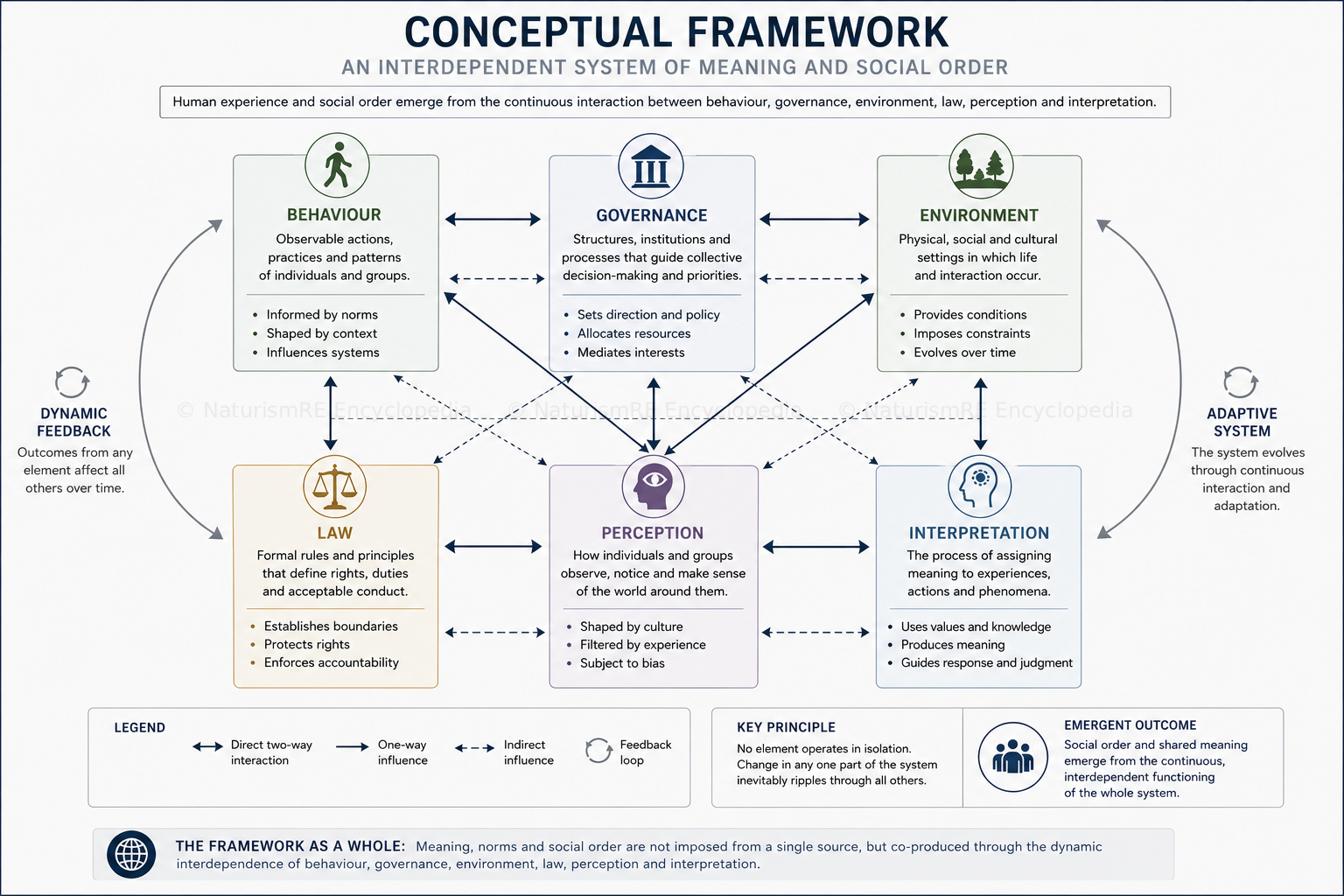
Meaning is constructed through the interaction of six variables: context, intent, behaviour, consent, governance, and perception.
Context
Defines the environment in which exposure occurs, including location, cultural setting, legal framework, and situational norms.
Intent
Defines the purpose of exposure and distinguishes between non-sexual presence, provocative intent, and harmful intent.
Behaviour
Defines the actions accompanying exposure and differentiates passive presence from escalating conduct.
Consent
Defines whether exposure is accepted or imposed within a voluntary or involuntary environment.
Governance
Defines the presence of rules, enforcement mechanisms, and boundary control capable of stabilising interpretation.
Perception
Defines how exposure is interpreted by observers through cultural conditioning, media influence, and prior exposure.
These dimensions do not operate independently. They interact to produce interpretation.
4.5 Interaction Model of Meaning Construction
These variables operate in combination rather than isolation. Interpretation is produced through their interaction.
Identical physical conditions may lead to different outcomes depending on context. Within a medical environment, exposure may be interpreted as functional. Within a naturist setting, it may be interpreted as regulated and non-sexual. Within an uncontrolled public environment, it may be interpreted as ambiguous or disruptive.
This demonstrates that meaning is produced through interaction between variables, not through the condition itself.
4.6 The Misclassification Mechanism
Misclassification occurs when one dimension dominates interpretation while others are disregarded. The most common case arises when perception overrides context and intent.
This leads to the sexualisation of non-sexual contexts, the collapse of distinct categories, and inconsistency in policy and legal interpretation.
This outcome is not incidental. It is a predictable result of unstructured interpretation.
4.7 Alignment with Legal Systems
Modern legal systems implicitly operate through this framework. They do not regulate nudity as an isolated condition. Instead, they assess intent, behaviour, context, and impact.
This confirms that the conceptual model is not theoretical. It reflects the structure of actual legal reasoning. Where interpretation is structured, outcomes become more consistent. Where it is not, variability persists.
4.8 Cultural and Media Mediation
Cultural systems influence perception through media representation, dominant narratives, and patterns of exposure. In many societies, nudity is primarily encountered through sexualised media, while alternative contexts remain limited in visibility.
This produces a narrowing of interpretative pathways in which nudity is disproportionately associated with sexual meaning. As a result, perception becomes both dominant and potentially unreliable.
This imbalance reinforces the persistence of misclassification.
4.9 Naturism as a Stabilised Interpretative System
Naturism represents a controlled application of this framework. It stabilises the interpretative variables within defined conditions.
Context is defined through designated environments. Intent is explicitly non-sexual. Behaviour is regulated. Consent is voluntary. Governance is enforced. Perception stabilises progressively through repeated exposure within controlled conditions.
This is not incidental. Naturism functions as a system designed to stabilise interpretation.
4.10 Structured vs Unstructured Interpretation
The framework clarifies the difference between structured and unstructured environments.
In structured environments, ambiguity is reduced, interpretation stabilises, and outcomes become predictable. Behaviour is encountered within defined conditions that support consistent understanding.
In unstructured environments, ambiguity remains high, interpretation varies, and the likelihood of misinterpretation or conflict increases. Each instance must be interpreted independently.
This establishes a governing principle:
Structure determines interpretative stability.
4.11 Analytical Implications
This framework provides a unified model applicable across all domains of analysis. It supports consistent classification and reduces vulnerability to misinterpretation.
It ensures that legal analysis remains grounded in behaviour and context, that social analysis explains variability in perception, that health analysis distinguishes between variables, and that policy analysis operates within structured conditions.
Without this framework, analysis becomes inconsistent. With it, conclusions remain coherent and defensible.
4.12 Conclusion
Nudity does not possess inherent meaning. It acquires meaning through structured interpretation, the interaction of variables, and contextual framing.
This establishes a defining principle:
Nudity is not a category. It is a variable within an interpretative system.
Understanding this system allows for consistent classification, accurate analysis, and defensible conclusions across domains. Without it, interpretation defaults to assumption and misclassification becomes inevitable.
With it, nudity can be analysed as a structured, context-dependent phenomenon operating within identifiable and predictable systems.
Primary Supporting Articles
Context as the Primary Determinant of Meaning in Naturist Systems
Interpretative Boundaries, How Meaning Is Stabilised in Naturist Systems
Why Context Fragmentation Prevents Consistent Interpretation
Why Defining the Environment Matters More Than Regulating the Behaviour