

Risk, Liability, and Reputational Dynamics in Structured Naturist Systems
Examining how structured naturist systems manage behavioural, legal, reputational, and media-related risks within complex contemporary environments.
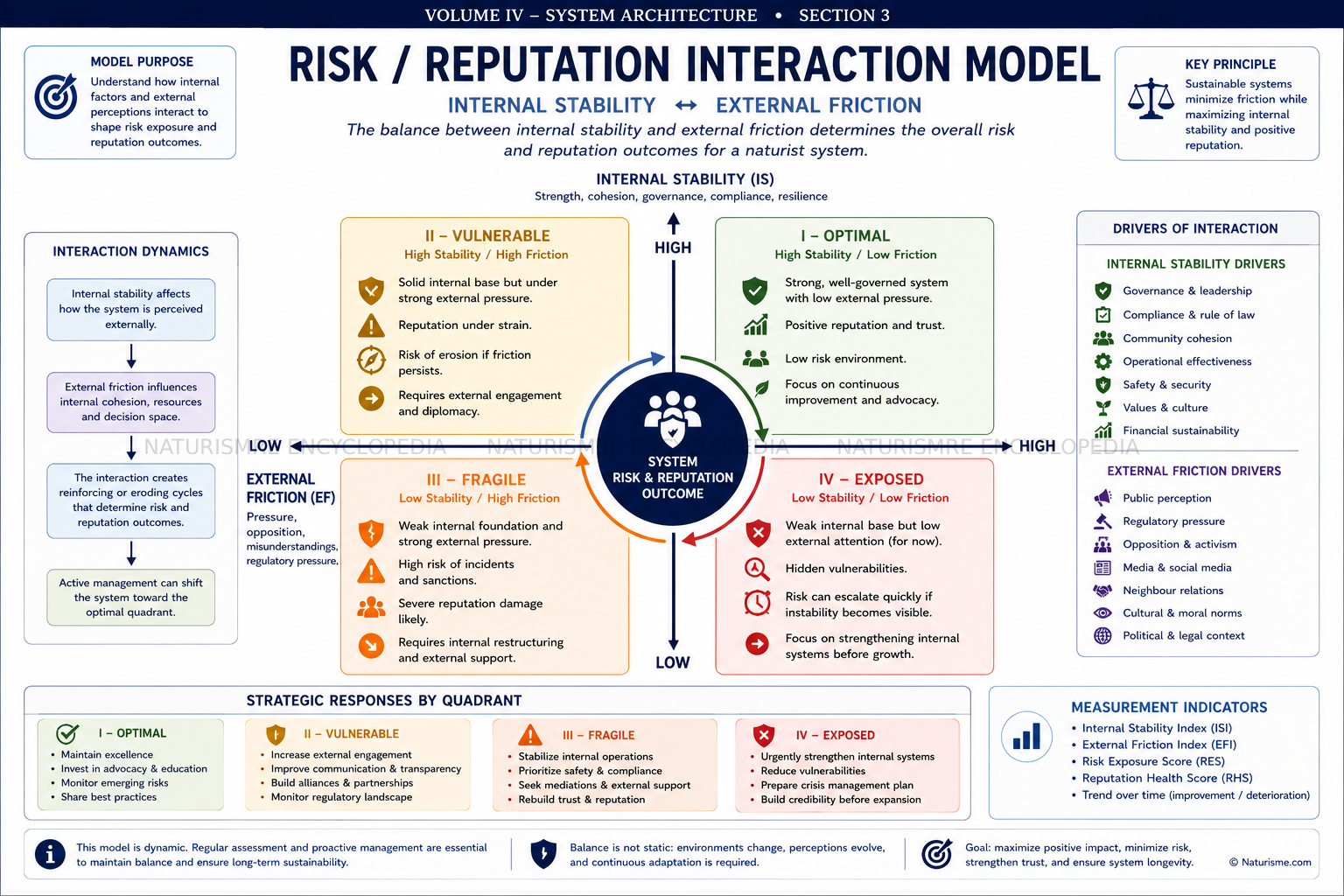
The sustainability of structured naturist systems depends not on the absence of risk, but on the capacity to contain, interpret, and manage risk within clearly defined operational frameworks.
3.1 The Centrality of Risk in System Expansion
As naturism transitions from informal practice to structured, context-defined systems, risk becomes a central governing variable rather than a peripheral concern.
In traditional environments, risk exposure is limited by geographic isolation, controlled membership, and low visibility. In structured or semi-public environments, these buffers are reduced or removed.
As a result, naturist systems must operate within a multi-dimensional risk landscape that includes legal liability, public safety concerns, reputational exposure, media amplification, and misinterpretation of intent.
The viability of system expansion is therefore directly linked to the ability to identify, assess, and manage these risks in a consistent and demonstrable manner.
Risk is not an argument against expansion. It is the condition that defines how expansion must occur.
3.2 Categories of Risk in Naturist Environments
Risk in structured naturist systems can be understood across four interrelated domains.
Behavioural Risk
Arises from deviation from non-sexual behavioural expectations, ambiguity of participant conduct, or actions perceived as inappropriate.
Legal and Regulatory Risk
Emerges through inconsistent interpretation of public decency laws, jurisdictional variability, and unclear contextual definition.
Reputational Risk
Develops when isolated incidents influence broader perception of naturist systems beyond the original environment.
Media and Amplification Risk
Results from selective reporting, decontextualised imagery, and rapid digital dissemination of localised events.
These categories do not operate independently. A behavioural incident may trigger legal scrutiny, which generates media exposure and results in reputational impact across the system.
3.3 The Disproportionate Impact of Isolated Incidents
A defining characteristic of naturist systems is the asymmetry of impact.
In many social environments, isolated incidents are absorbed without systemic consequence. In naturism, the same conditions often produce disproportionate effects.
This asymmetry is influenced by pre-existing societal sensitivity to nudity, limited public familiarity with structured naturist environments, media dynamics that favour controversy, and the absence of widely established counter-narratives.
As a result, a single incident may influence policy decisions, localised events may affect unrelated environments, and perception may shift independently of actual system performance.
System design must therefore operate on the assumption that incident amplification is probable rather than exceptional.
3.4 Liability Structures and Responsibility Allocation
Structured naturist environments must define liability with precision.
Key considerations include the allocation of responsibility for participant behaviour, the existence and scope of duty of care, the processes for documenting and addressing incidents, and the extent of organisational or individual accountability.
Liability structures differ depending on the governance model.
Institutional environments involve defined operators, formal duty of care obligations, and structured compliance requirements. Framework-based or decentralised environments operate with reduced central authority, greater reliance on participant responsibility, and potential ambiguity in accountability.
Effective systems mitigate exposure by establishing clear participant expectations, documented behavioural standards, defined intervention protocols, and demonstrable evidence of proactive risk management.
These measures do not eliminate liability. They establish that reasonable and structured controls are in place.
3.5 Reputational Contagion Across the Ecosystem
Reputation within naturist systems operates beyond the level of individual environments.
Naturist activity is often perceived as part of a single conceptual category, resulting in cross-environment impact. Incidents in one location may influence perception elsewhere, and negative events may affect broader acceptance, policy development, and advocacy efforts.
This creates a condition of reputational contagion in which negative events propagate rapidly, while positive developments may have limited reach.
Structured systems must therefore prioritise consistency of standards, responsiveness to incidents, and clarity of communication.
Reputation is not managed solely through successful operation. It is defined by the system’s response to failure or deviation.
3.6 Media Dynamics and Narrative Formation
Media interaction plays a critical role in shaping external understanding of naturist systems.
Media environments tend to favour conflict-driven narratives, simplify complex contexts, and provide limited differentiation between structured and unstructured environments.
As a result, contextual nuance may be lost, behavioural intent may be misrepresented, and visual content may override explanatory frameworks.
Structured systems must anticipate these dynamics by minimising conditions that allow misinterpretation, ensuring behavioural and environmental coherence, and maintaining the capacity to respond to external narratives where necessary.
Media cannot be controlled. However, exposure to adverse narratives can be reduced through system design.
3.7 Risk Mitigation Through Structural Design
Effective risk management is achieved through proactive structural design rather than reactive intervention.
Environmental Clarity
Clearly defined spaces and operational purpose reduce ambiguity and stabilise interpretation.
Behavioural Governance
Explicit standards and observable compliance reduce behavioural drift and reputational exposure.
Participant Conditioning
Pre-entry communication and awareness processes align participants with environmental expectations.
Operational Visibility
Supervisory presence and demonstrable oversight reinforce legitimacy and intervention capability.
Scenario Planning
Prepared response protocols and communication strategies reduce escalation risk during incidents.
System Containment
Structural controls transform risk from unpredictable exposure into a bounded operational variable.
These measures transform risk from an unpredictable condition into a managed and bounded system variable.
3.8 Analytical Conclusion
Risk, liability, and reputation are not secondary considerations in the evolution of naturist systems. They are structural determinants of viability.
The expansion of naturism into structured environments requires recognition of multi-layered risk exposure, acceptance of asymmetrical impact from isolated incidents, development of clear accountability frameworks, and proactive management of reputational dynamics.
The long-term viability of naturist systems depends on their ability to operate predictably under scrutiny, withstand incident amplification, and maintain credibility across diverse stakeholders.
In this context, risk management is not defensive. It is a foundational capability that enables expansion while preserving legitimacy.
This establishes a critical principle for Volume IV:
The sustainability of structured naturist systems depends not on the absence of risk, but on the capacity to contain, interpret, and manage risk within clearly defined operational frameworks.
Primary Supporting Articles
Perception, Media, and the Amplification of Risk
Liability as a Structural Constraint, Why Risk Allocation Will Shape the Future of Naturist Systems