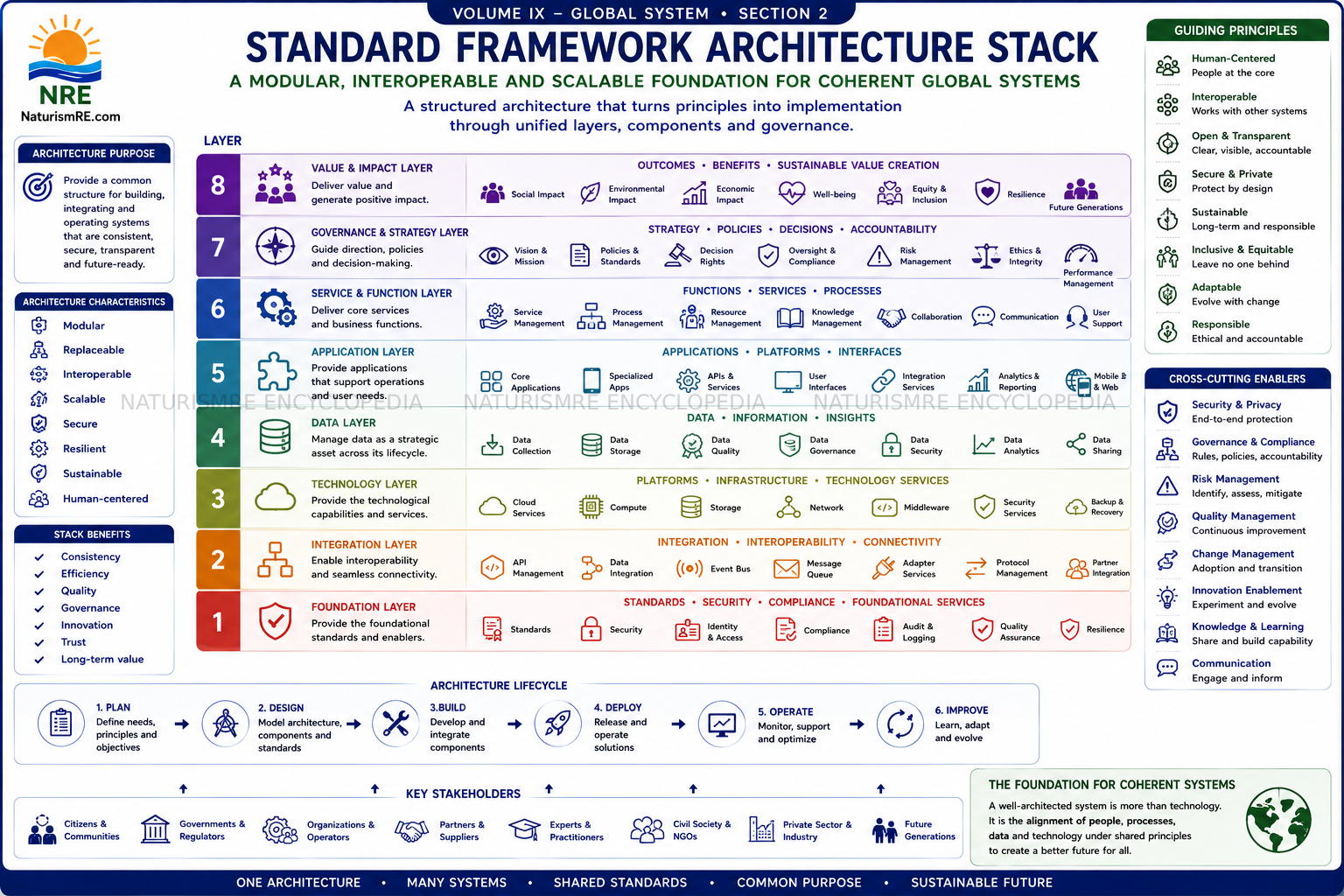
Standard Framework Architecture, Core Protocols, and Interoperability Models
Examining how standardised yet modular framework architectures enable interoperability, scalable implementation, and global coherence across naturist systems.
The development of a coherent global naturist system depends on the ability to define and implement standardised yet modular framework architectures that ensure interoperability, verifiability, and continuous adaptation across diverse environments and jurisdictions.
2.1 From Conceptual Alignment to Structured Architecture
System coherence requires more than alignment of principles. It requires a formalised architecture that translates those principles into repeatable structures, interoperable components, and verifiable operational conditions.
A standard framework architecture provides a common reference model for implementation, enables comparison across environments, and supports consistency at scale.
This architecture does not replace local systems. It enables them to operate within a shared structural logic.
2.2 Core Components of the Standard Framework
A coherent global framework is built on five foundational components.
Context Definition Protocol
Specifies spatial boundaries, purpose, and operational conditions aligned with local legal and environmental parameters.
Behavioural Integrity Protocol
Defines conduct expectations and mechanisms that maintain consistency and reduce ambiguity.
Risk Management Protocol
Identifies foreseeable risks and integrates proportional mitigation strategies into operational systems.
Governance and Oversight Protocol
Defines roles, responsibilities, monitoring systems, intervention pathways, and continuity mechanisms.
Communication and Interpretation Protocol
Establishes structured messaging aligned with operational reality for participants and external stakeholders.
These components function as interdependent layers within a unified operational system.
2.3 Protocol Standardisation and Minimum Viable Conditions
Standardisation does not require uniform implementation. It requires definition of minimum viable conditions for acceptable operation.
These conditions include clearly defined boundaries, observable behavioural consistency, identifiable governance mechanisms, documented risk awareness and mitigation, and consistent communication of purpose and expectations.
Environments that meet these conditions can be evaluated consistently, compared across contexts, and integrated into broader systems.
Minimum viable conditions establish a baseline for legitimacy rather than a fixed operational model.
2.4 Interoperability Across Systems and Jurisdictions
Interoperability refers to the ability of different environments to operate under a shared framework, exchange knowledge, and maintain consistent interpretation across contexts.
This is achieved through common definitions, alignment of core protocols, and compatibility of data and evaluation systems.
Interoperability enables scalability across jurisdictions, reduces duplication of effort, and increases system coherence.
It does not eliminate local variation. It ensures that variation occurs within a consistent structural framework.
2.5 Modular Design and Adaptive Implementation
A standard framework must support modular design, allowing adaptation to local legal, social, and environmental conditions while preserving system integrity.
Modules may include environmental configuration templates, behavioural governance structures, risk assessment tools, and communication frameworks.
Modularity enables flexible implementation, rapid deployment across contexts, and continuous refinement without disrupting the underlying system structure.
2.6 Verification, Certification, and System Integrity
To maintain coherence, systems require mechanisms for verification to ensure that defined protocols are implemented, operational conditions meet minimum standards, and environments remain aligned over time.
Verification may include self-assessment, external review where appropriate, and periodic reassessment.
Certification, where applied, can signal compliance with framework standards, enhance stakeholder confidence, and support institutional recognition.
Verification processes must remain proportionate, adaptable, and aligned with system scale and complexity.
2.7 Data Integration and System Feedback
Interoperable frameworks enable integration of data across environments.
This supports aggregation of performance indicators, identification of patterns, and continuous system improvement.
Data integration requires standardised measurement criteria, consistent reporting formats, and alignment with privacy and ethical considerations.
Integrated systems transform individual environments into components of a broader learning network rather than isolated units.
2.8 Analytical Conclusion
Standard framework architecture provides the structural basis for global coherence and scalable implementation.
Formalised architecture translates principles into operational systems. Core protocols define context, behaviour, risk, governance, and communication. Minimum viable conditions establish baseline legitimacy. Interoperability enables coordination across jurisdictions. Modular design supports adaptation without fragmentation. Verification maintains integrity. Data integration supports continuous improvement.
Naturist systems that adopt structured frameworks can transition from isolated implementations to interconnected, scalable, and institutionally recognisable systems.
This establishes a defining principle for Volume IX:
The development of a coherent global naturist system depends on the ability to define and implement standardised yet modular framework architectures that ensure interoperability, verifiability, and continuous adaptation across diverse environments and jurisdictions.