

Stakeholder Mapping, Engagement Protocols, and Alignment Strategies
Examining how structured naturist systems engage diverse stakeholder groups through risk-aware communication, contextual positioning, and operational alignment strategies.
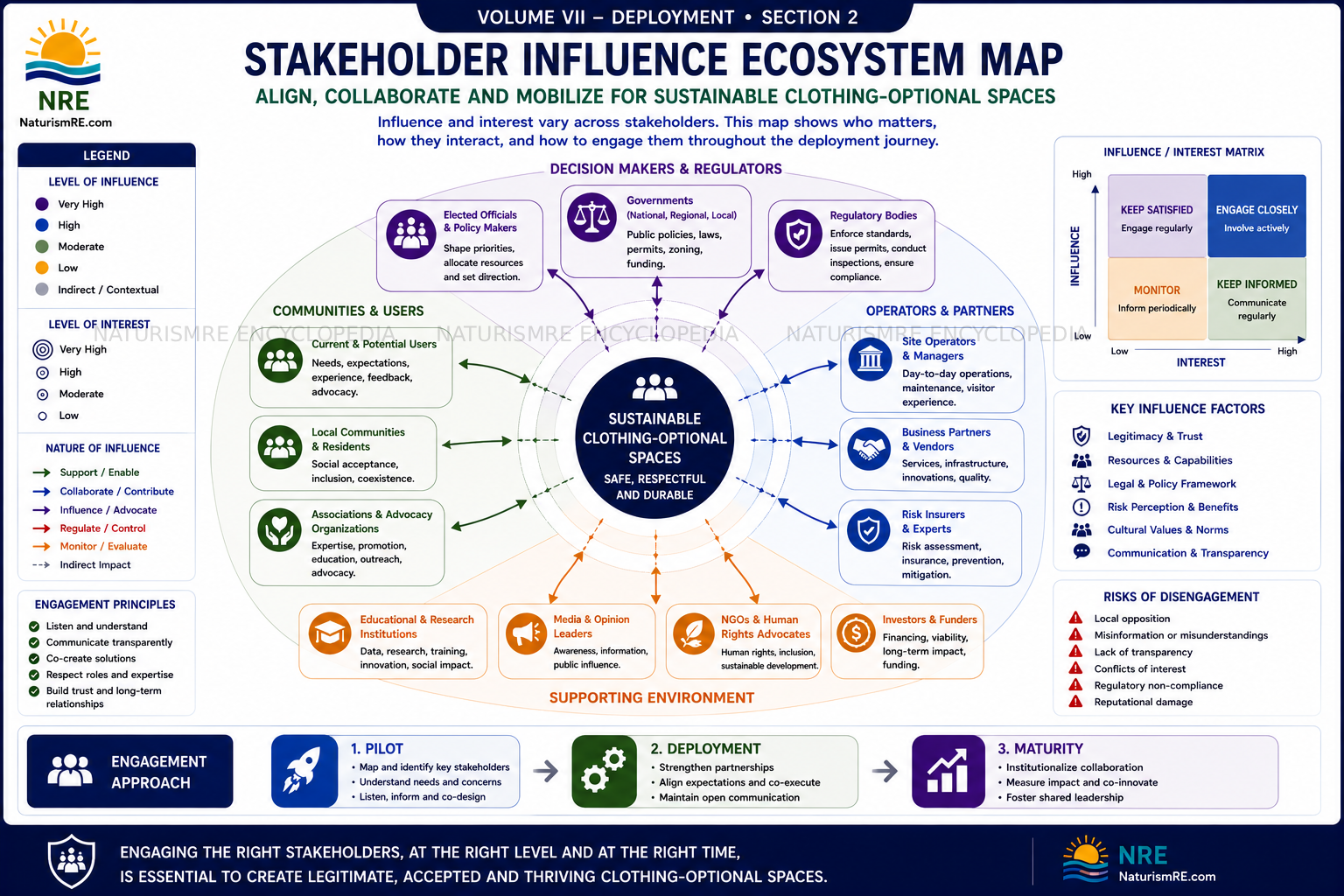
The implementation of naturist systems depends on the ability to identify, engage, and align diverse stakeholder groups through structured communication, risk-aware positioning, and consistent operational behaviour, ensuring that external perception evolves alongside system deployment.
2.1 The Multi-Stakeholder Nature of Deployment
Naturist system deployment does not occur in isolation. It operates within a multi-stakeholder environment in which outcomes depend on perception, tolerance, authority, and influence.
Key stakeholder groups include local authorities and regulators, landowners or land managers, adjacent users of shared spaces, participants and prospective participants, and community groups or advocacy actors.
Each group operates with distinct objectives, different risk thresholds, and varying levels of influence over outcomes.
Implementation success therefore depends on alignment across stakeholder interests rather than unilateral action.
2.2 Stakeholder Typology and Influence Levels
Stakeholders can be categorised based on their influence and level of engagement.
Decision-Making Stakeholders
Regulatory authorities and landowners determine approval conditions, restrictions, and operational legitimacy.
Impacted Stakeholders
Local communities and adjacent users influence perception and may generate support or opposition.
Participatory Stakeholders
Participants and organisers influence behavioural outcomes and operational stability.
Observational Stakeholders
The broader public contributes to reputational context and indirect perception dynamics.
Understanding these categories enables targeted engagement strategies rather than uniform communication approaches.
2.3 Stakeholder Perception and Risk Sensitivity
Stakeholders assess naturist environments through perception frameworks that are often centred on risk.
Common concerns include the potential for inappropriate behaviour, impact on shared space usage, reputational implications, and enforceability of behavioural standards.
These concerns are frequently influenced by prior assumptions, media narratives, and lack of familiarity with structured environments rather than direct experience.
Effective engagement must therefore address perceived risk and uncertainty, not only objective conditions.
Reducing perceived risk is essential for achieving acceptance, avoiding resistance, and enabling controlled implementation.
2.4 Engagement Protocols and Communication Strategy
Stakeholder engagement requires structured, consistent, and context-sensitive communication.
Clarity of purpose is essential. Environments must be defined as structured and context-specific, with no ambiguity regarding intent.
Alignment with recognised objectives, such as recreation, wellbeing, or managed use of space, supports institutional understanding.
Communication must be proportionate, providing sufficient information without unnecessary complexity, and tailored to stakeholder relevance.
Consistency between communication and operational reality is critical. Stated conditions must align with observable behaviour.
Engagement protocols should avoid over-promising, abstract or ideological framing, and assumptions of acceptance.
2.5 Managing Opposition and Resistance
Resistance may arise from perceived intrusion into shared spaces, discomfort with unfamiliar practices, or concern about precedent and expansion.
Effective management focuses on maintaining clear spatial and behavioural boundaries, demonstrating controlled conditions, and avoiding confrontational positioning.
Where opposition persists, the objective shifts from persuasion to containment. Environments must remain within defined limits, and interaction with opposing stakeholders should be minimised to reduce escalation.
This approach lowers the likelihood of complaints and regulatory intervention.
2.6 Building Incremental Trust
Trust develops through consistent performance over time rather than through initial engagement alone.
Key factors include absence of incidents, predictable behaviour, and alignment between expectations and observed conditions.
Trust operates at multiple levels, including participant confidence in the environment, stakeholder confidence in system stability, and institutional confidence in governance mechanisms.
Incremental trust enables reduced resistance, increased tolerance, and potential expansion or formal recognition.
2.7 Alignment with Institutional Stakeholders
Engagement with institutional stakeholders requires translation of naturist systems into policy-compatible frameworks.
This includes demonstrating risk management, behavioural governance, and operational predictability.
Environments should be presented as controlled, low-risk, and consistent with existing regulatory and planning frameworks.
This reduces perceptions of uncontrolled expansion, regulatory complexity, and reputational exposure.
2.8 Analytical Conclusion
Stakeholder engagement is a determining factor in successful system deployment.
Deployment occurs within a multi-stakeholder environment requiring alignment across differing interests and influence levels. Stakeholders vary in perception and risk sensitivity, and engagement must address perceived risk and uncertainty. Structured communication supports clarity and consistency, while resistance is managed through boundary control and containment.
Trust is established incrementally through consistent system performance, and institutional alignment depends on policy-compatible positioning.
Naturist systems that succeed in deployment are those that actively manage external perception and stakeholder interaction in parallel with internal system coherence.
This establishes a defining principle for Volume VII:
The implementation of naturist systems depends on the ability to identify, engage, and align diverse stakeholder groups through structured communication, risk-aware positioning, and consistent operational behaviour, ensuring that external perception evolves alongside system deployment.
Primary Supporting Articles
The Authority Gap, Who Actually Speaks for Naturism
Perception, Media, and the Amplification of Risk
Visibility Management and Its Role in Perception Stability
From Policy Avoidance to Policy Design, The Case for Structured Clothing-Optional Zones
Secondary Supporting Articles
The Normalisation Threshold, When Acceptance Actually Shifts
Why Boundary Definition Determines Whether Systems Stabilise or Collapse
Why Policy Without Structure Produces Control Instead of Clarity
From Risk to Regulation, The Structural Logic Behind Controlled Clothing-Optional Environments