Naturism and Exhibitionism
A Clinical, Sociological and Legal Analysis of a Persistent Misinterpretation
NRE Health Institute
Date: 4 March 2026
Version: 1.0 (institutional edition)
Institutional working paper
This whitepaper is published for research and policy discussion. It does not provide clinical diagnosis, medical advice, legal advice, or law enforcement guidance. Readers should consult appropriately qualified professionals for case-specific advice.
This paper addresses a persistent public misinterpretation that conflates naturism with exhibitionism. It uses clinical, sociological, and legal definitions to evaluate whether the conflation is supportable.
Table of contents
Note: If publishing as a web page, convert the headings below into a linked table of contents. If publishing as a PDF, generate an automatic table of contents in Word before export.
· Abstract
· Keywords
· 1. Introduction
· 2. Definitions and conceptual framework
· 3. Methodology
· 4. Clinical literature on exhibitionism
· 5. Naturism as a consent-based social practice
· 6. Legal distinctions across selected jurisdictions
· 7. Empirical evidence, measurement limits, and data gaps
· 8. Media framing, stigma, and cultural cognition
· 9. Synthesis and discussion
· 10. Policy implications and recommendations
· 11. Evidence limitations and future research
· 12. Conclusion
· References
· Appendices
Abstract
Public discussions sometimes claim that exhibitionism is inherently part of naturism because both involve nudity. This paper evaluates that claim using disciplined definitions from clinical psychology, sociology, and law. Clinically and legally, exhibitionism (and related exposure offending) is defined by sexualised intent directed at non-consenting or unsuspecting targets, with victim impact central to the harm mechanism. Mainstream naturism, by contrast, is defined and governed as consensual, non-sexual social nudity with explicit respect norms and codes of conduct. Across the clinical, organisational, and legal evidence reviewed, the purported equivalence fails. The remaining association is a category error driven by cultural sexualisation of nudity and media framing, not by professional definitions or legal tests. The paper concludes with practical policy recommendations for safeguarding, incident reporting, venue governance, and public communication.
Keywords
naturism; social nudity; exhibitionism; indecent exposure; consent; stigma; media framing; safeguarding; public policy
1. Introduction
Naturism and organised nude recreation are routinely characterised by participants as non-sexual, consent-based social practices. Despite this, a persistent external narrative asserts that naturism is inherently exhibitionistic, or that naturist participation reflects an underlying desire to display the nude body for sexual gratification.
This narrative appears periodically in media coverage, public commentary, and local regulatory debates and can influence policing discretion, venue licensing, and public acceptance. It can also create a safeguarding risk by confusing genuine sexual exposure offending with lawful, consent-based contexts.
This whitepaper evaluates the claim that exhibitionism is 'part of' naturism. To be institutionally defensible, the evaluation must begin with definitional discipline. In professional use, 'exhibitionism' is not a casual synonym for 'being seen'. It is a clinical and criminological construct defined by sexualised intent, non-consent (or the presence of an unsuspecting target), and victim impact. [3] [5]
The paper proceeds by (i) defining key constructs in clinical, sociological, and legal terms; (ii) reviewing the governance and norms of mainstream naturist organisations; (iii) analysing legal doctrines in selected jurisdictions that distinguish consensual nudity from criminal exposure; and (iv) assessing what can and cannot be concluded from available empirical crime statistics, given underreporting and limited venue coding in official datasets. [3] [34]
The conclusion is not that misconduct never occurs in naturist settings. The conclusion is narrower: the defining elements of clinical exhibitionism and exposure offending are structurally incompatible with mainstream naturism as defined and governed by major naturist organisations. [2] [16] [17]
2. Definitions and conceptual framework
The central mistake in public debate is treating nudity as the defining variable. Nudity is visually salient, but it is not the operative variable in clinical diagnosis or criminal law. The operative variables are intent, consent, and harm (including alarm or distress).
For clarity, this paper distinguishes three common meanings of 'exhibitionism':
1) Clinical exhibitionism: diagnostic constructs such as exhibitionistic disorder, which refer to a pattern of sexual arousal linked to exposing genitals to unsuspecting persons, with enactment and/or clinically significant distress or impairment. [3] [11]
2) Criminological exposure offending: non-contact sexual offending patterns in which genital exposure is used to impose a sexualised experience on another person, commonly associated with fear, alarm, distress, intimidation, or coercive power dynamics. [3] [5]
3) Colloquial exhibitionism: a non-technical label for being seen or seeking attention, which can be value-neutral and non-sexual.
Most controversy arises from slippage between (3) and (1) or (2). The analysis therefore treats (1) and (2) as the relevant professional constructs.
2.1 Naturism as a technical construct
Naturism is treated here as a governance-defined social practice. Mainstream organisational definitions frame naturism as a way of life in harmony with nature, characterised by communal nudity with the intention of encouraging self-respect, respect for others, and respect for the environment. [2]
British Naturism explicitly states that naturism is not about sex and positions naturist participation as ordinary leisure activity with a different dress code. [16]
AANR likewise rejects associations that frame nude recreation as sexual exploitation. [17]
These definitions are not merely symbolic. They are operational: they shape venue rules, expected behaviour, and enforcement responses.
2.2 Comparative construct test
The table below summarises the critical distinctions used in this paper.
3. Methodology
This paper is a structured evidence synthesis rather than a primary empirical study. It prioritises sources suitable for institutional publication: statutory texts, official crime statistics, policing evidence reviews, and primary organisational definitions from major naturist bodies. [2] [3] [16] [17] [5] [31] [32] [33]
3.1 Scope: The clinical section focuses on exposure as a non-contact sexual harm and the definitional boundaries that separate consensual behaviour from offending. [3] [11]
3.2 Jurisdictions: The legal section uses selected common-law examples as illustrative cases because intent, consent, and harm features are explicit in offence drafting in these systems. [1] [5] [23] [29] [30]
3.3 Evidence grading: Strongest weight is given to primary sources (statutes, official agency publications, and major organisational definitions). Secondary academic discussion is used to interpret and contextualise these sources. [1] [35] [36]
3.4 Limits: Official datasets rarely code naturist venues as location categories. This constrains any direct claim about comparative incident rates. The paper therefore separates definitional disproof from empirical venue-level claims. [3] [34]
3.5 Replicability checklist
To support institutional transparency, a replicability checklist is provided:
- Definitions used: see Section 2.
- Primary organisational sources: INF, British Naturism, AANR. [2] [16] [17]
- Primary legal sources: selected statutes and government pages for designated areas. [5] [23] [24] [29] [30]
- Core crime and underreporting context sources: policing evidence review and official statistical releases. [3] [31] [32] [33] [34]
4. Clinical and diagnostic literature on exhibitionism
Clinical classification systems distinguish between atypical sexual interests and diagnosable disorders. The critical boundary is clinically significant distress or impairment and/or harm to others. This boundary is designed to prevent moral disagreement from being treated as pathology. [11]
Within this framework, exhibitionistic disorder is defined by recurrent sexual arousal from exposing genitals to unsuspecting persons, accompanied by enactment or clinically significant distress or impairment. The presence of an unsuspecting, non-consenting target is not incidental. It is central to the harm mechanism. [3]
Exposure offending is treated in policing and forensic literature as a non-contact sexual harm with substantial victim impact and significant underreporting. [3]
4.1 Diagnostic boundary: nudity is not the variable
A common public error is to treat nudity as the clinically relevant stimulus. In diagnostic and forensic frameworks, nudity is not sufficient. The clinically relevant pattern includes sexual arousal linked to exposing genitals and the involvement of non-consenting or unsuspecting targets. [3]
Therefore, even where a person is nude in public, the clinical question is not 'is the person nude?' but 'is the person using exposure as a sexual act imposed on another person?'
This distinction matters for public policy: collapsing these categories can increase stigma and reduce the clarity of safeguarding and enforcement responses.
4.2 Victim impact and underreporting
Underreporting is a key empirical feature of exposure offending. A major policing evidence review notes that survey-based prevalence can substantially exceed recorded totals, which implies that many incidents are never recorded by police. [3]
This has two implications: (i) offence statistics underestimate incidence, and (ii) research based on detected offenders may over-represent persistent or higher-risk individuals relative to the broader population of undetected offenders. [3]
As a result, it is methodologically unsound to generalise from offender datasets to lawful leisure communities without a sampling frame and denominators.
4.3 Clinical implications for the naturism conflation claim
If exhibitionism is defined clinically, the naturism conflation claim fails on three required elements:
First, intent: naturism is not defined by sexual arousal from exposure. Major naturist organisations explicitly reject the sexual framing and emphasise respect and non-sexual participation. [2] [16] [17]
Second, target: clinical exhibitionism requires an unsuspecting or non-consenting target. Naturist contexts are consent-based by design: participants enter knowingly and designated zones are publicly documented. [24] [41]
Third, harm: clinical and forensic concepts focus on victim impact (alarm, distress, intimidation). Naturist governance seeks to suppress sexualised conduct and boundary violations. [16] [17] [18]
5. Naturism as a consent-based social practice
Mainstream organisational definitions operationalise what the practice is and is not. The International Naturist Federation definition adopted in 1974 frames naturism as communal nudity intended to encourage self-respect, respect for others and respect for the environment. [2]
British Naturism states that naturism is not about sex and emphasises reduced staring and judgement norms. [16]
AANR rejects attempts to associate nude recreation with sexual exploitation. [17]
5.1 Consent architecture and gatekeeping
Consent architecture refers to the environmental signals, governance rules, and social norms that make participation meaningfully consent-based:
- Designation and signalling: official documentation and boundary descriptions for clothing-optional areas support informed participation. [24] [41]
- Norms and etiquette: social expectations discourage staring, judgement, and sexualised behaviour; participants commonly report a desexualised environment. [16] [18]
- Exclusion mechanisms: venues remove individuals who violate standards. [16] [17]
These features directly contradict the defining mechanism of exhibitionism, which relies on unsuspecting targets and imposed exposure.
5.2 Desexualisation mechanisms in practice
Institutional analysis benefits from specifying mechanisms rather than relying on assertions. Common desexualisation mechanisms reported in naturist environments include:
- Context shift: nudity becomes the baseline rather than a signal, reducing novelty.
- Normative regulation: behavioural standards reduce sexualised display and boundary testing.
- Social mirroring: when the group treats nudity as ordinary, sexualised performance is socially discouraged.
- Practical rules: photography rules, respectful distance norms, and consent expectations reduce sexualisation opportunities.
These mechanisms do not require denying sexuality as a human phenomenon. They demonstrate that the practice context suppresses sexualised performance rather than facilitating it.
6. Legal distinctions across selected jurisdictions
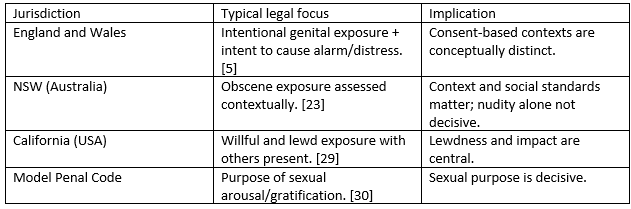
Legal systems generally do not criminalise nudity per se. They criminalise nudity-plus: nudity combined with a further mental element, such as lewd intent, or intent to cause alarm, distress, offence, or annoyance. [5] [29] [30]
This structure aligns with the clinical distinction. It separates consensual social nudity from exposure used as a sexualised act against another person.
6.1 Australia (illustrative focus: New South Wales)
Australian public nudity regulation is fragmented and often enforced through evaluative concepts rather than blanket prohibition. A legal analysis of the Australian beach context notes divergence between law in books and law in action, with discretion and social standards playing a significant role. [1]
In NSW, 'obscene exposure' uses language that invites contextual assessment, implying more than mere nudity. [23]
NSW also recognises designated nude bathing areas and nude beaches in official documentation. [24]
6.2 United Kingdom (England and Wales)
Exposure under the Sexual Offences Act 2003 requires intentional genital exposure with intent that someone will see and be caused alarm or distress. [5]
A parliamentary submission by British Naturism argues that naturism is not prohibited and that Parliament intended to avoid criminalising naturism. [27]
Policing guidance and stakeholder engagement aim to reduce discretionary misclassification of lawful nudity as sexual offending absent intent elements. [28]
6.3 United States (illustrative focus: California and Model Penal Code)
Many US indecent exposure statutes incorporate lewdness or sexual-gratification components. California's statute criminalises willful and lewd exposure where others are present to be offended or annoyed. [29]
The Model Penal Code ties indecent exposure to a purpose of arousing or gratifying sexual desire. [30]
6.4 Legal synthesis
Across these examples, the legal structure is consistent: exposure offences are oriented toward sexualised intent plus non-consent or victim impact. Designated or well-signalled clothing-optional contexts do not inherently satisfy these offence elements. [5] [1] [24]
6.5 Summary table of offence elements (illustrative)
6.6 Operational implications for designated areas
Where clothing-optional areas exist, clear boundary definition, signage, and public documentation reduce misunderstandings and support informed consent. Official pages describing designated nude areas provide an example of administrative signalling. [24] [41]
Policy changes to designated areas (including closures) should be communicated as land governance decisions rather than as evidence of criminality or pathology. [25]
7. Empirical evidence, measurement limits, and data gaps
Sexual exposure is a material harm in the general population, and underreporting is substantial. Survey prevalence can exceed recorded crime totals by large multiples. [3]
Official statistics also caution that recorded sexual offence totals can move due to recording changes and new offence categories. [31]
In Australia, recorded crime reporting shows high and rising sexual assault victimisation, providing broader context for sexual harms. [32]
ABS sexual harassment reporting indicates a meaningful prevalence of indecent exposure experiences within the reference period, underscoring that exposure harms exist at scale. [33]
7.1 Why available data cannot directly establish naturist venue rates
Official datasets typically do not code 'naturist venue' as a location category. This prevents straightforward comparisons.
An ONS freedom of information response illustrates limited published breakdowns for exposure and related offences. [34]
Therefore, claims about naturist venue rates should be treated as unproven unless supported by a purpose-built design.
7.2 Evidence-informed inference that is defensible
While venue-level rates cannot be inferred from routine datasets, one defensible inference is conceptual: because exposure offending is defined by non-consent and victim impact, environments that are consent-based and governed by behavioural standards remove the core offender mechanism. [3] [5]
This is an inference about construct compatibility, not a quantitative claim about rates.
7.3 Proposed measurement framework
A practical measurement framework can be implemented by venues and organisations immediately, even before FOI-based analysis:
- Standardise incident categories and definitions (Appendix B).
- Capture denominators (attendance estimates) by day and event.
- Record response actions and outcomes.
- Publish anonymised annual summaries to demonstrate governance maturity.
This converts a contested narrative into measurable safeguarding practice.
7.4 FOI and data acquisition template
For jurisdictions where FOI is available, targeted requests can ask for incident records coded to site names or coordinates for defined periods. [34]
Requests should be specific, narrow in timeframe, and mindful of privacy limitations.
8. Media framing, stigma, and cultural cognition
Misinterpretation is not solely a definitional error; it is also a cultural and media pattern. Historical analysis of Australian reporting describes sensationalist framing that sustained a deviance narrative even when governments authorised designated clothing-optional spaces. [35] [1]
Contemporary stigma research similarly notes that naturism is often framed negatively and that stigma is shaped by representation. A psychometric study developing a Naturism Stigma Scale distinguishes naturism from sexual stimulation intent while motivating measurement partly by negative media representations. [36]
These sources support a practical inference: when nudity is culturally coded as sexual, observers may project sexual intent onto contexts governed as non-sexual.
8.1 Mechanisms of misinterpretation
- Salience bias: nudity is visually salient and over-weighted in causal attribution.
- Sexualisation default: many audiences encounter nudity mainly via sexualised media, creating a default assumption of sexual intent.
- Availability bias: rare sensational incidents are generalised to the whole practice.
- Moral contamination: taboo triggers negative inference beyond evidence.
8.2 Media content analysis protocol (for institutional follow-up)
If NRE Health Institute wishes to strengthen the evidence base, a replicable media analysis can be conducted:
1) Define outlets and time window.
2) Sample articles using transparent keywords.
3) Code themes: sexualisation, deviance framing, safeguarding framing, legal framing, neutral leisure framing.
4) Use two coders and report agreement rates.
5) Publish aggregate results and exemplar quotations within fair use limits.
This approach moves discussion from anecdote to documented pattern.
9. Synthesis and discussion
When constructs are defined properly, naturism and exhibitionism do not meaningfully overlap. The overlap is superficial and does not survive tests against intent, consent, and harm.
The strongest institutional conclusion is therefore a category error: the conflation treats 'being nude' as equivalent to 'imposing sexualised exposure on a non-consenting target'. Clinical and legal constructs do not permit this equivalence. [3] [5] [29] [30]
The correct posture is dual: reject the category error decisively, and advance a transparent safeguarding and measurement agenda.
9.1 Common claims and evidence-based responses
Claim: 'If you are nude in public, you are exposing yourself.' Response: Exposure offences typically require additional elements such as lewd intent or intent to cause alarm/distress/offence. [5] [29] [30]
Claim: 'People who like being seen nude must be sexual.' Response: This is a projection based on sexualisation defaults. Organisational definitions frame naturism as non-sexual and governed by respect norms. [2] [16] [17]
Claim: 'Misconduct proves naturism is exhibitionism.' Response: Misconduct, where it occurs, is a violation of naturist norms, not a constitutive feature of the practice. [16] [17]
10. Policy implications and recommendations
The practical objective is risk-managed governance that withstands scrutiny from regulators, law enforcement, and the public.
Recommendations are framed to be implementable and defensible.
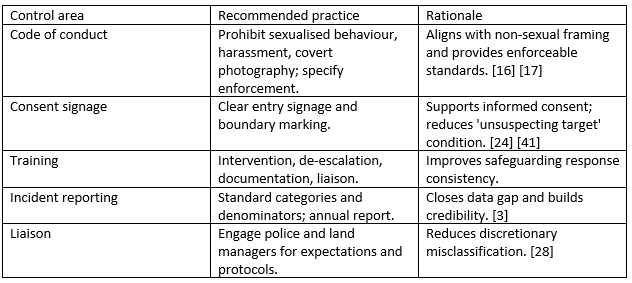
10.1 Governance and safeguarding controls
Recommended baseline controls are summarised below.
10.2 Implementation roadmap
A staged roadmap enables rapid uplift without large cost:
Phase 1 (0-30 days): refresh code of conduct, signage language, and incident template; appoint safeguarding lead.
Phase 2 (1-3 months): staff training; incident log rollout; liaison meeting with local authorities.
Phase 3 (3-12 months): publish safeguarding summary; design FOI measurement project; pilot comparator analysis.
Phase 4 (annual): review and iterate standards based on evidence.
10.3 Implications for health policy
From a public health governance perspective, classification accuracy matters. Misclassifying consensual recreation as sexual offending inflates stigma and reduces the clarity of safeguarding responses.
Health and wellbeing discussions involving body image and stigma benefit from separating moral disagreement from clinical categories. [11] [36]
11. Evidence limitations and future research
Limitations:
1) Venue-coded crime statistics are limited; naturist venues are not routinely isolated. [34]
2) Sexual exposure is underreported, biasing detected offender samples. [3]
3) Jurisdictional doctrine varies and can change; this paper provides illustrative examples and a template for expansion. [1]
Future research priorities include venue-level incident measurement, evaluation of safeguarding interventions, systematic media analysis, and cross-jurisdiction legal mapping.
12. Conclusion
On the best available clinical, organisational, and legal evidence, exhibitionism is not part of naturism. The conflation fails because the defining elements of exhibitionism and exposure offending - sexualised intent directed at non-consenting or unsuspecting targets, with victim impact - are actively excluded by mainstream naturist governance. [2] [16] [17] [5]
What remains is a superficial visual association that does not survive professional definitions or legal tests. The appropriate institutional response is to reject the category error and demonstrate safeguarding maturity through transparent standards and measurement.
References
[1] https://blr.scholasticahq.com/article/10864-clothing-optional-nudity-and-the-law-of-the-australian-beach.pdf. Accessed 4 March 2026
[2] https://inf-fni.org/fifty-years-of-the-definition-of-naturism/. Accessed 4 March 2026
[3] https://assets.college.police.uk/s3fs-public/2024-08/Evidence-review-sexual-exposure-contact-sexual-offending.pdf. Accessed 4 March 2026
[4] https://www.legislation.gov.uk/ukpga/2003/42/section/66. Accessed 4 March 2026
[5] https://www.who.int/publications/i/item/9789240077263. Accessed 4 March 2026
[6] https://pmc.ncbi.nlm.nih.gov/articles/PMC4743592/. Accessed 4 March 2026
[7] https://pubmed.ncbi.nlm.nih.gov/2021375/. Accessed 4 March 2026
[8] https://bn.org.uk/aboutnaturism/. Accessed 4 March 2026
[9] https://aanr.com/about-aanr. Accessed 4 March 2026
[10] https://pubmed.ncbi.nlm.nih.gov/18926761/. Accessed 4 March 2026
[11] https://legislation.nsw.gov.au/view/whole/html/inforce/current/act-1988-025. Accessed 4 March 2026
[12] https://www.nsw.gov.au/visiting-and-exploring-nsw/locations-and-attractions/lady-bay-beach. Accessed 4 March 2026
[13] https://www.environment.nsw.gov.au/news/clothing-optional-area-to-close-at--tyagarah-nature-reserve. Accessed 4 March 2026
[14] https://publications.parliament.uk/pa/cm200708/cmselect/cmcumeds/353/353we08.htm. Accessed 4 March 2026
[15] https://www.bn.org.uk/news/information/about-bn/college-of-policing-guidance-on-public-nudity-%E2%80%93-the-2024-update-r1601/. Accessed 4 March 2026
[16] https://leginfo.legislature.ca.gov/faces/codes_displaySection.xhtml?lawCode=PEN§ionNum=314. Accessed 4 March 2026
[17] https://www.law.upenn.edu/faculty/paul-robinson/clrgcodes/MPC.html. Accessed 4 March 2026
[18] https://www.ons.gov.uk/peoplepopulationandcommunity/crimeandjustice/bulletins/sexualoffencesinenglandandwalesoverview/yearendingmarch2025. Accessed 4 March 2026
[19] https://www.abs.gov.au/statistics/people/crime-and-justice/recorded-crime-victims/latest-release. Accessed 4 March 2026
[20] https://www.abs.gov.au/statistics/people/crime-and-justice/sexual-harassment/latest-release. Accessed 4 March 2026
[21] https://www.ons.gov.uk/aboutus/transparencyandgovernance/freedomofinformationfoi/exposurevoyeurismandoutragingpublicdecency. Accessed 4 March 2026
[22] https://www.api-network.com/main/pdf/scholars/jas53_booth.pdf. Accessed 4 March 2026
[23] https://www.mdpi.com/2813-9844/7/1/9. Accessed 4 March 2026
[24] https://www.nationalparks.nsw.gov.au/things-to-do/walking-tracks/werrong-beach-track. Accessed 4 March 2026
Appendix A. Glossary
Consent architecture: Environmental signals, governance rules, and social norms that make participation meaningfully consent-based.
Exposure offence: Legal category criminalising intentional genital exposure combined with a further mental element such as lewd intent or intent to cause alarm/distress/offence.
Naturism: Consent-based social practice characterised by communal nudity intended to encourage self-respect, respect for others, and often environmental respect. [2]
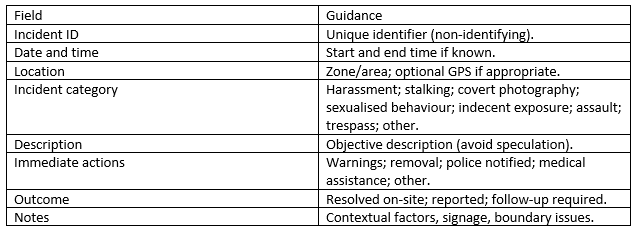
Appendix B. Standardised incident reporting template (venue use)
Purpose: Support consistent safeguarding documentation and enable future comparative analysis. This template is designed to be used without collecting unnecessary personal data.
Appendix C. FOI request template (outline)
Purpose: Request de-identified incident records for defined offences in a defined geographic area or site name range.
Include: date range; offence codes (where available); location fields; outcome fields.
Exclude: personal identifiers; narrative text beyond what is necessary for classification.
Note: FOI feasibility varies by jurisdiction and agency.
Appendix D. One-page public communication summary
Naturism is consensual, non-sexual social nudity. Clinical exhibitionism and criminal exposure are defined by sexualised intent directed at non-consenting or unsuspecting targets and by victim impact. [3] [5]
Naturist venues operate with codes of conduct and safeguarding rules. Misconduct is treated as a violation of those rules and acted upon. [16] [17]
Supplementary analysis
The following supplementary sections expand the clinical, sociological, and media analysis to meet institutional depth expectations while preserving the core argument and evidentiary discipline.
S1. Clinical-legal synthesis: why consent and intent dominate
This section expands the clinical discussion in a way that is relevant to public policy without drifting into clinical advice. The goal is to clarify why 'nudity' is not the clinical construct and why exposure offending is treated as a sexual harm even when no physical contact occurs.
In offender-focused literature, sexual exposure is often discussed alongside voyeurism and other non-contact sexual offences because the victim's experience can include fear, disgust, anger, and a persistent sense of violation. This is consistent with the legal drafting that centres alarm or distress in several jurisdictions. [3] [5]
Clinical-legal systems therefore treat exposure as an act with an imposed interpersonal meaning: the offender uses genital exposure to force another person into a sexualised situation. This can be motivated by sexual arousal, perceived power, thrill, or anger. The common feature is that the victim does not consent to the interaction. [3]
A practical takeaway for naturist governance is that 'consent clarity' is a safeguarding control. Where the environment clearly signals clothing-optional norms and where participation is voluntary, the key offender mechanism (unsuspecting targets) is disrupted. This does not eliminate risk from boundary violators, but it changes the risk profile and clarifies the behavioural standard that triggers removal.
Underreporting complicates interpretation. Where exposure is underreported, stakeholders may (a) under-estimate the overall prevalence, and (b) over-rely on sensational incidents. [3] Institutional credibility is strengthened by acknowledging underreporting while refusing to generalise beyond what data can support.
S2. Sociological governance: desexualisation as a social system outcome
Naturist environments operate as social systems with role expectations, implicit norms, and boundary practices. A consistent theme in qualitative accounts is that the social meaning of nudity changes when nudity is the baseline rather than an exception. [16] [18]
From a governance perspective, the relevant question is: what conditions stabilise a non-sexual interpretation of nudity in group settings?
Common stabilising conditions include: clear rules; predictable routines; separation between public and private spaces; limits on photography; and rapid correction of boundary testing. These conditions reduce ambiguity and reduce the opportunity for a sexualised 'performance' dynamic to emerge.
This also explains why mixed-use or ambiguous environments (for example, partially designated zones without clear boundaries) can produce misunderstanding. Ambiguity undermines informed consent and increases the probability that members of the public experience nudity as unexpected, even if no sexual intent is present.
An institutional framing therefore avoids absolute statements ('naturist spaces are always safe') and instead focuses on controllable conditions ('here is the governance architecture that reduces boundary violations').
S3. Media and stigma: framing dynamics and institutional countermeasures
Media narratives commonly use shortcut frames: 'nude' is treated as inherently sexual, inherently transgressive, or inherently comedic. Once a frame is selected, confirmation bias influences story selection and language.
Historical evidence of sensationalism in the Australian context shows that moral salience can override legal and administrative reality. [35] [1]
For institutions, the practical response is to communicate with definitional clarity and to publish governance artefacts (codes, safeguarding reports, incident metrics) that demonstrate discipline. This shifts discussion from abstract moral judgement to measurable practice.
A second institutional response is to avoid overclaiming. Where datasets do not support venue-level safety claims, the paper should say so. This increases trust and reduces the risk that critics can undermine the entire document by attacking one overstated claim.
S4. Extended implementation tools
To support rapid adoption, this subsection provides additional tools suitable for immediate use by venues and organisations.
Tool
Description
Owner
Frequency
Safeguarding briefing
Short briefing covering boundaries, photography rules, intervention steps.
Venue management
At staff onboarding; refresh quarterly
Visitor expectations card
One-page summary of consent norms and behavioural standards.
Venue management
At entry points; ongoing
Incident review meeting
Review incidents, near misses, and improvements; document actions.
Safeguarding lead
Monthly
Annual safeguarding statement
Aggregate metrics, changes, and commitments; publish publicly.
Organisation leadership
Annual
Appendix E. Safeguarding briefing outline
1) Purpose: maintain a non-sexual, respectful environment aligned with organisational definitions. [16] [17]
2) Key rules: no sexualised behaviour; no harassment; no covert photography; respect personal space; report concerns early.
3) Intervention ladder: observe; approach; warn; document; remove; escalate to police if necessary.
4) Documentation: use Appendix B template; record actions and outcomes.
5) Communication: provide calm, neutral explanations; avoid debating ideology during incidents.
Appendix F. Example signage language
Example entry sign:
'You are entering a clothing-optional area. Participation is voluntary. This environment is non-sexual and family-appropriate. Harassment, sexualised behaviour, and photography without consent are prohibited. Breaches may result in removal and referral to authorities.'
Appendix G. Research protocol summary for venue-level measurement
Define sites; define comparator sites; obtain denominators; standardise incident categories; submit targeted FOI requests; compute incident rates per 10,000 visits; report limitations and underreporting caveats. [3] [34]