

Certification Systems, Quality Assurance, and Trust Signalling
Examining how certification frameworks provide verifiable assurance of quality, integrity, and operational coherence across naturist systems.
The scalability and institutional recognition of naturist systems depend on the development of balanced certification frameworks that provide verifiable assurance of quality and integrity while maintaining flexibility, accessibility, and alignment with diverse operational contexts.
5.1 The Need for Verifiable System Integrity
As naturist systems scale and diversify, stakeholders require verifiable indicators of system quality and integrity.
In the absence of verification, environments are difficult to differentiate, stakeholders rely on assumption or informal reputation, and institutional engagement remains limited.
Certification systems provide structured validation of operational standards, consistent criteria for evaluation, and a mechanism for signalling reliability and compliance.
Certification is not an end in itself. It functions as a trust infrastructure within the system.
5.2 Defining Certification in Naturist Systems
Certification refers to the process by which an environment is assessed against defined framework criteria and recognised as meeting minimum operational standards, behavioural integrity requirements, risk management protocols, and communication and governance expectations.
Certification does not imply uniformity of environments or elimination of local variation.
It confirms that core structural conditions are met and that environments operate within recognisable and interpretable parameters.
5.3 Core Elements of a Certification Framework
A certification framework must be based on clearly defined and measurable criteria.
Contextual Definition
Boundaries and environmental purpose must remain clear, interpretable, and aligned with legal conditions.
Behavioural Standards
Observable behavioural consistency and mechanisms for maintaining non-ambiguous interaction are required.
Risk Management
Systems must identify foreseeable risks and implement proportional mitigation measures.
Governance and Oversight
Monitoring, intervention, and continuity mechanisms must remain clearly defined and operationally functional.
Communication and Transparency
Participants and stakeholders must receive accurate information aligned with operational reality.
These elements ensure that certification reflects actual system performance rather than theoretical compliance.
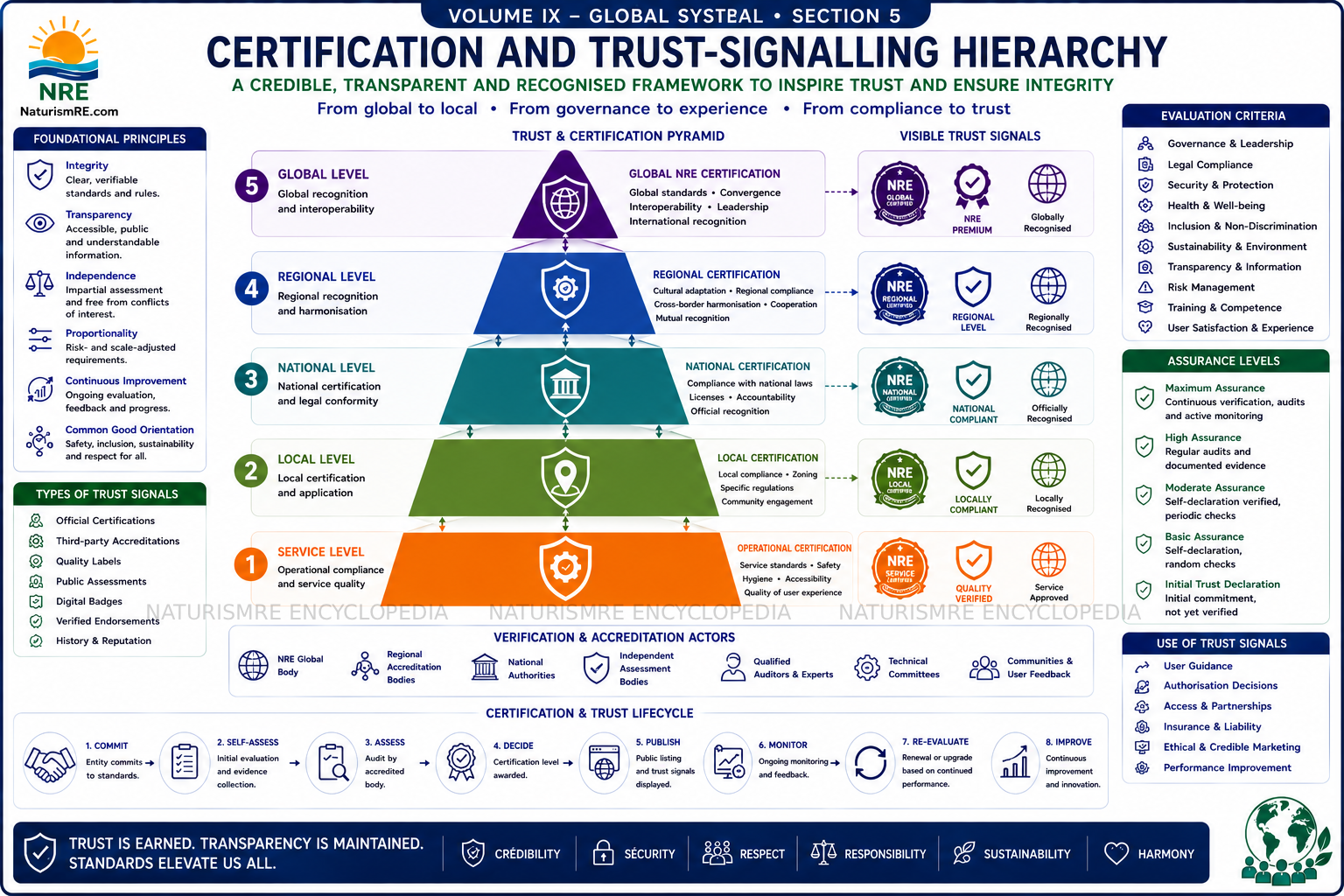
5.4 Levels of Certification and System Differentiation
Certification systems may incorporate tiered levels to differentiate environments based on scale, governance complexity, and degree of integration.
Baseline certification establishes minimum viable conditions for operation, while advanced certification reflects higher levels of governance, monitoring, and system integration.
Tiered structures enable recognition of varying system maturity, support progression pathways, and maintain flexibility across diverse operational contexts.
5.5 Verification Processes and Audit Mechanisms
Certification requires verification to maintain credibility.
Verification processes may include self-assessment against defined criteria, periodic review of operational conditions, and independent evaluation where appropriate.
These mechanisms must remain proportionate to system scale, consistent across environments, and adaptable to varying contexts.
Audit processes support ongoing compliance, identify gaps or deviations, and contribute to continuous improvement.
5.6 Trust Signalling and Stakeholder Confidence
Certification functions as a trust signal for participants, communities, regulatory authorities, and institutional partners.
It provides assurance of structured operation, reduces perceived risk, and supports willingness to engage.
Trust signalling enhances alignment with policy frameworks and contributes directly to system legitimacy and acceptance.
Without such signals, environments may be perceived as uncertain or unmanaged, increasing stakeholder resistance.
5.7 Risks of Over-Certification and System Rigidity
While certification strengthens system integrity, excessive or rigid frameworks may introduce operational constraints.
These include administrative burden, reduced flexibility, and barriers to entry for new or low-resource environments.
Over-certification may limit innovation, create dependency on formal processes, and restrict scalability.
Effective certification systems must balance rigour with accessibility, ensuring consistency without compromising adaptability.
5.8 Analytical Conclusion
Certification systems are essential for establishing verifiable quality, trust, and coherence across naturist environments.
They provide structured validation of operational integrity, define core criteria across context, behaviour, risk, governance, and communication, and support differentiation through tiered frameworks.
Verification and audit mechanisms maintain credibility, while trust signalling supports stakeholder engagement and institutional integration.
At the same time, systems must avoid excessive rigidity to preserve flexibility and scalability.
Naturist systems that implement effective certification frameworks are those that provide clear, verifiable standards, maintain alignment between certification and operational reality, and support both integrity and adaptability.
This establishes a defining principle for Volume IX:
The scalability and institutional recognition of naturist systems depend on the development of balanced certification frameworks that provide verifiable assurance of quality and integrity while maintaining flexibility, accessibility, and alignment with diverse operational contexts.
Primary Supporting Articles
Minimum Viable Standards for Global Naturist Systems
Data Integrity and Validation Logic in Contextualised Naturist Measurement Systems
Why Boundary Enforcement Determines System Credibility
Why Systems Without Defined Governance Layers Remain Operationally Fragile