

System Integration, Deployment Maturity, and Operational Equilibrium
Examining how naturist systems achieve long-term operational viability through integration, adaptive governance, equilibrium management, and deployment maturity.
The long-term success of naturist systems depends on their ability to achieve and maintain operational equilibrium across integrated deployment variables, ensuring that growth, governance, perception, and capacity remain continuously aligned within stable and adaptive system structures.
8.1 Convergence of Implementation Variables
Across Volume VII, deployment has been examined through multiple operational dimensions, including implementation pathways, stakeholder alignment, site selection and spatial design, operational governance, communication systems, scaling mechanics, and monitoring and evaluation.
These variables do not operate independently. They converge into a single operational system in which site selection influences perception and risk, governance determines behavioural stability, communication shapes interpretation, monitoring informs adaptation, and scaling tests system limits.
The effectiveness of deployment is therefore determined by alignment across all variables rather than optimisation of any single component.
8.2 From Deployment to System Maturity
Deployment represents an initial condition. Long-term viability depends on progression toward system maturity.
System maturity is characterised by stable behavioural patterns, predictable operational conditions, consistent stakeholder response, and reduced reliance on reactive intervention.
Early-stage systems typically exhibit higher variability, increased need for oversight, and sensitivity to external factors.
As systems mature, governance becomes embedded, participant behaviour stabilises, and perception aligns with operational reality.
Maturity is achieved through repetition, consistency, and adaptive refinement over time.
8.3 Operational Equilibrium in Deployed Environments
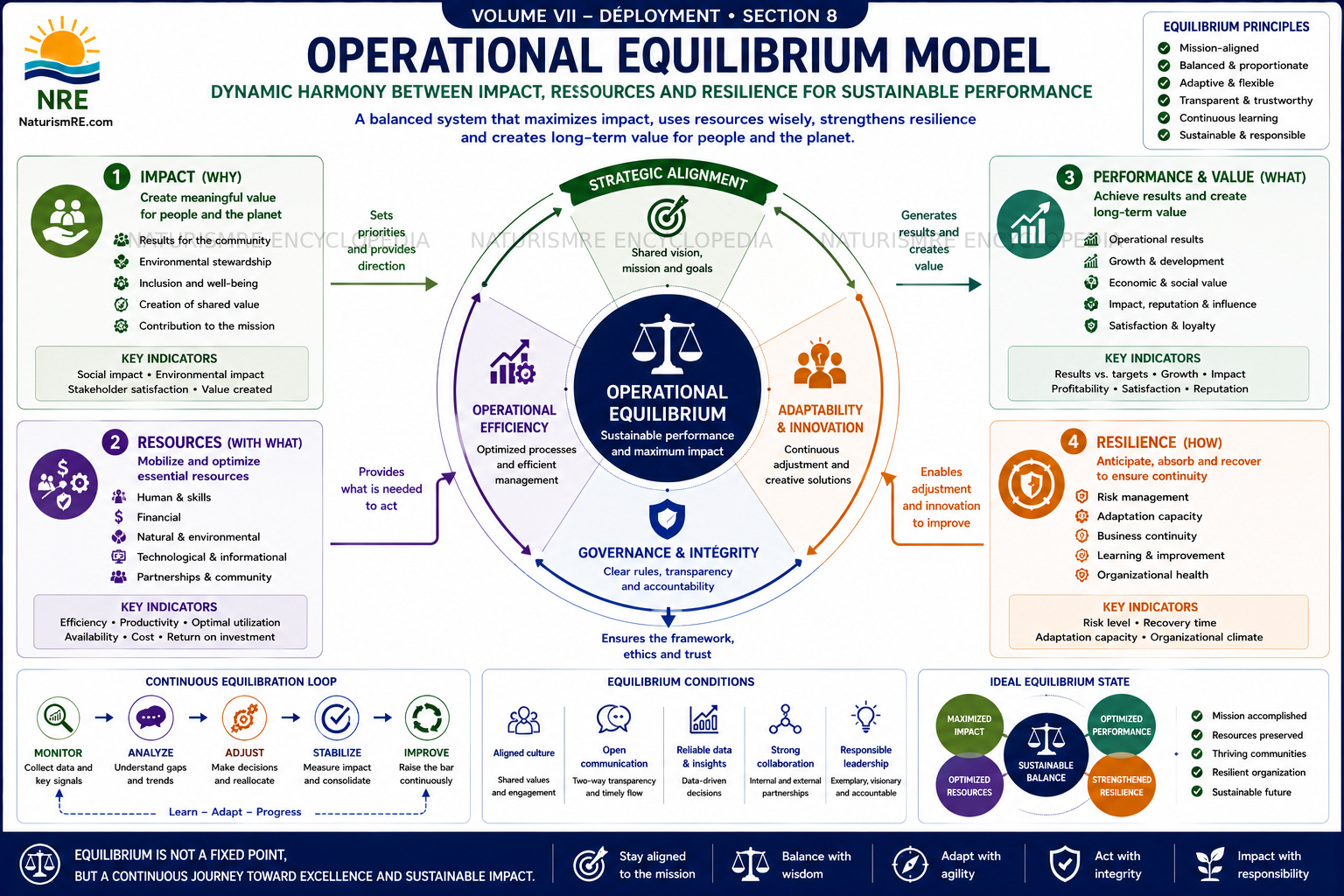
Sustainable naturist systems operate within a state of operational equilibrium.
This equilibrium is defined by alignment between participation levels and governance capacity, environmental conditions within manageable limits, and stakeholder perception that does not trigger escalation.
Equilibrium is dynamic rather than static. It requires continuous adjustment, monitoring of internal and external variables, and responsiveness to emerging conditions.
When equilibrium is maintained, systems operate predictably, risk remains bounded, and expansion becomes feasible.
When equilibrium is disrupted, instability increases, behavioural variability rises, and the likelihood of regulatory or social intervention grows.
8.4 Integration Across Multiple Sites and Systems
As deployment expands, individual environments become part of a broader network.
Integration across sites requires alignment of core operational principles, consistency in behavioural standards, and coherence in communication and positioning.
Without integration, variability increases, perception becomes fragmented, and network-level stability is weakened.
Effective integration supports a shared identity across environments, facilitates transfer of learning and best practices, and reinforces consistent norms.
8.5 Adaptive Capacity and System Resilience
Deployment environments must remain adaptive to changing conditions.
These include shifts in participation patterns, evolving legal or regulatory frameworks, and changes in social perception.
Adaptive capacity is supported by flexible governance structures, continuous monitoring and feedback systems, and the ability to modify operational parameters.
Resilient systems absorb minor disruptions without structural failure, adjust to new conditions without loss of core integrity, and maintain continuity under varying circumstances.
8.6 Limits of Expansion and System Saturation
All systems operate within capacity limits.
Indicators of approaching saturation include increasing participant density beyond manageable levels, rising frequency of behavioural deviations, increased interaction with non-participants, and heightened external attention.
Exceeding system capacity may result in loss of behavioural control, increased legal and reputational risk, and potential restriction or contraction.
Sustainable deployment requires recognition of capacity limits, willingness to stabilise rather than expand, and prioritisation of system integrity over scale.
8.7 Transition from Experimental to Established Systems
Deployment progresses through identifiable stages.
The experimental phase is characterised by testing and adjustment. The stabilisation phase introduces predictable patterns and reduced variability. The established phase reflects recognised and integrated systems.
Transition to established systems requires consistent operational performance, absence of significant incidents, and alignment with stakeholder expectations.
Established systems benefit from reduced uncertainty, increased acceptance, and potential integration into formal regulatory frameworks.
8.8 Analytical Conclusion
Deployment of naturist systems culminates in a process of integration, stabilisation, and equilibrium management.
Successful implementation depends on alignment across operational variables. System maturity is achieved through consistency and adaptation over time. Operational equilibrium is required for sustained viability. Integration across sites supports network stability. Adaptive capacity enables resilience. Expansion must be balanced against system capacity limits. Transition to established systems depends on predictable and stable operation.
Naturist environments that succeed in deployment are those that move beyond initial implementation, maintain coherence across variables, and operate within defined limits while adapting to evolving conditions.
This establishes the overarching principle of Volume VII:
The long-term success of naturist systems depends on their ability to achieve and maintain operational equilibrium across integrated deployment variables, ensuring that growth, governance, perception, and capacity remain continuously aligned within stable and adaptive system structures.
Primary Supporting Articles
From Fragmented Systems to Operational Coherence, Defining Maturity in Naturist System Deployment
Human Adaptation and Long-Term System Alignment in Structured Naturist Environments
Scaling Without Loss of Behavioural Integrity
Why Systems Without Defined Continuity Mechanisms Cannot Sustain Growth