

Europe: Context-Based Tolerance and Differentiated Legal Interpretation
Examining European legal systems as structured models of conditional accommodation in which nudity is interpreted through context, behaviour, and social expectation rather than blanket prohibition.
Legal systems can accommodate non-sexual nudity without compromising public order, provided that context, behaviour, and boundaries remain clearly defined and consistently interpreted.
6.1 Purpose
This section examines the legal treatment of nudity across European jurisdictions as a case study of context-based tolerance operating within structured legal systems.
Its purpose is to identify common regulatory principles across European frameworks, to analyse how legal systems differentiate between non-sexual nudity and unlawful conduct, and to define the operational mechanisms that enable tolerance within regulated environments.
This section positions Europe as a reference model of conditional accommodation, in which legality is determined through structured interpretation rather than absolute prohibition.
6.2 Structural Characteristics of European Legal Systems
European legal frameworks typically combine intent-sensitive interpretation, context-based evaluation, and conditional tolerance supported by established environments.
Across most jurisdictions, nudity is not categorically criminalised. Legal classification depends on behaviour, context, and impact, while enforcement is influenced by cultural norms and social expectations.
This places European systems within a hybrid regulatory model in which legality is neither absolute permission nor absolute prohibition, but a function of structured interpretation.
6.3 Distinction Between Physical State and Legal Offence
A consistent feature across European jurisdictions is the clear legal distinction between nudity as a physical condition and indecency as a legal classification.
Legal systems generally require demonstrable intent to offend or provoke, behaviour inconsistent with accepted norms, or disruption of public order in order to establish unlawfulness.
This reflects a shared legal principle:
The presence of nudity alone is insufficient to establish illegality.
This distinction separates physical condition from legal classification, allows non-sexual nudity to exist within defined conditions, and shifts legal focus toward behaviour and context.
6.4 Context as the Primary Determinant
European legal systems rely heavily on contextual evaluation.
Ubicación
Legal interpretation considers whether exposure occurs within recognised or expected environments.
Voluntary Participation
Tolerance increases where participation is consensual and exposure is avoidable.
Recognised Naturist Environments
Designated beaches, clubs, and controlled areas stabilise legal interpretation and behavioural expectation.
Behavioural Predictability
Contextual legitimacy depends on non-disruptive conduct and adherence to established norms.
This establishes a defining operational principle:
Legal outcomes are determined by situational context rather than fixed classification.
6.5 Designated Environments as Legal Integration Mechanisms
European systems frequently incorporate designated or recognised environments as part of their regulatory approach.
These include naturist beaches, clothing-optional zones within public spaces, and private clubs or resorts.
Within these environments, participation is voluntary, behavioural expectations are clearly defined, and exposure is contained within established boundaries.
These conditions reduce legal ambiguity, lower the likelihood of complaints, and limit enforcement intervention.
Designated environments therefore function as mechanisms of legal integration, enabling coexistence between naturist practice and public order frameworks.
6.6 Jurisdictional Variability Within a Shared Model
Despite shared structural principles, European systems exhibit variation due to national legal traditions, cultural attitudes, and historical development of naturism.
Some regions demonstrate broader tolerance, while others maintain more restrictive frameworks and lower thresholds for what constitutes offensive conduct.
Even within stricter jurisdictions, enforcement often remains context-sensitive and discretionary.
This confirms that variability exists at the level of application rather than at the level of structural design.
6.7 Regulation Through Public Order Frameworks
European systems typically regulate nudity through broader legal categories such as public order, public decency, disturbance, or nuisance.
These categories are intentionally flexible, allowing adaptation to local conditions, interpretation based on social norms, and avoidance of rigid classification.
This approach enables legal systems to accommodate non-sexual nudity in appropriate contexts while maintaining regulatory control.
6.8 Enforcement as Contextual Application
In practice, enforcement across European jurisdictions is characterised by complaint-based activation, evaluation of behaviour and context, and proportional response to perceived impact.
Authorities typically intervene where behaviour is disruptive or provocative, where exposure is imposed on unwilling individuals, or where escalation or conflict occurs.
Where these conditions are absent, enforcement may be minimal or absent, and tolerance is effectively maintained.
This confirms a consistent operational reality:
Enforcement is triggered by disruption, not by the mere presence of nudity.
6.9 Influence of Social Acceptance
Social acceptance plays a central role in shaping enforcement thresholds, interpretation of behaviour, and legal outcomes.
In regions where naturism is culturally established and historically integrated, tolerance is generally higher and more stable.
Where nudity is less familiar or more strongly associated with indecency, interpretation becomes stricter and enforcement more likely.
This reinforces a core structural condition:
Legal frameworks operate in continuous interaction with cultural perception.
6.10 Stability and Predictability of the European Model
Compared to prohibition-based systems, European frameworks offer greater flexibility, higher tolerance for contextual variation, and increased recognition of non-sexual environments.
However, this flexibility introduces reduced certainty, greater reliance on interpretation, and variability across jurisdictions.
The result is a system that provides moderate predictability and conditional stability rather than fixed legal certainty.
6.11 Analytical Implications
The European regulatory model demonstrates several system-level characteristics.
Conditional Tolerance
Non-sexual nudity may be accommodated where behavioural and contextual conditions remain stable.
Contextual Interpretation
Legal classification depends on behaviour, environment, and participant expectation.
Integrated Environments
Designated and recognised spaces function as stabilisation mechanisms within broader legal systems.
Perception-Dependent Enforcement
Social acceptance and cultural familiarity directly influence enforcement thresholds and legal outcomes.
These characteristics position Europe as a structured tolerance model that balances flexibility with regulatory control.
6.12 Conclusion
European legal systems illustrate a regulatory approach in which nudity is neither fully unrestricted nor categorically prohibited.
Instead, it is governed through contextual interpretation within defined boundaries shaped by behavioural consistency, environmental context, and social perception.
Nudity is generally tolerated where it aligns with recognised environments, does not impose on non-participants, and remains behaviourally non-disruptive. It is restricted where these conditions are not met.
The European model does not remove regulation. It redistributes control from rigid prohibition to conditional evaluation.
This establishes a defining principle:
Legal systems can accommodate non-sexual nudity without compromising public order, provided that context, behaviour, and boundaries remain clearly defined and consistently interpreted.
This framework represents one of the most operationally viable regulatory models and serves as a critical reference point for comparative legal analysis and system design.
Comparative interpretative framework only.
Legal outcomes remain highly context-dependent and may vary by region, municipality, court interpretation, and enforcement practice.
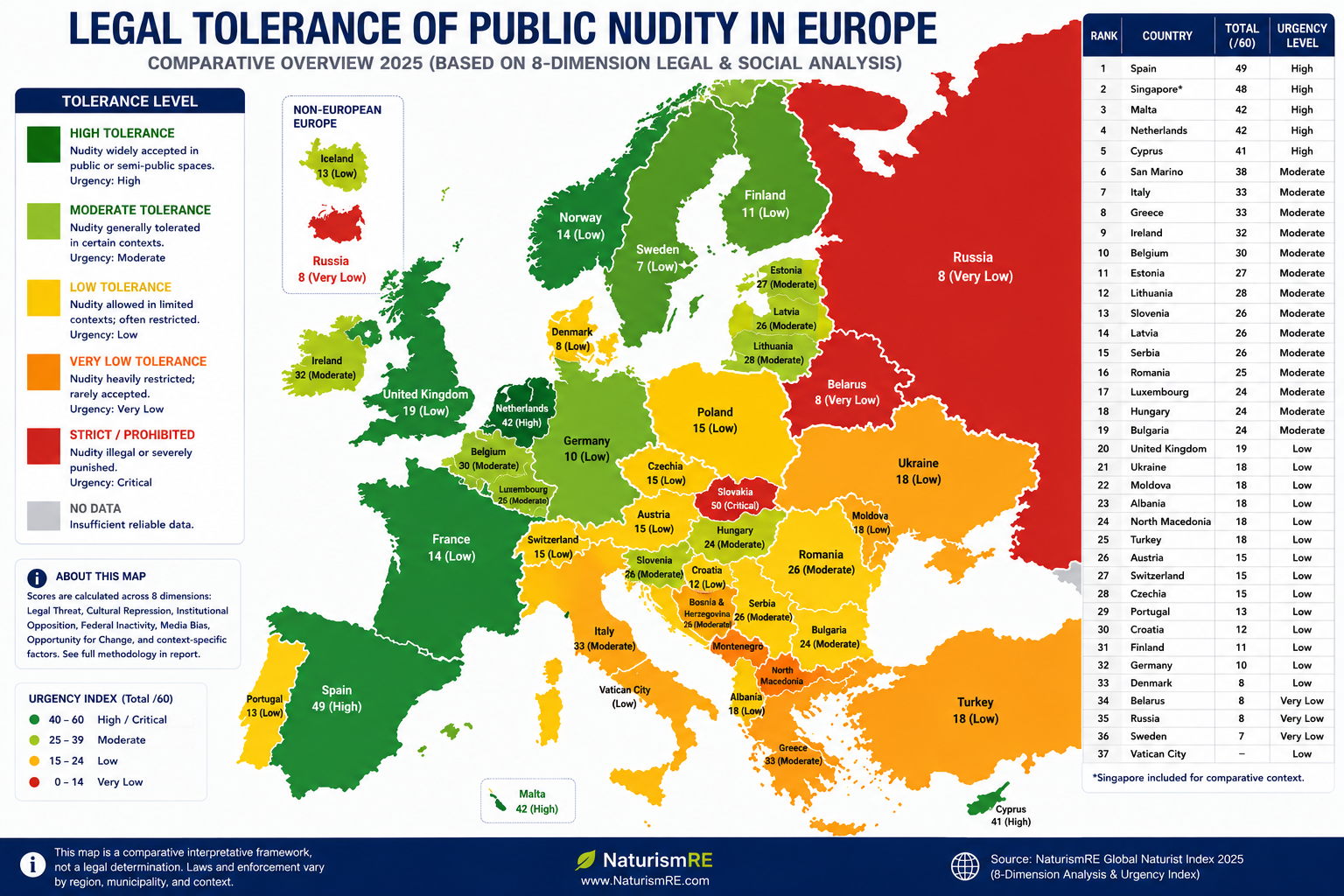
This comparative map uses a colour-gradient system based on the NaturismRE Global Naturist Index 2025 and associated urgency analysis framework.
The colour scale reflects the overall level of legal, cultural, institutional, and social tolerance toward non-sexual public nudity within each country:
• Dark Green = High tolerance and lower structural barriers
• Light Green = Moderate tolerance with some contextual limitations
• Yellow = Mixed or conditional tolerance with important restrictions
• Orange = Significant legal, cultural, or institutional barriers
• Red = Very restrictive or highly hostile environments toward non-sexual public nudity
The numerical rating shown for each country represents the cumulative score generated from multiple analytical dimensions, including:
• Legal threat
• Cultural repression
• Institutional opposition
• Government inactivity
• Media bias
• Opportunity for change
Lower scores generally indicate more tolerant and stable environments, while higher scores indicate greater structural resistance, restrictions, or urgency for reform.
This map is not a legal determination or legal advice. It is a comparative interpretative framework designed to visualise broad trends and systemic conditions across jurisdictions. Local laws, enforcement practices, court interpretations, and municipal regulations may vary significantly within each country.
Primary Supporting Articles
Legal Pluralism and Conditional Tolerance, The European Model of Naturist Regulation
From Legal Diversity to Structural Convergence, A Global Synthesis of Naturist Regulation
From Zones to Systems, How Structured Environments Scale Across Jurisdictions
From Risk to Regulation, The Structural Logic Behind Controlled Clothing-Optional Environments
Why Cities Require Defined Clothing-Optional Zones to Achieve Stability