

Operational Governance, On-Site Management, and Control Systems
Examining how governance frameworks are translated into real-time operational control systems that maintain stability, behavioural consistency, and environmental predictability.
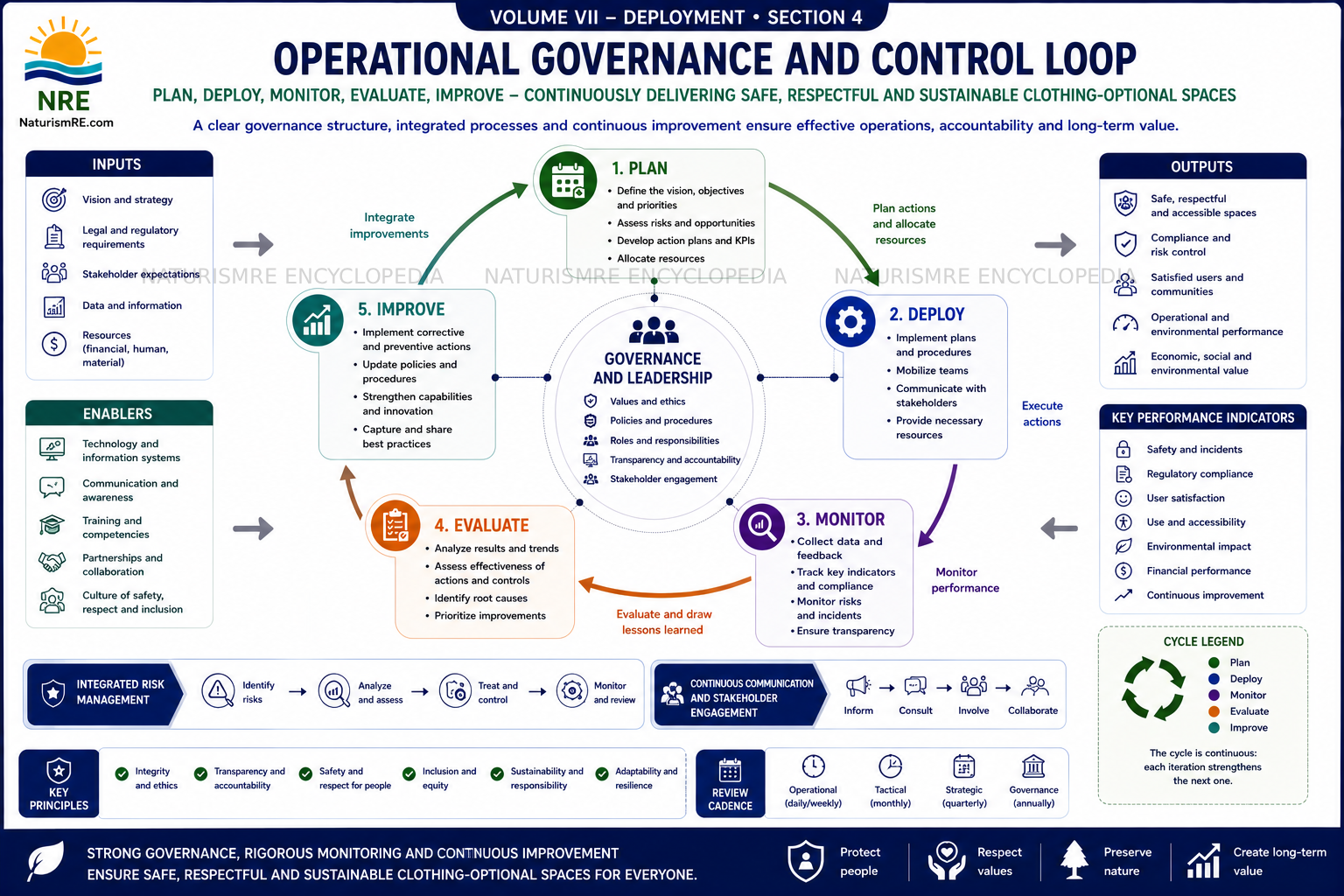
The stability of naturist environments depends on their ability to translate governance frameworks into effective on-site control systems, ensuring that behaviour, density, and environmental conditions remain continuously aligned within defined operational parameters.
4.1 Governance in the Operational Phase
Once a naturist environment is deployed, governance transitions from design to execution.
Operational governance focuses on maintaining defined conditions, ensuring behavioural consistency, and responding to variability in real time.
Unlike conceptual governance, which defines rules, operational governance ensures that rules are applied consistently, conditions remain within defined parameters, and deviations are identified and managed.
This phase determines whether a system remains stable and interpretable or becomes variable and exposed to risk.
4.2 Roles and Responsibility Structures
Effective on-site management requires clear allocation of roles, even in low-formality environments.
Operational Oversight
Responsible for monitoring overall conditions and maintaining alignment with defined operational parameters.
Behavioural Stewardship
Responsible for observing participant conduct and reinforcing behavioural norms through presence and intervention.
Environmental Monitoring
Responsible for assessing weather, terrain, and environmental conditions while identifying emerging risks.
Scalable Responsibility Allocation
Responsibilities must remain adaptable according to environment size, density, and operational complexity.
Ambiguity in roles leads to delayed response, inconsistent enforcement, and erosion of system stability.
4.3 Behavioural Control Mechanisms
Behavioural consistency is maintained through visible and implicit control mechanisms.
Norm visibility allows participants to observe expected behaviour through others, reinforcing alignment through consistency.
Presence-based regulation introduces visible oversight that encourages adherence to defined standards and reduces the likelihood of deviation.
Direct intervention provides immediate and proportionate response to behaviour that introduces ambiguity or disruption, restoring stability.
Control mechanisms must remain proportionate, consistent, and aligned with behavioural standards. Over-control may reduce participation and create rigidity, while under-control increases variability and weakens system credibility.
4.4 Density Management and Operational Load
Participant density directly influences behavioural variability, monitoring capacity, and overall system stability.
Operational governance must adapt to these conditions. Low-density environments may require minimal oversight, moderate density requires active observation, and higher density necessitates structured control presence.
Failure to align governance with density leads to delayed detection of deviation, increased interaction complexity, and reduced predictability.
Density management may involve limiting participant numbers, controlling access points, and adjusting operational scope to maintain stability.
4.5 Real-Time Decision-Making and Adaptive Control
Operational environments require continuous real-time decision-making based on environmental conditions, participant behaviour, and external interactions.
Key decision points include continuation or suspension of activity under adverse conditions, thresholds for intervention in behavioural deviation, and adjustment of operational parameters.
Effective decision-making is characterised by speed, proportionality, and alignment with predefined protocols.
Delayed or inconsistent decisions increase risk exposure, reduce perceived stability, and raise the likelihood of escalation.
4.6 Interaction with External Actors
Naturist environments may interact with non-participating individuals, authorities or enforcement bodies, and adjacent user groups.
Managing these interactions requires clear communication of context, maintenance of spatial and behavioural boundaries, and avoidance of escalation.
Responses must be controlled and consistent, reinforcing the defined nature of the environment.
Poorly managed interaction may result in complaints, regulatory attention, and disruption of participant experience.
4.7 Continuity and Operational Consistency Over Time
Sustained operation depends on consistency over time.
This includes stable application of rules, predictable participant experience, and continuity of governance mechanisms.
Inconsistent operation may lead to participant confusion, erosion of behavioural norms, and increased likelihood of deviation.
Continuity is achieved through repeatable procedures, clear role allocation, and ongoing alignment with defined conditions.
4.8 Analytical Conclusion
Operational governance represents the execution layer of naturist system design.
Governance must transition from conceptual definition to consistent application. Clear roles and responsibilities are essential. Behavioural control mechanisms maintain stability. Density influences operational requirements. Real-time decision-making ensures conditions remain within defined parameters. External interactions must be managed carefully. Continuity reinforces predictability and trust.
Naturist systems that succeed operationally are those that maintain alignment between design and execution, adapt to changing conditions without losing structure, and ensure that behaviour, environment, and governance remain consistently interpretable.
This establishes a defining principle for Volume VII:
The stability of naturist environments depends on their ability to translate governance frameworks into effective on-site control systems, ensuring that behaviour, density, and environmental conditions remain continuously aligned within defined operational parameters.
Primary Supporting Articles
Governance Without Constant Intervention, Passive Control Systems in Naturist Contexts
Behaviour Stabilisation in Open vs Controlled Access Environments
Controlled Entry Systems and Their Role in Stabilisation
How Behavioural Standards Become Self-Enforcing Within Defined Environments