Institutional Structures, Governance Models, and Global Coordination Mechanisms
Examining how distributed institutional structures enable coordination, integrity, and scalable implementation across global naturist systems.
The transition to a coherent global naturist system depends on the development of distributed institutional structures that enable coordination, maintain integrity, and support scalable implementation without imposing centralised control, ensuring adaptability and long-term system stability.
3.1 From Frameworks to Institutions
Standardised frameworks provide structural alignment, but institutions provide continuity, coordination, and long-term stability.
Without institutional structures, frameworks remain optional and inconsistently applied, knowledge consolidation is limited, and coordination across jurisdictions remains fragmented.
Institutionalisation enables sustained implementation, consistent application of standards, and alignment across distributed systems.
This represents a transition from framework-based alignment to system-level coordination.
3.2 Defining Institutional Roles in Naturist Systems
Institutions within a global naturist system function as coordination and support mechanisms rather than centralised authorities.
Framework Development and Maintenance
Institutions update standards and ensure continued relevance to evolving operational conditions.
Knowledge Aggregation
Collection and analysis of data across environments supports system learning and refinement.
Implementation Guidance and Support
Operational assistance and structured guidance enable scalable and context-aligned deployment.
System Integrity Oversight
Verification processes ensure continued alignment with core principles and operational standards.
These roles are functional rather than hierarchical, enabling coordination without imposing control.
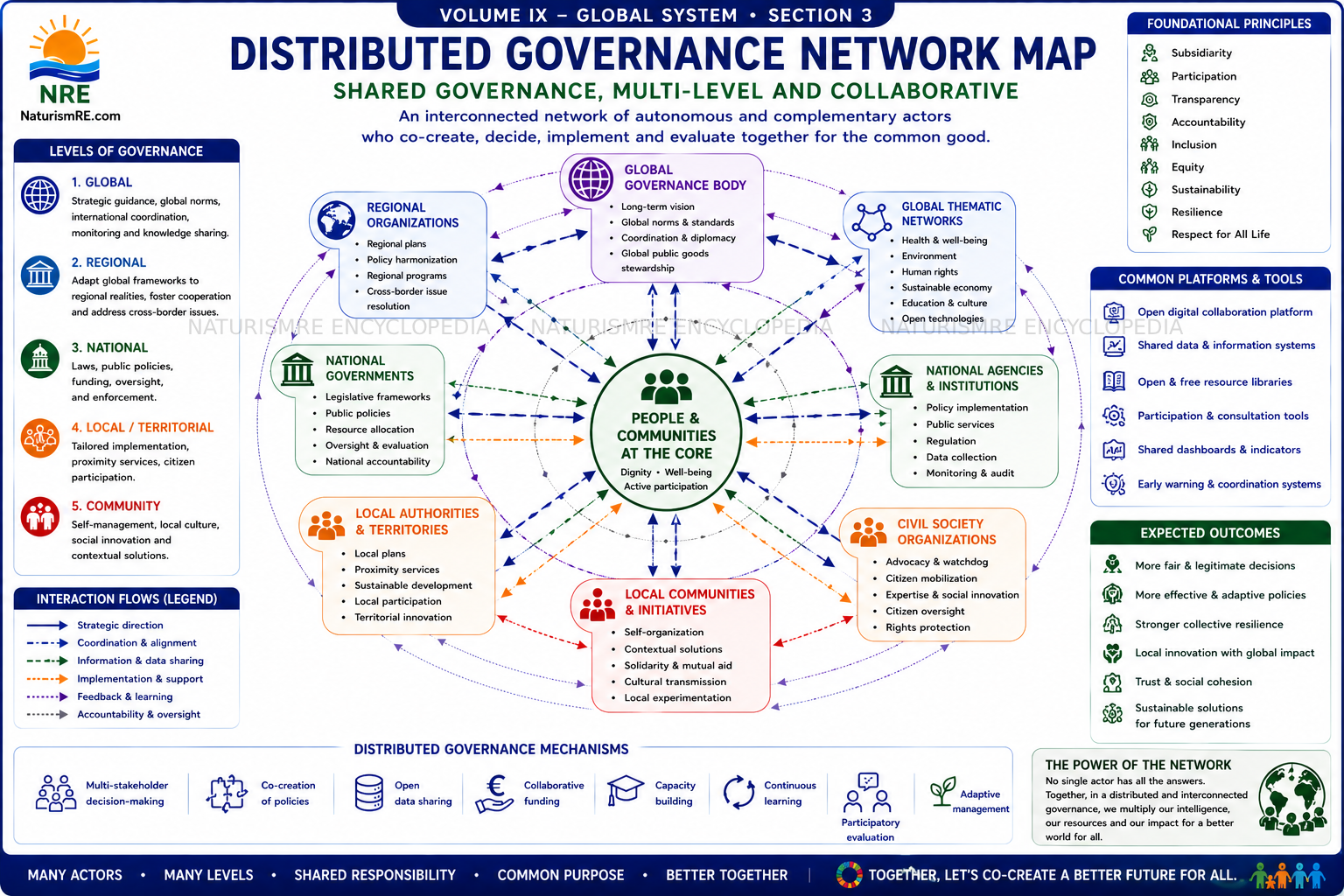
3.3 Distributed Governance Models
Given the global and context-dependent nature of naturist systems, governance must be distributed.
Distributed governance is characterised by decentralised implementation, local decision-making authority, and shared adherence to core frameworks.
This approach supports adaptability to diverse legal and cultural contexts, resilience to local disruption, and reduced dependency on centralised control.
However, it introduces challenges in maintaining consistency, preventing fragmentation, and ensuring alignment without direct authority.
Effective distributed governance depends on shared principles, transparent communication, and consistent application of frameworks.
3.4 Coordination Without Centralisation
Global coordination must avoid excessive centralisation and rigid hierarchical structures.
Coordination is achieved through common frameworks, shared data systems, and ongoing exchange of information.
This allows independence at the local level while maintaining coherence at the global level.
Mechanisms for coordination may include standardised reporting, collaborative knowledge platforms, and periodic review of system performance.
3.5 Institutional Legitimacy and Recognition
For institutions to operate effectively, they must establish legitimacy.
Legitimacy is based on consistency of standards, transparency of operations, and alignment with recognised legal, health, and planning frameworks.
It enables engagement with regulatory bodies, participation in policy discussions, and recognition within broader societal systems.
Without legitimacy, institutional influence is limited, frameworks lack authority, and coordination remains informal.
3.6 Integration with External Institutions
Global naturist systems must interact with external institutional structures including public authorities, planning bodies, health organisations, and environmental agencies.
Integration requires translation of naturist frameworks into institution-compatible language, alignment with external objectives, and demonstration of operational reliability.
Effective integration enhances credibility, supports policy inclusion, and enables access to resources.
3.7 Governance Evolution and System Maturity
Institutional structures evolve in parallel with system maturity.
Early-stage systems rely on informal coordination and limited framework adoption. As systems develop, governance becomes more structured, roles and responsibilities are clarified, and coordination mechanisms are formalised.
Mature systems exhibit stable institutional frameworks, consistent global alignment, and capacity for long-term planning.
3.8 Analytical Conclusion
Institutional structures are essential for transforming naturist systems from distributed practices into coordinated global frameworks.
They provide continuity, coordination, and stability. Roles are functional and focused on support and integrity. Distributed governance enables adaptation while maintaining coherence. Coordination occurs without centralisation. Legitimacy supports influence and recognition. Integration with external institutions enhances scalability. Governance evolves as systems mature.
Naturist systems that achieve global coherence balance decentralised operation with coordinated frameworks, maintain alignment across diverse environments, and develop institutions that support rather than control.
This establishes a defining principle for Volume IX:
The transition to a coherent global naturist system depends on the development of distributed institutional structures that enable coordination, maintain integrity, and support scalable implementation without imposing centralised control, ensuring adaptability and long-term system stability.