

The Structural Evolution Toward Context-Defined Naturist Systems
Examining the transition of naturism from informal cultural practice toward structured, context-defined, and operationally governed systems.
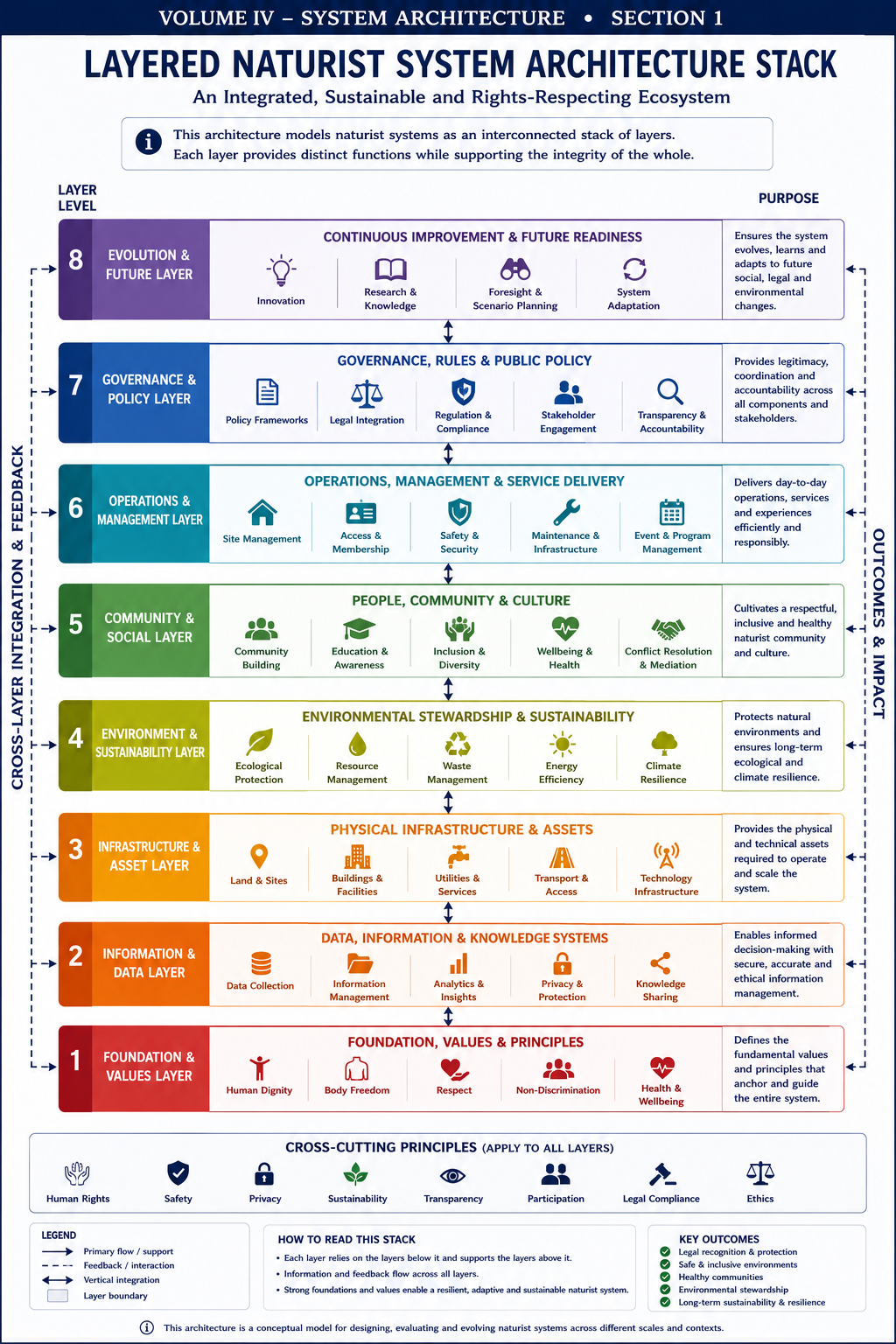
Naturism’s future is not determined by cultural advocacy alone, but by its capacity to function as a coherent, structured system within complex modern environments.
1.1 Transition from Cultural Practice to Structured Systems
Naturism in the twenty-first century is no longer adequately defined as a cultural or recreational practice. While its historical foundations remain grounded in lifestyle expression and philosophical positioning, contemporary conditions are driving a transition toward structured, system-based models of participation.
This transition is not ideological. It is functional.
Several converging pressures contribute to this shift, including increasing urban density and reduced access to informal natural environments, legal ambiguity surrounding public nudity across jurisdictions, heightened sensitivity to perception, consent, and public safety, the expansion of digital visibility and associated reputational risk, and institutional reluctance to engage in unstructured or uncontrolled environments.
Under these conditions, naturism cannot operate sustainably as an informal or purely cultural activity. It must progressively integrate defined structures that clarify context, intent, and behavioural expectations.
This marks the beginning of systemisation.
Systemisation does not alter the nature of naturism. It introduces the frameworks required for its coexistence within modern societal conditions.
1.2 The Emergence of Context-Defined Environments
A defining characteristic of this evolution is the increasing importance of context-defined environments.
Historically, naturism relied on remote or low-density locations, implicit social codes, and informal community enforcement. These conditions are no longer sufficient in contemporary settings.
Modern environments require explicit boundaries, clearly communicated purpose, behavioural expectations aligned with public norms, and risk mitigation structures.
This leads to the emergence of environments in which nudity is not simply present, but contextually defined.
Spatial Delineation
Physical or operational boundaries establish environmental clarity and reduce interpretative ambiguity.
Defined Non-Sexual Intent
Environmental purpose must be clearly aligned with non-sexual objectives and participant understanding.
Behavioural Alignment
Observable behavioural consistency supports legal defensibility and social stability.
Intervention Capacity
Structured systems require operational mechanisms capable of responding to deviation or escalation.
These environments do not represent expansion into all public spaces. They represent controlled integration within specific contexts.
This distinction is critical for public acceptance and legal defensibility.
1.3 Behavioural Integrity as a Structural Requirement
As naturism transitions toward structured environments, behavioural integrity becomes a central operational requirement rather than an implicit expectation.
In informal settings, behavioural norms may be assumed or culturally transmitted. In structured systems, they must be defined, communicated, observable, and enforceable.
Behavioural integrity operates across three interdependent dimensions. Intent must be clearly non-sexual and non-exploitative. Conduct must remain consistent with the defined purpose of the environment. External perception must allow the environment to be interpreted without ambiguity.
Failure in any of these dimensions introduces systemic risk, including public misinterpretation, amplification of isolated incidents, regulatory response, and loss of operational legitimacy.
Behavioural integrity is therefore not a moral construct. It is a risk management mechanism necessary for the sustainability of structured naturist systems.
1.4 Decentralisation and Individual-Led Adoption
A parallel development is the decentralisation of naturist participation.
Contemporary participation patterns indicate that a significant proportion of individuals engage in naturist activity outside formal organisations. Membership-based structures represent only a limited subset of total participation, while digital platforms facilitate independent discovery and engagement.
This creates a structural divergence between institutional models, which rely on governance and controlled environments, and individual-led participation, which operates informally.
Systemisation introduces a third pathway: framework-enabled decentralisation.
In this model, individuals retain autonomy while structured frameworks provide guidance, safety parameters, and operational templates. Participation occurs without mandatory affiliation, while maintaining consistency and risk control across distributed activity.
This reflects broader societal trends toward decentralised systems in governance, information, and community formation.
1.5 Legal Adaptation and Context-Based Interpretation
Legal systems globally demonstrate increasing reliance on context-based interpretation when addressing public behaviour, including nudity.
Traditional legal approaches relied on binary classification, treating nudity as inherently indecent and clothing as inherently acceptable. Contemporary legal reasoning in several jurisdictions has evolved toward assessing intent, context, behaviour, and impact on others.
This shift does not eliminate legal risk. It introduces variability.
The same act may be interpreted differently depending on context. Absence of clear environmental definition increases exposure to enforcement. Structured environments reduce interpretative ambiguity.
System-based naturist environments therefore provide a form of legal stabilisation by establishing predictable conditions, demonstrating non-sexual intent, and providing evidence of behavioural standards.
However, inconsistency across jurisdictions remains a limiting factor. The evolution toward structured systems is partially driven by the need to operate within fragmented legal landscapes.
1.6 Technological Mediation and Surveillance Pressures
The contemporary environment is increasingly shaped by technological mediation, including ubiquitous mobile recording, social media dissemination, algorithmic content moderation, and surveillance infrastructure in public and semi-public spaces.
These conditions introduce new constraints. Context may be lost once content is captured. Environments may be misrepresented. Platform-level censorship may occur regardless of intent. Digital material may persist indefinitely, creating long-term reputational exposure.
For naturism, this creates a structural tension. The practice depends on context and intent, while digital systems frequently remove or ignore both.
Structured environments mitigate these risks through defined boundaries, communication protocols, participant awareness, and operational policies regarding recording.
Technological pressure is therefore a key driver of systemisation, requiring environments capable of maintaining integrity under conditions of decontextualisation.
1.7 Institutional Resistance and Structural Limitations
Existing naturist organisations often operate within legacy frameworks characterised by membership-based access, private or semi-private environments, controlled participation, and established governance systems.
While effective within their scope, these models present limitations. They offer limited scalability into public or semi-public environments, expose organisations to reputational risk from external incidents, depend on revenue structures tied to membership or facilities, and may lack flexibility in responding to decentralised participation trends.
As a result, institutional actors may demonstrate cautious engagement with broader system expansion. This reflects structural constraint rather than opposition.
Framework-based decentralised models introduce an alternative pathway. They do not require organisational transformation, operate alongside existing institutions, and expand participation without imposing structural change.
This coexistence model reduces friction while enabling system evolution.
1.8 Analytical Conclusion
The evolution of naturism in the twenty-first century is defined by a transition from informal cultural practice to context-dependent, system-enabled participation models.
This transition is driven by legal variability, social perception pressures, technological exposure, decentralised participation patterns, and structural limitations of legacy institutions.
The resulting trajectory does not indicate unrestricted expansion of nudity into all public spaces. It indicates the emergence of clearly defined environments, behaviourally governed systems, framework-supported decentralisation, and context-based legal integration.
Naturism under these conditions becomes more structured and more operationally viable.
Its sustainability depends on balancing autonomy with structure, ensuring that environments remain interpretable, defensible, consistent, and adaptable to evolving societal systems.
This section establishes the foundational premise for Volume IV:
Naturism’s future is not determined by cultural advocacy alone, but by its capacity to function as a coherent, structured system within complex modern environments.
Primary Supporting Articles
From Fragmented Practice to Structured Systems, The Evolution of Naturism as a Social Architecture
From Isolated Systems to Integrated Frameworks, The Emergence of Multi-Domain Naturist Models
From Fragmented Systems to Operational Coherence, Defining Maturity in Naturist System Deployment
Naturism at a Structural Crossroads, From Fragmented Practice to Governed Systems
Drivers of Structural Evolution, Behaviour, Context, and Governance as Interdependent System Forces
Secondary Supporting Articles
Why Structure Converts Participation Into Systems
Why Systems Without Defined Governance Layers Remain Operationally Fragile
The Missing Interface, Why Behaviour Exists but Systems Fail to Capture It
Why Partial Integration Produces Persistent Instability
Why Context Fragmentation Prevents Consistent Interpretation