

From Fragmented Practice to Coherent Global System
Examining how fragmented naturist practices evolve toward globally coherent systems through shared frameworks, modular alignment, and distributed coordination.
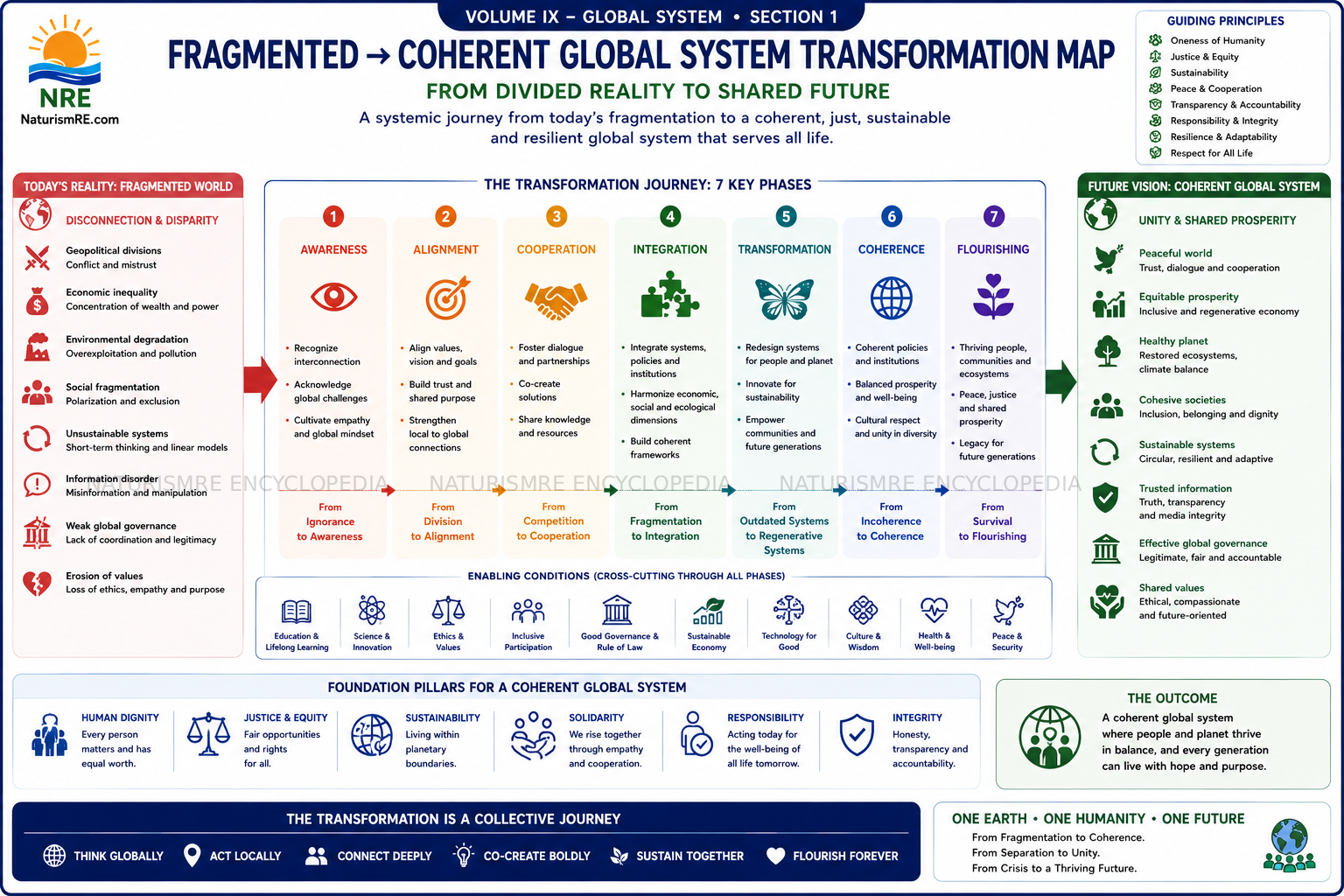
The transition from fragmented practice to a coherent global system depends on the development of shared frameworks, consolidation of knowledge, and alignment of operational principles across jurisdictions, enabling scalable, adaptive, and institutionally recognisable naturist systems.
1.1 The Structural Fragmentation of Naturist Practice
Across preceding volumes, naturist practice has been defined as context-dependent, jurisdictionally variable, behaviourally governed, and operationally structured.
At a global level, however, it remains structurally fragmented.
This fragmentation is characterised by inconsistent legal treatment across jurisdictions, divergent organisational models, absence of unified operational standards, and variability in perception and social acceptance.
As a result, similar environments operate under different conditions, knowledge remains distributed and non-standardised, and scalability is constrained by lack of coherence.
Fragmentation does not prevent operation. It limits system-wide development and recognition.
1.2 The Need for System Coherence
To progress beyond isolated implementation, naturist systems require coherence.
Coherence is defined as alignment of core principles across environments, consistency in behavioural and operational frameworks, and shared understanding among stakeholders.
It enables transferability of models, comparability of outcomes, and accumulation of knowledge across contexts.
Without coherence, systems remain localised, perception remains inconsistent, and institutional integration is constrained.
Coherence does not imply uniformity. It requires structural alignment while allowing contextual adaptation.
1.3 Defining a Global Naturist System Framework
A global system framework integrates behavioural standards, governance principles, risk management structures, legal alignment strategies, and communication models.
These elements form a baseline architecture that supports consistent interpretation across jurisdictions, scalable implementation, and alignment with institutional systems.
The framework functions as a reference structure and guiding model for deployment and evaluation.
It does not replace local adaptation but provides a common foundation for system coherence.
1.4 Standardisation Versus Local Adaptation
A central challenge in global system development is balancing standardisation with local adaptation.
Standardisation
Provides consistency, recognisability, and comparability across operational environments.
Local Adaptation
Ensures alignment with jurisdictional, cultural, and environmental conditions.
Over-Standardisation Risk
Excessive rigidity may reduce flexibility and create contextual misalignment.
Modular Alignment
Core operational elements remain stable while implementation details adapt locally.
Effective systems adopt a modular approach in which core elements remain consistent while operational details are adapted locally.
This enables global coherence alongside local applicability.
1.5 Knowledge Consolidation and System Learning
Fragmented systems often lack mechanisms for consolidating knowledge.
A global framework enables aggregation of data and observations, identification of patterns across environments, and sharing of best practices.
This supports a system learning process in which operational models improve over time, risks are better understood, and scalability is enhanced.
Without consolidation, knowledge remains isolated, errors are repeated, and innovation is constrained.
1.6 Institutional Positioning at the Global Level
A coherent global system enables naturism to be positioned within international health, planning, environmental, and policy frameworks.
Institutional positioning requires consistent terminology, evidence-based models, and alignment with recognised systems of governance and analysis.
Global coherence enhances credibility, recognisability, and capacity for engagement with institutional actors.
1.7 Transition from Decentralised Practice to Coordinated Systems
Naturist participation is largely decentralised, with individuals and local groups operating independently and limited coordination across regions.
Future systems must enable coordination without centralised control and alignment without restricting autonomy.
This is achieved through shared frameworks, distributed implementation models, and common standards of behaviour and operation.
Such systems allow scalability, resilience, and adaptability while preserving decentralised participation.
1.8 Analytical Conclusion
Naturist practice at a global level is characterised by fragmentation and variability, which limit scalability and institutional recognition.
Fragmentation arises from legal, cultural, and operational differences. System coherence is required for transferability and scalability. Global frameworks provide baseline structure while allowing adaptation. Modular standardisation balances consistency and flexibility. Knowledge consolidation enables continuous improvement. Institutional positioning depends on coherent and evidence-based frameworks. Coordinated systems can emerge without centralised control.
Naturist systems that evolve toward global coherence will align core principles across environments, support distributed implementation, and maintain adaptability within a structured framework.
This establishes the foundational principle for Volume IX:
The transition from fragmented practice to a coherent global system depends on the development of shared frameworks, consolidation of knowledge, and alignment of operational principles across jurisdictions, enabling scalable, adaptive, and institutionally recognisable naturist systems.
Primary Supporting Articles
The Global Integration Problem, Why Naturism Remains Fragmented Across Countries
The Convergence Question, Can Naturism Ever Become a Unified System
From Fragmented Practice to Structured Systems, The Evolution of Naturism as a Social Architecture
From Isolated Systems to Integrated Frameworks, The Emergence of Multi-Domain Naturist Models