Global System Integration, Strategic Alignment, and Institutional Equilibrium
Examining how naturist systems achieve global coherence through strategic alignment, institutional equilibrium, and resilient integration across multiple operational domains.
The long-term global viability of naturist systems depends on their ability to achieve institutional equilibrium through coordinated, adaptive, and standardised frameworks that align behavioural integrity, governance, legal compatibility, and societal integration within a resilient and scalable global system architecture.
8.1 Convergence of Global System Components
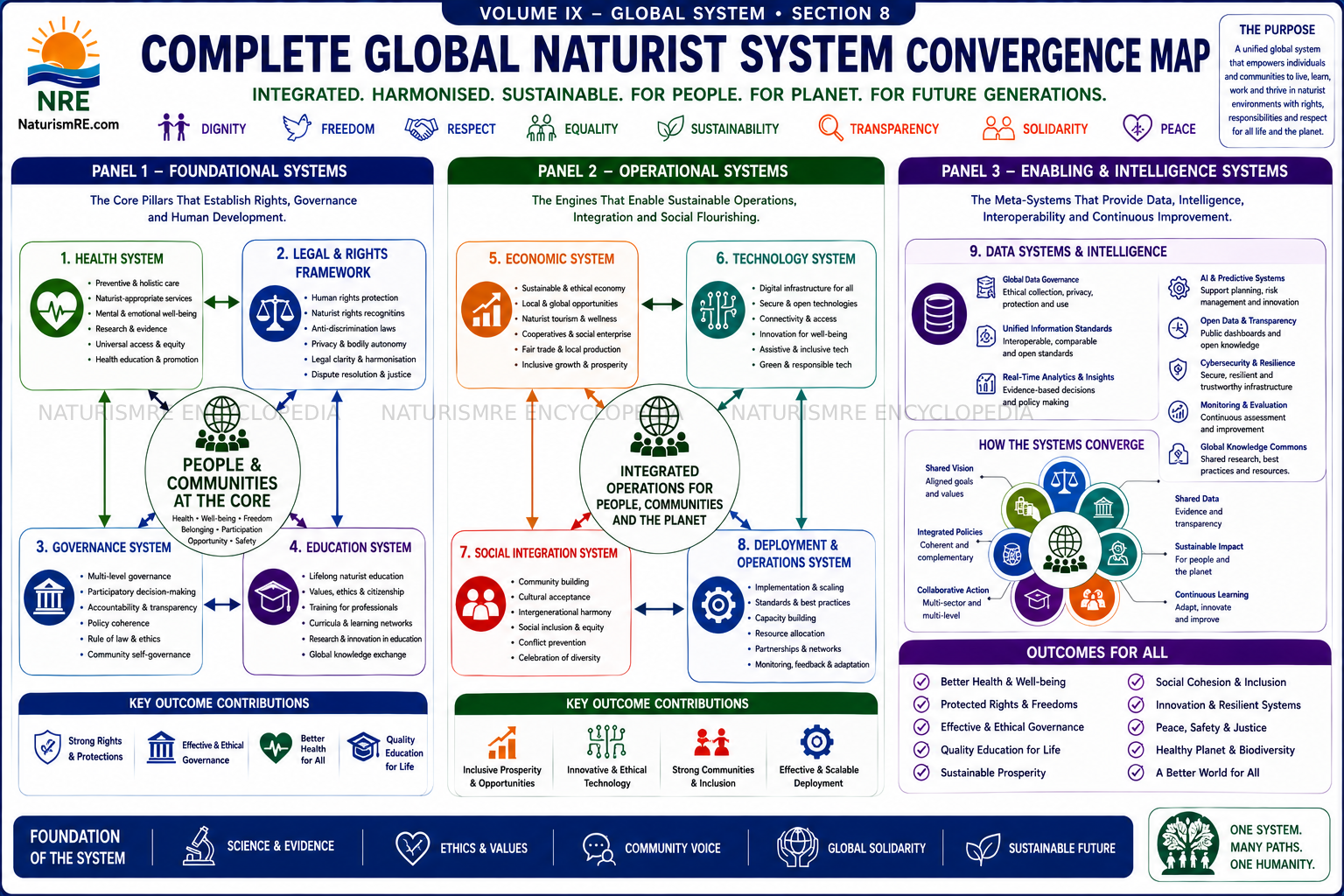
Volumes I–IX collectively establish naturist systems as a multi-dimensional, structured framework comprising behavioural integrity systems, governance and compliance architectures, legal and regulatory alignment, health and human factors integration, implementation and scaling models, technological and urban adaptation, economic and ethical frameworks, and standardisation, certification, and education systems.
These components do not operate independently. They converge into a global system architecture in which each element reinforces the others, system stability depends on alignment across all dimensions, and fragmentation is progressively replaced by coordinated structure.
The transition from isolated environments to a global system requires integration across all operational layers.
8.2 Strategic Alignment Across Domains
Global system viability depends on alignment across multiple domains.
Legal Alignment
Ensures compatibility with jurisdictional frameworks and regulatory interpretation thresholds.
Social Alignment
Maintains consistency with perception dynamics, cultural expectations, and acceptance thresholds.
Economic Alignment
Supports sustainable cost structures, value generation, and scalable operational models.
Technological Alignment
Enables digital integration without creating dependency or compromising operational resilience.
Institutional Alignment
Ensures compatibility with governance systems, policy structures, and institutional expectations.
Misalignment in any domain may destabilise environments, reduce scalability, and limit institutional recognition.
Strategic alignment ensures that systems operate within a coherent, multi-domain equilibrium.
8.3 From Distributed Systems to Coordinated Networks
Naturist practice has historically been decentralised, loosely coordinated, and context-dependent.
A global framework enables transition toward coordinated networks of environments characterised by shared standards, interoperable systems, and distributed implementation.
These networks preserve local autonomy and contextual adaptation while achieving global coherence, consistent interpretation, and scalable development.
8.4 Institutional Equilibrium and System Stability
At the global level, system stability is achieved through institutional equilibrium.
This occurs when frameworks are consistently applied, governance structures operate effectively, and stakeholder expectations are aligned.
Institutional equilibrium requires balance between central coordination and decentralised implementation, continuous adaptation to evolving conditions, and integration of feedback across system levels.
When equilibrium is maintained, systems remain stable across jurisdictions, scalability is supported, and long-term viability is enhanced.
8.5 Long-Term Trajectories of Global Integration
Global naturist systems may evolve along multiple trajectories.
Coordinated integration involves alignment across jurisdictions and institutions, recognition within policy frameworks, and stable system operation.
Partial integration reflects coherence within some regions while variability persists elsewhere.
Persistent fragmentation represents limited adoption of frameworks and continued reliance on isolated environments.
These trajectories are influenced by standardisation effectiveness, alignment with external systems, and consistency of operational performance.
8.6 System Resilience and Adaptive Capacity at Scale
Global systems must demonstrate resilience.
Resilience involves maintaining function across diverse conditions, absorbing local disruptions, and adapting to changing legal, social, and technological environments.
This is supported by modular frameworks, distributed governance, and integrated data and feedback systems.
Adaptive capacity ensures that systems evolve without structural failure, new environments are integrated effectively, and long-term coherence is maintained.
8.7 Limits and Boundary Conditions of Global Systems
Global systems operate within structural constraints, including jurisdictional variability, cultural diversity, regulatory limitations, and resource availability.
These constraints define the pace of integration, the extent of scalability, and the degree of achievable uniformity.
Recognition of these limits is essential to avoid over-expansion, maintain system integrity, and ensure sustainable development.
8.8 Analytical Conclusion
The synthesis of Volumes I–IX establishes naturist systems as coherent, multi-layered frameworks capable of global integration.
Global systems emerge through alignment of behavioural, legal, operational, and institutional components. Strategic alignment across domains is essential for stability and scalability. Coordinated networks enable global coherence while preserving local adaptation. Institutional equilibrium supports long-term viability. Multiple integration trajectories are possible. Resilience and adaptive capacity are critical at scale. Structural limits define achievable outcomes.
Naturist systems that achieve global integration maintain coherence across operational dimensions, adapt to diverse conditions without fragmentation, and operate within defined limits while supporting continuous evolution.
This establishes the overarching principle of Volume IX:
The long-term global viability of naturist systems depends on their ability to achieve institutional equilibrium through coordinated, adaptive, and standardised frameworks that align behavioural integrity, governance, legal compatibility, and societal integration within a resilient and scalable global system architecture.