

Site Selection, Environmental Criteria, and Spatial Design Parameters
Examining how site selection, environmental alignment, and spatial design influence the operational viability, stability, and scalability of naturist systems.
The viability and scalability of naturist environments depend on the ability to select and design sites that minimise ambiguity, align with legal and social conditions, and support controlled and predictable interaction within clearly defined spatial parameters.
3.1 The Strategic Importance of Site Selection
Site selection is a determinant variable in the success or failure of naturist system deployment.
Even well-designed governance and compliance frameworks may fail if the environment is misaligned with context, interaction with non-participants is uncontrolled, or visibility creates unintended exposure.
Conversely, appropriate site selection can reduce legal and social risk, support behavioural consistency, and enhance interpretability of the environment.
Site selection is therefore not a logistical step. It is a primary risk control mechanism.
3.2 Core Environmental Criteria
Effective site selection is based on a combination of physical, social, and regulatory criteria.
Spatial Separation
Distance from high-density general-use areas reduces unintended interaction and likelihood of complaint.
Controlled Visibility
Exposure remains contextually appropriate through management of sight lines and public visibility.
Balanced Accessibility
Participant access is maintained while excessive through-traffic by non-participants is limited.
Environmental Stability
Predictable terrain and manageable environmental conditions support operational safety and consistency.
Land-Use Compatibility
Alignment with surrounding land use reduces conflict and supports contextual legitimacy.
These criteria collectively support clarity, predictability, and operational stability.
3.3 Legal and Regulatory Alignment in Site Selection
Site selection must align with applicable bylaws, land-use regulations, and local enforcement patterns.
Key considerations include the presence of precedent for similar use, proximity to regulated or sensitive areas, and the likelihood of regulatory scrutiny.
Sites characterised by ambiguous legal status or high enforcement visibility increase the risk of intervention and inconsistent operation.
Site selection therefore functions as a first-stage legal filter, reducing exposure before deployment begins.
3.4 Social Context and Interaction Potential
The surrounding social environment influences perception, tolerance, and likelihood of conflict.
Relevant variables include population density, typical use patterns, and demographic characteristics of adjacent users.
Sites with mixed or conflicting use patterns introduce interpretative ambiguity and increase the risk of complaint.
In contrast, environments with consistent use patterns and predictable user behaviour support stable integration and clearer interpretation.
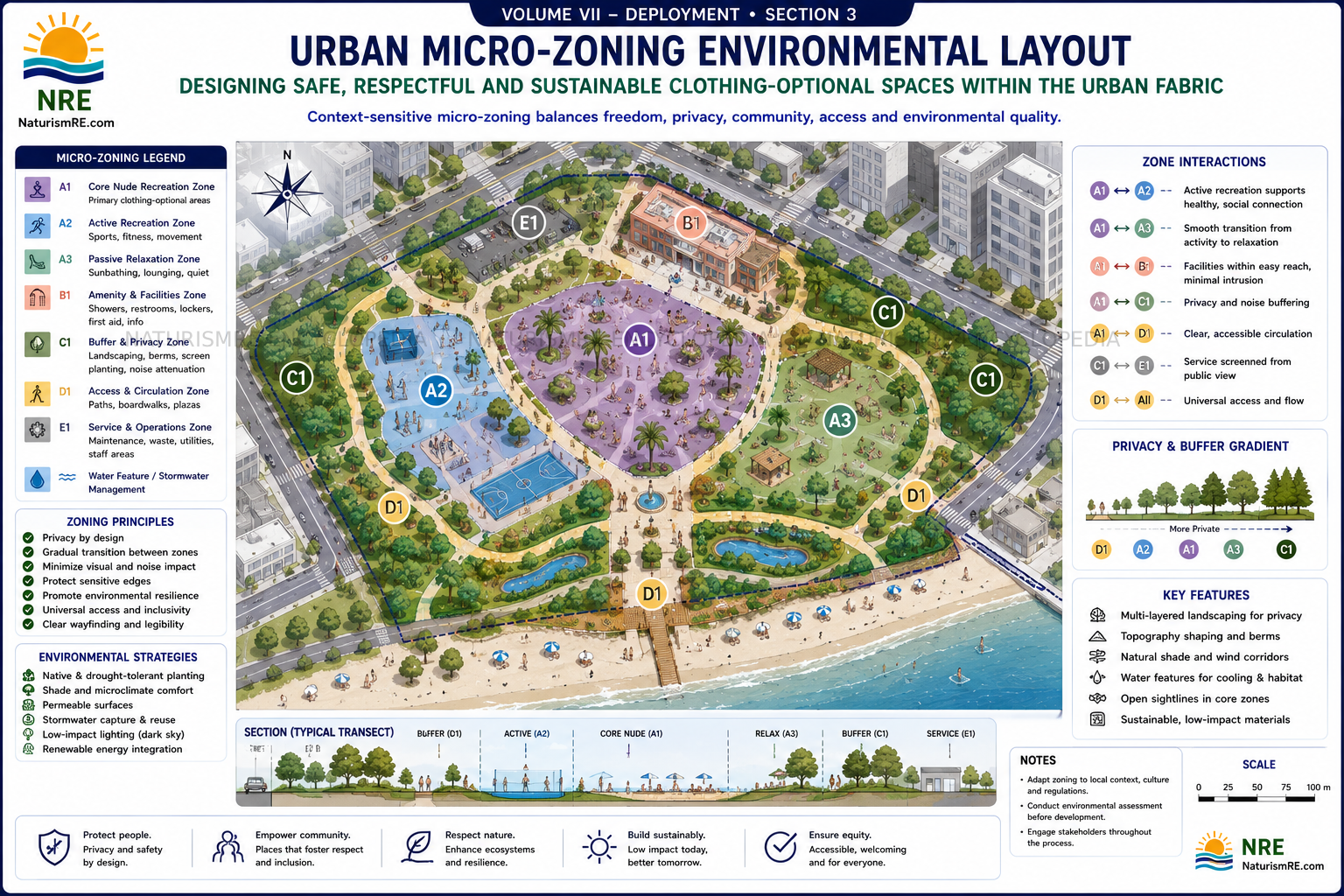
3.5 Spatial Design and Boundary Definition
Beyond selection, spatial design determines how the environment operates in practice.
Boundary clarity requires clear demarcation of operational areas and identifiable transition points between zones.
Internal zoning allows allocation of space for different activities and management of participant density.
Flow management controls movement within and around the environment, reducing unintended interaction between zones.
Defined entry and exit points ensure controlled access and support participant awareness upon entry.
Effective spatial design reduces ambiguity, supports behavioural consistency, and limits uncontrolled interaction.
3.6 Environmental Conditions and Operational Suitability
Operational viability depends on environmental conditions such as climate, seasonal variation, terrain stability, and availability of shelter.
These conditions must support safe exposure, predictable behaviour, and manageable risk profiles.
Sites with extreme or highly variable conditions, or limited capacity for adaptation, may not be suitable for structured deployment.
Environmental suitability is therefore a core determinant of operational feasibility.
3.7 Scalability Constraints Linked to Site Characteristics
Not all sites support scalable expansion.
Constraints may arise from physical space limitations, visibility exposure, and surrounding land-use conflicts.
As participation increases, density may exceed behavioural control capacity, and interaction with non-participants may rise.
Scaling must therefore consider whether the site can accommodate increased use and whether governance mechanisms can adapt accordingly.
Failure to align scaling with site capacity can result in instability and increased risk exposure.
3.8 Analytical Conclusion
Site selection and spatial design are foundational elements of naturist system deployment.
Site selection functions as a primary risk control mechanism. Environmental criteria must address spatial, social, and regulatory conditions. Legal alignment reduces exposure before operation begins. Social context influences perception and tolerance. Spatial design ensures clarity, flow, and behavioural consistency. Environmental conditions determine suitability, and scalability is constrained by site characteristics.
Naturist systems are not location-neutral. Their viability depends on alignment between environmental conditions and system requirements.
This establishes a defining principle for Volume VII:
The viability and scalability of naturist environments depend on the ability to select and design sites that minimise ambiguity, align with legal and social conditions, and support controlled and predictable interaction within clearly defined spatial parameters.
Primary Supporting Articles
Spatial Segmentation as a Conflict Prevention Mechanism
Urban Density Constraints and Adaptation Models
Urban Constraints and the Limits of Informal Naturism
Micro-Zoning Models for Urban Integration
Why Spatial Constraints Shape the Limits of Naturist Systems