

Monitoring, Evaluation, and Performance Feedback Systems
Examining how structured monitoring, performance evaluation, and adaptive feedback systems preserve operational stability and long-term viability within naturist environments.
The long-term sustainability of naturist systems depends on their ability to implement continuous monitoring and adaptive evaluation processes, ensuring that performance, behaviour, and environmental conditions remain aligned with defined operational parameters over time.
7.1 The Role of Monitoring in System Stability
Deployment and scaling do not conclude implementation. They initiate a phase requiring continuous monitoring and evaluation.
Naturist systems operate within variable environments, evolving social contexts, and shifting legal conditions. Without monitoring, deviations may go undetected, emerging risks may escalate, and system stability may degrade over time.
Monitoring therefore functions as a stability-preserving mechanism, ensuring that operational conditions remain aligned with defined parameters.
7.2 Defining Performance Indicators
Effective evaluation requires clearly defined performance indicators aligned with system objectives.
Behavioural Stability Indicators
Assess consistency of participant conduct and the frequency and nature of behavioural deviations.
Environmental Condition Indicators
Measure alignment between operational conditions and defined environmental parameters.
Interaction Outcome Indicators
Evaluate conflict levels, external complaints, and interaction patterns with non-participants.
Participation Pattern Indicators
Track participant density, distribution, repeat engagement, and operational load.
Perception Indicators
Assess participant perception of predictability and safety alongside external stakeholder response.
Indicators must be observable, relevant, and proportionate to the scale of operation.
7.3 Data Collection and Observational Methods
Monitoring relies on structured data collection adapted to the nature of the environment.
Methods may include direct observation of behavioural patterns, participant feedback mechanisms, recording of environmental conditions, and documentation of incidents or deviations.
Data collection must balance the need for information with respect for participant privacy and operational practicality.
Overly complex systems may reduce compliance and increase operational burden. Effective systems prioritise simple, repeatable methods.
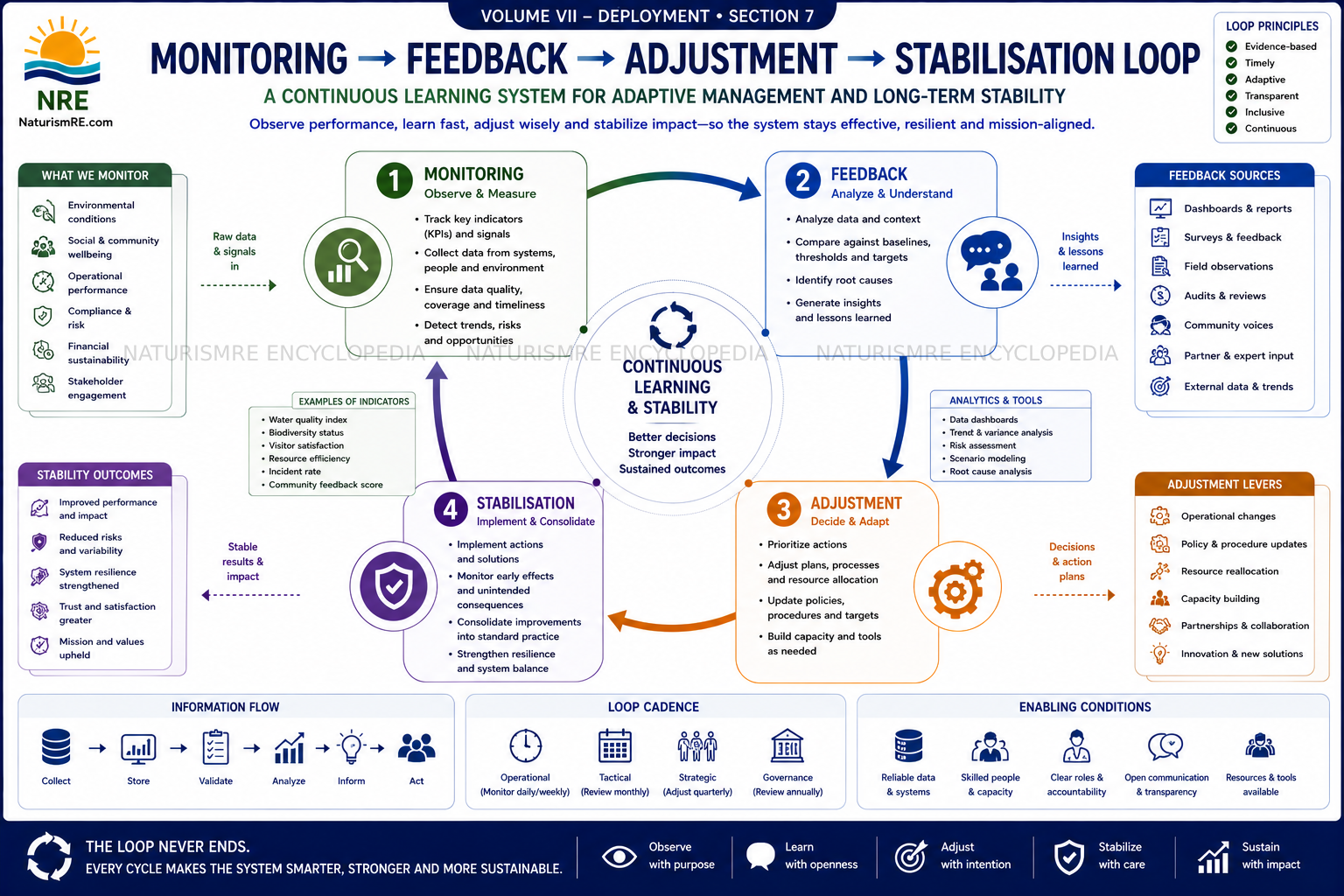
7.4 Feedback Loops and Adaptive Management
Monitoring is effective only when linked to feedback mechanisms.
Feedback loops involve data collection, evaluation against defined criteria, identification of variance or risk, and adjustment of operational parameters.
This creates a system of adaptive management in which conditions are continuously refined, emerging issues are addressed early, and system performance improves over time.
Without feedback loops, monitoring becomes passive, issues persist, and system resilience declines.
7.5 Early Warning Indicators and Threshold Detection
Effective monitoring systems identify early warning indicators, enabling intervention before instability develops.
Examples include increases in minor behavioural deviations, rising participant density beyond expected levels, changes in external interaction patterns, and environmental conditions approaching risk thresholds.
Detection of these indicators enables timely adjustment, prevention of escalation, and maintenance of system equilibrium.
Failure to detect early signals may result in rapid deterioration, increased complaints, and potential enforcement action.
7.6 Evaluation Cycles and Periodic Review
In addition to continuous monitoring, systems require periodic evaluation cycles.
These involve structured review of performance indicators, assessment of alignment with objectives, and identification of trends over time.
Evaluation cycles may be time-based or triggered by events such as incidents or significant changes.
Periodic review enables validation of system effectiveness, identification of long-term patterns, and informed decision-making for scaling or adjustment.
7.7 Transparency and Stakeholder Confidence
Monitoring and evaluation contribute to transparency, which supports participant confidence, stakeholder trust, and institutional acceptance.
Transparency does not require full disclosure of all data, but it requires demonstrable awareness of system conditions, evidence of ongoing management, and the ability to respond to inquiries or concerns.
Lack of transparency may reduce trust, increase perceived risk, and hinder stakeholder alignment.
7.8 Analytical Conclusion
Monitoring and evaluation systems are essential for maintaining the integrity and adaptability of naturist environments.
Continuous monitoring preserves stability under variable conditions. Performance indicators must align with behavioural, environmental, and interaction outcomes. Data collection should be structured but practical. Feedback loops enable adaptive management. Early warning indicators support proactive intervention. Periodic evaluation ensures long-term alignment. Transparency reinforces stakeholder confidence.
Naturist systems that operate without monitoring remain vulnerable to undetected deviation, gradual instability, and loss of operational control.
This establishes a defining principle for Volume VII:
The long-term sustainability of naturist systems depends on their ability to implement continuous monitoring and adaptive evaluation processes, ensuring that performance, behaviour, and environmental conditions remain aligned with defined operational parameters over time.
Primary Supporting Articles
Data Integrity and Validation Logic in Contextualised Naturist Measurement Systems
Behavioural Drift, Causes, Detection, and Correction Mechanisms
Incident Response, System Resilience, and Recovery Protocols in Structured Naturist Environments