


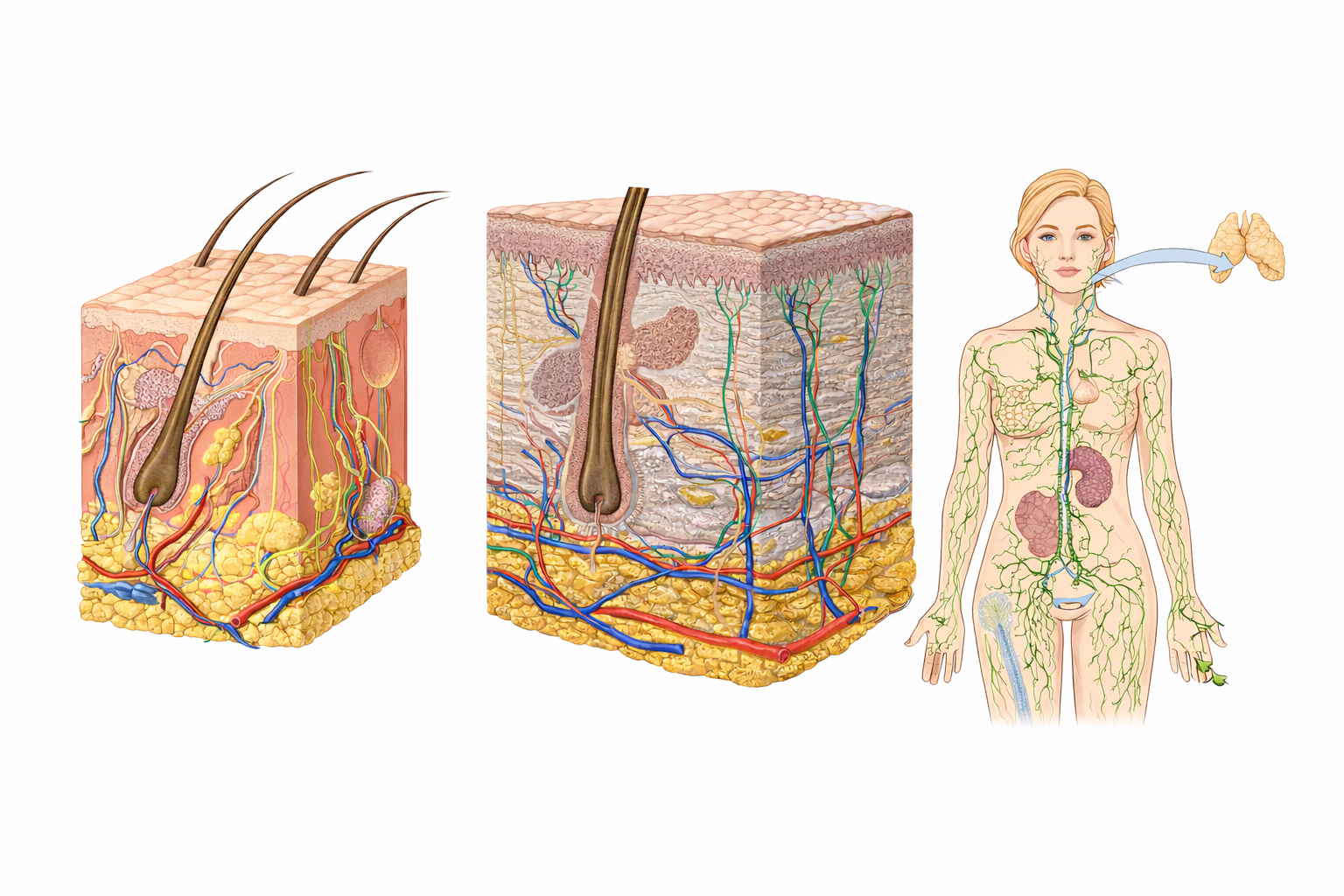
Skin, Fascia & the Lymphatic System
How clothing influences surface physiology, recovery, regulation, and wellbeing.
This page examines skin, fascia, and the lymphatic system as an integrated surface regulation layer affected by airflow, pressure, movement, heat, friction, hydration, and mechanical freedom.
Skin: The Body’s Largest, Most Exposed and Most Regulated Organ
Human skin is the largest organ of the body, representing approximately 15 to 20 percent of total body weight and covering close to two square metres in the average adult. It is not cosmetic. It is a metabolically active, sensory, immune, and regulatory organ that plays a central role in maintaining health and internal stability.
Skin is the body’s primary interface with the external environment. Unlike internal organs, which operate in relatively stable conditions, skin functions at the boundary between the body and constantly changing external variables including temperature, humidity, airflow, pressure, friction, microorganisms, light, and movement. Because of this role, the physical conditions at the skin surface directly influence systemic physiology.
Skin as an Environmental Regulation System
Skin continuously senses environmental inputs and converts them into physiological responses. Thermal sensors, pressure receptors, stretch receptors, and pain receptors embedded in the skin feed real-time data into the nervous system. This information drives adjustments in circulation, sweating, posture, behaviour, hydration, and energy expenditure.
Skin therefore functions as a regulatory system rather than a passive covering. When its interaction with the environment is altered through sustained coverage, compression, or ventilation restriction, regulatory efficiency is reduced and compensatory strain increases elsewhere in the body.
Structural and Functional Organisation of the Skin
- The epidermis provides barrier protection, microbial defence, and water retention.
- The dermis contains blood vessels, nerves, immune cells, sweat glands, and connective tissue.
- The skin surface hosts a complex microbiome that contributes to immune defence and barrier stability.
Core Physiological Functions of the Skin
Barrier protection: Skin forms a physical, chemical, and biological barrier against injury, dehydration, toxins, and pathogens.
Thermoregulation and heat exchange: Skin regulates body temperature through vasodilation, vasoconstriction, and sweat evaporation.
Immune defence and immune balance: Skin contains specialised immune cells that detect pathogens, coordinate inflammatory responses, and support immune tolerance.
Sensory input and nervous system integration: Skin provides continuous sensory feedback related to touch, pressure, vibration, temperature, and pain.
Fluid regulation and tissue support: Skin works with microcirculation and the lymphatic system to support fluid exchange, immune transport, and tissue clearance.
Metabolic and endocrine activity: Skin participates in vitamin D synthesis, local hormone signalling, and circadian rhythm regulation through light and temperature sensing.
Effects of Sustained Skin Coverage and Compression
- Reduced evaporation of sweat and impaired cooling.
- Increased local heat retention and humidity.
- Greater friction between skin and fabric.
- Repeated microtrauma at seams, elastic bands, and folds.
- Barrier disruption in high-contact areas.
- Alteration of the skin microbiome in warm, enclosed zones.
- Increased inflammatory responses in susceptible tissues.
Key Principle
Fascia: The Body’s Continuous Connective and Communication Network
Fascia is a continuous, body-wide connective tissue system that surrounds, supports, separates, and integrates muscles, organs, nerves, blood vessels, and bones. It is not packing material. It is a living, responsive tissue network that plays a central role in movement, circulation, sensory awareness, and structural integrity.
Fascia connects every part of the body to every other part. Mechanical forces, fluid movement, and sensory signals are transmitted through fascial pathways.
Core Physiological Functions of Fascia
Force transmission and load distribution: Fascia distributes mechanical forces generated by movement across the body.
Tissue glide and movement efficiency: Healthy fascia allows tissues to slide smoothly over one another.
Structural support and posture: Fascia contributes to posture by maintaining tension and alignment throughout the body.
Sensory signalling and body awareness: Fascia plays a major role in proprioception and interoception.
Circulatory and lymphatic integration: Blood vessels and lymphatic vessels travel through fascial planes.
Inflammatory and immune interaction: Fascia contains immune cells and responds to irritation with inflammatory signalling.
Effects of Sustained Surface Compression and Restriction
- Reduced tissue glide.
- Increased local stiffness.
- Altered force transmission.
- Localised fluid accumulation.
- Impaired lymphatic drainage.
- Distorted sensory feedback.
- Increased perception of tightness or restriction.
Key Principle
Lymphatic System: The Body’s Silent Circulation and Immune Transport Network
The lymphatic system is a body-wide transport and regulatory network responsible for fluid balance, immune surveillance, waste removal, and inflammation control. Unlike the cardiovascular system, the lymphatic system has no central pump. Its efficiency depends on movement, breathing, tissue expansion, and mechanical freedom.
The Role of the Lymphatic System
Fluid balance: The lymphatic system collects excess fluid from tissues and returns it to the bloodstream.
Immune transport and surveillance: Lymphatic vessels transport immune cells, antigens, and signalling molecules.
Waste and byproduct clearance: The system removes cellular waste products, metabolic byproducts, and debris.
Inflammation regulation: Lymphatic transport helps initiate, sustain, and resolve inflammatory responses.
How Lymph Moves Without a Pump
- Muscle contraction during movement.
- Breathing, especially diaphragm movement.
- Pressure changes created by tissue expansion and recoil.
- Valves within lymphatic vessels that prevent backflow.
Effects of Reduced Lymphatic Flow
- Localised swelling or puffiness.
- Sensations of heaviness or fatigue.
- Slower tissue recovery.
- Prolonged inflammation.
- Increased sensitivity or discomfort.
- Reduced immune responsiveness at the tissue level.
Key Principle
Practical Conclusion on Clothing and Physiology
From a physiological perspective, clothing is a functional tool rather than a biological requirement. The skin, fascia, and lymphatic system are designed to operate with airflow, movement, temperature variation, and mechanical freedom.
Where conditions allow, reducing unnecessary coverage, compression, and occlusion supports more efficient thermoregulation, tissue glide, fluid movement, and sensory feedback.
For this reason, minimal or no clothing, when safe, lawful, and contextually appropriate, represents the lowest-interference state for surface regulation systems. Clothing remains valuable where protection is required, but excess or continuous coverage should be understood as a trade-off rather than a default for health.
Safe Health Zones (SHZ)
Learn how NRE health principles are applied within structured recovery and wellbeing environments.
Explore SHZNRE-HEALTH Radio™
Listen to calm, evidence-informed health briefings available anytime through the live stream.
Click Here to ListenEnglish Encyclopedia
Explore the English NRE Nudism & Naturism Encyclopedia ecosystem.
Open English EncyclopediaEncyclopédie Française
Découvrez l’écosystème encyclopédique français de NRE consacré au nudisme et au naturisme.
Ouvrir l’Encyclopédie FrançaiseNRE Health Institute Library
Access institutional-grade educational articles, frameworks, research, and wellbeing resources.
Open English LibraryBibliothèque Française du NRE Health Institute
Explore the French-language NRE Health Institute educational and institutional library.
Ouvrir la Bibliothèque Française