

Late 20th Century Diversification: Structural Expansion and System Fragmentation (1980s–2000)
Examining the diversification of naturism into a distributed and multi-form system characterised by decentralised participation, increased visibility, and structural fragmentation.
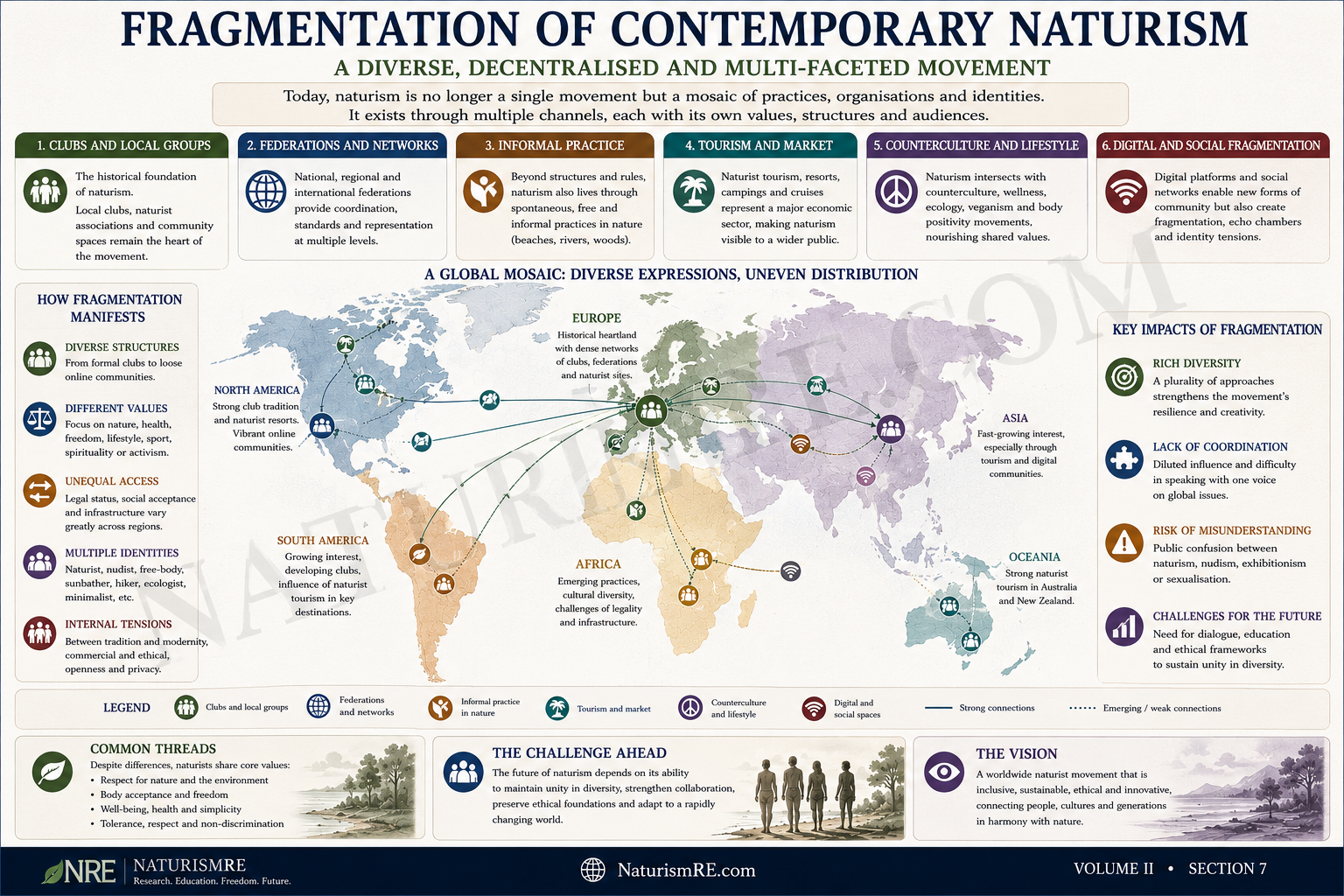
Naturism does not expand through uniformity. It expands through diversification across contexts.
7.1 Purpose
This section analyses the late twentieth century as a phase of structural diversification and system expansion in the evolution of naturism.
Its purpose is to examine the transition from consolidated institutional models to diversified participation systems, to identify the mechanisms driving expansion across cultural, geographic, and economic domains, and to define how naturism evolves into a multi-form, distributed system.
This section establishes the structural transformation of naturism into a variable and adaptive system.
7.2 Transition from Consolidation to System Diversification
Following post-war consolidation, naturism entered a phase in which institutional structures remained stable, while modes of participation diversified.
This transition was characterised by expansion beyond club-based systems, increased variation in environments and practices, and growing interaction with broader social and cultural systems.
Naturism ceased to operate as a single structured model and began to exist as a system composed of multiple overlapping participation formats.
7.3 Expansion of Participation Modalities
Participation extended beyond traditional environments such as organised clubs, federated associations, and regulated resorts.
Organised Participation
Structured clubs, associations, resorts, and regulated environments continued operating through governance and behavioural control.
Informal Beach Participation
Independent participation expanded through non-affiliated beach use and informal social environments.
Travel-Based Activity
Increased global mobility enabled destination-based participation and tourism-driven engagement.
Decentralised Participation
Self-directed and non-institutional participation increasingly became a dominant component of naturist systems.
In many regions, informal participation expanded more rapidly than formal membership, establishing decentralised participation as a dominant system component.
7.4 Cultural Integration and Increased Visibility
Naturism became increasingly visible within broader cultural contexts due to the expansion of global travel, increased media exposure, and wider public discourse on the human body.
This produced a structural shift in which naturism moved from marginal classification toward partial integration as a context-dependent lifestyle form.
However, this shift remained uneven across regions and dependent on local cultural frameworks. Visibility increased, but interpretation remained variable.
7.5 Post-Revolution Body Culture and Interpretative Risk
The continuing influence of the sexual revolution contributed to increased visibility of the body in media and public discourse.
This produced dual effects. On one hand, accessibility and interest in naturism increased. On the other, the risk of misclassification intensified.
The distinction between non-sexual social nudity and sexualised representation became structurally critical. Where this distinction was not maintained, interpretative ambiguity increased, resulting in reputational instability.
7.6 Media System Interaction and Narrative Divergence
Media representation expanded significantly during this period but remained structurally inconsistent.
Patterns included sensationalist framing of atypical cases, conflation with sexual behaviour, and selective emphasis on extremes. At the same time, more neutral representations emerged through documentary, journalistic, and academic formats.
This produced a dual narrative environment characterised by increased awareness alongside persistent misinterpretation.
Naturism’s public representation became a contested informational space shaped by competing narratives.
7.7 Economic Integration and Tourism Structuring
Naturism became more formally integrated into economic systems, particularly through tourism, destination-based participation, and specialised service environments.
Key developments included expansion of naturist resorts, emergence of clothing-optional travel markets, and growth in repeat participation patterns.
This established naturism as a structured niche within the global tourism economy. However, this integration remained geographically concentrated, dependent on regulatory conditions, and sensitive to social perception.
7.8 Geographic Expansion and System Distribution
Naturism expanded beyond its traditional European base into regions including North America, Oceania, and parts of Latin America.
Expansion was influenced by climate suitability, legal permissibility, tourism infrastructure, and cultural openness.
Despite this growth, distribution remained uneven, resulting in a system that was globally present but regionally variable.
7.9 Institutional Adaptation and Structural Tension
Traditional naturist organisations adapted to changing conditions by expanding membership structures, increasing outreach, and engaging with media and public discourse.
However, they faced structural challenges including declining membership in some regions, competition from informal participation, and difficulty engaging emerging demographics.
This created a divergence between institutional frameworks and evolving participation patterns.
7.10 Structural Tension Between Governance and Informality
A defining characteristic of this period is the persistent tension between structured environments and informal participation.
Structured systems provided stability, behavioural consistency, and legal defensibility. Informal systems provided accessibility, adaptability, and low barriers to entry.
This tension did not resolve. It became a permanent feature of naturist system architecture.
7.11 Legal and Social Stabilisation Mechanisms
Legal frameworks in some regions evolved toward recognition of designated environments, context-based enforcement, and clearer differentiation between nudity and indecency.
This increased stability where environments were controlled and expectations clearly defined.
However, stability remained region-specific, dependent on cultural acceptance, and vulnerable to misinterpretation.
Naturism continued to rely on controlled environments as stabilising structures.
7.12 Analytical Implications
The late twentieth century establishes several system-level transformations.
Multi-Form Systems
Naturism evolves from unified institutional structure into a distributed and diversified participation system.
Informal Expansion
Informal participation becomes a dominant and rapidly expanding component of system activity.
Visibility Without Uniformity
Increased cultural visibility does not eliminate interpretative variability or misclassification risk.
Institutional Decentralisation
Traditional organisations adapt structurally but lose exclusivity as primary participation channels.
These developments redefine naturism as a distributed, multi-layered system operating across formal and informal domains.
7.13 Conclusion
The late twentieth century transforms naturism from a contained institutional system into a diversified and distributed structure.
This transformation is characterised not by uniform expansion, but by variation in participation models, divergence in perception, and the coexistence of structured and informal systems.
Naturism becomes more visible, more accessible, and more complex to define within a single framework.
This leads to a defining principle:
Naturism does not expand through uniformity. It expands through diversification across contexts.
This diversification strengthens adaptability but introduces fragmentation, interpretative variability, and continued dependence on controlled environments.
The late twentieth century therefore establishes naturism as a flexible but structurally dependent system, capable of operating across multiple environments while remaining reliant on behavioural consistency and contextual stability.
This forms the foundation for the twenty-first century recontextualisation, in which digital, legal, and global systems further reshape its operational conditions.
Primary Supporting Articles
From Representation to Reality, Why Most Naturists Are Invisible to the System
Secondary Supporting Articles
Why Partial Integration Produces Persistent Instability
Why Fragmentation Persists Even When Conditions Improve
The Global Integration Problem, Why Naturism Remains Fragmented Across Countries
Why Systems Fail to Scale When Entry and Structure Diverge
Why Behaviour Remains Interpreted as Exception Rather Than Norm