Communication Systems, Public Interface, and Narrative Control
Examining how communication systems shape interpretation, stakeholder perception, operational legitimacy, and narrative stability within structured naturist environments.
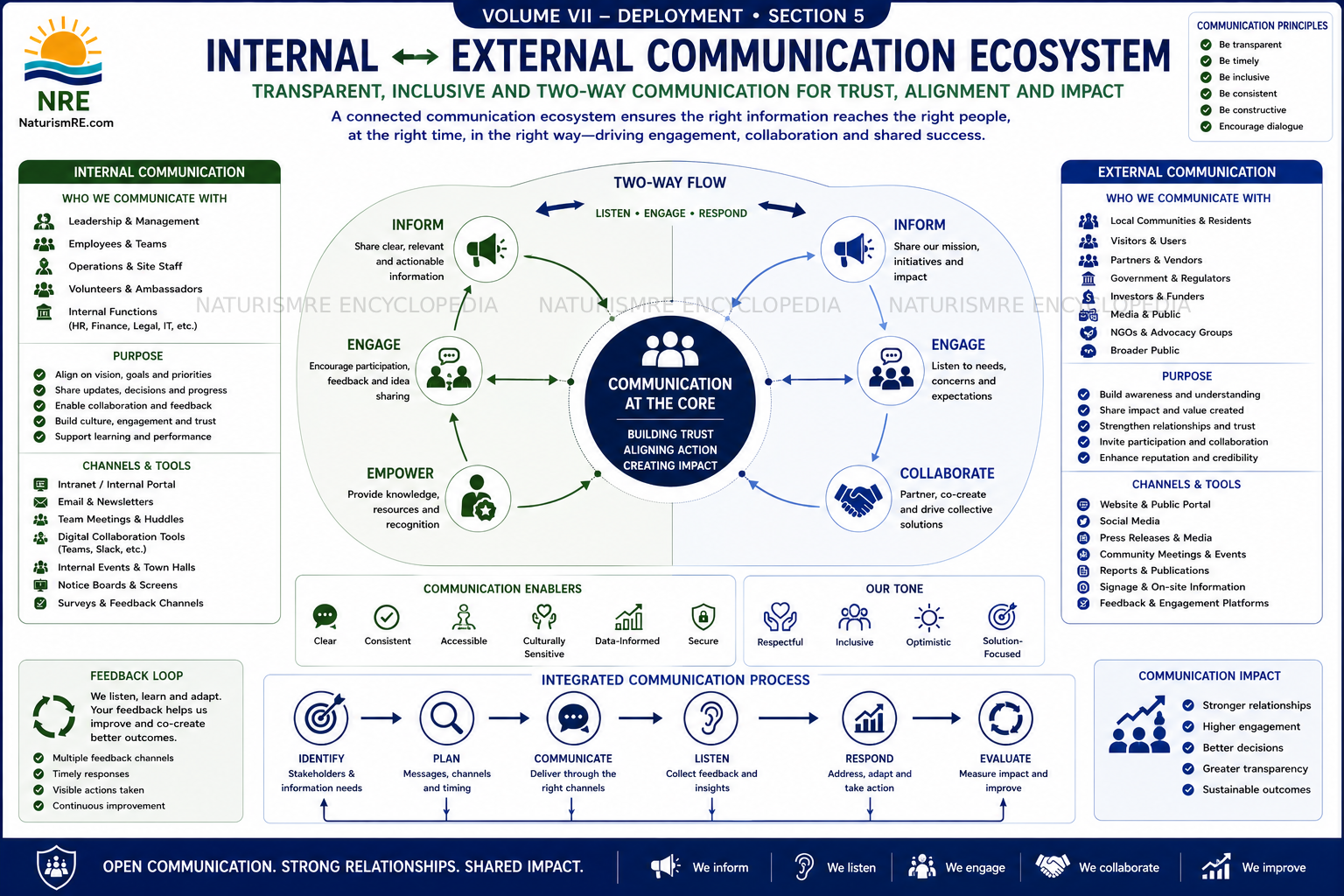
The sustainability and scalability of naturist environments depend on their ability to maintain coherent communication systems that align internal behaviour with external perception, ensuring that context, intent, and operational reality remain consistently interpretable across all stakeholder interfaces.
5.1 Communication as an Operational Layer
Communication in naturist systems is not ancillary. It is an operational layer that directly influences interpretation, acceptance, and legal exposure.
While internal governance regulates behaviour, communication frames how the environment is understood, shapes stakeholder perception, and affects the likelihood of complaint or escalation.
A system may be internally consistent yet externally unstable if its purpose is unclear, its conditions are misinterpreted, or its narrative is inconsistent.
Communication therefore functions as the bridge between operational reality and external perception.
5.2 Internal Communication and Participant Alignment
Internal communication ensures that participants understand the purpose of the environment, align with behavioural expectations, and recognise defined boundaries and conditions.
This includes clarity at entry, reinforcement of non-ambiguous and non-disruptive conduct, and awareness of environmental and social context.
Effective internal communication reduces behavioural variability, supports norm formation, and lowers the need for corrective intervention.
Where communication is inconsistent or absent, participant expectations may diverge, increasing the likelihood of deviation and reducing system stability.
5.3 External Communication and Public Interpretation
External communication addresses how the environment is perceived by non-participants, local communities, authorities, and the broader public.
Its primary objectives are to convey the structured nature of the environment, reduce ambiguity regarding intent, and align perception with operational reality.
External communication must be proportionate to the level of visibility, consistent with actual conditions, and free from overstatement.
Failure in external communication increases perceived risk, elevates the likelihood of complaint, and may trigger regulatory scrutiny.
5.4 Narrative Formation and Control Limitations
Narratives surrounding naturist environments are shaped by a combination of direct experience, second-hand accounts, media representation, and digital dissemination.
System operators do not fully control these narratives. External factors such as selective interpretation, amplification of atypical events, and simplification of complex contexts influence public understanding.
As a result, narrative control is inherently limited, and reactive correction alone is insufficient.
Operational strategy must therefore focus on reducing conditions that enable misinterpretation and ensuring that observable reality aligns with intended messaging.
5.5 Messaging Frameworks and Content Positioning
Effective communication requires structured messaging frameworks that define how environments are described, what elements are emphasised, and how risks and conditions are presented.
Contextual Precision
Clear definition of purpose, boundaries, and operational conditions reduces ambiguity and interpretative variability.
Behaviour-Centred Messaging
Emphasis is placed on observable conduct and environmental structure rather than abstract positioning.
Proportional Claims
Communication remains aligned with operational reality and avoids exaggeration or unsupported assertions.
Channel Consistency
Messaging remains coherent across all communication interfaces and stakeholder interactions.
Unstructured messaging introduces ambiguity, creates unrealistic expectations, and increases interpretative variability.
5.6 Digital Communication and Platform Constraints
Digital platforms introduce additional constraints on communication, including content moderation policies, algorithmic visibility filters, and risk of decontextualisation.
These constraints may limit dissemination, distort messaging through selective amplification, and reduce contextual clarity in shared content.
Effective digital strategies prioritise explanatory and text-based communication where appropriate, ensure compliance with platform policies, and avoid reliance on imagery that may be misinterpreted or restricted.
Digital communication must be adapted to platform constraints rather than assumed to operate as a neutral channel.
5.7 Crisis Communication and Incident Response
In situations involving incidents or heightened external attention, structured crisis communication is essential.
Effective response requires timely and proportionate communication, consistency with established messaging, and avoidance of escalation or defensive positioning.
Such responses reinforce system integrity, limit reputational impact, and support continued operation.
Absence of structured communication may result in narrative distortion, increased scrutiny, and erosion of stakeholder trust.
5.8 Analytical Conclusion
Communication systems are integral to the operational success of naturist environments.
Communication bridges internal operation and external perception. Internal communication aligns participant behaviour and reduces variability. External communication shapes stakeholder interpretation and influences acceptance. Narrative control is inherently limited and must be managed through observable consistency. Structured messaging reduces ambiguity. Digital communication requires adaptation to platform constraints. Crisis communication preserves system integrity under scrutiny.
Naturist systems that succeed are those that maintain alignment between communication and operation, minimise conditions for misinterpretation, and manage perception proactively.
This establishes a defining principle for Volume VII:
The sustainability and scalability of naturist environments depend on their ability to maintain coherent communication systems that align internal behaviour with external perception, ensuring that context, intent, and operational reality remain consistently interpretable across all stakeholder interfaces.