

United States: Fragmented Legal Architecture and Multi-Level Jurisdictional Variability
Examining the United States as a decentralised legal system in which nudity regulation emerges through layered interaction between federal principles, state law, local ordinances, judicial interpretation, and enforcement practice.
In decentralised systems, legality is not a fixed condition but an emergent outcome of interacting legal, social, and enforcement variables.
4.1 Purpose
This section examines the legal treatment of nudity in the United States as a case study of a fragmented, multi-layered legal system.
Its purpose is to analyse how federal, state, and local legal frameworks interact, to identify the structural mechanisms that produce variability in legal outcomes, and to define the operational conditions under which nudity is interpreted and regulated.
This section positions the United States as a composite regulatory model in which legality emerges from overlapping jurisdictions rather than from a unified framework.
4.2 Structural Characteristics of the U.S. Legal System
The United States operates under a federal legal structure in which authority is distributed across federal law, state law, and local ordinances.
In the context of nudity, regulation is primarily determined at the state level and further refined through local government control over public spaces.
This creates a defining structural condition:
There is no single national standard governing public nudity.
Legality is determined through layered jurisdictional interaction, resulting in significant variability across locations.
4.3 Absence of a Uniform Legal Definition
No universally applicable definition of nudity or indecency exists across the United States.
Each state independently defines what constitutes nudity, what constitutes indecent exposure, and the conditions under which exposure becomes unlawful.
These definitions typically refer to exposure of specified anatomical areas, behavioural context, and intent or perceived impact.
However, terminology differs, thresholds vary, and interpretation is not standardised.
This produces a system in which legal meaning is constructed locally rather than nationally defined.
4.4 State-Level Regulatory Models
State statutes generally regulate nudity through offences such as indecent exposure, lewd conduct, or public indecency.
Intent-Based Models
Certain jurisdictions require demonstrable intent to arouse, offend, or disturb before legal thresholds are met.
Condition-Based Restriction
Some jurisdictions apply stricter approaches where exposure alone may trigger enforcement action.
Behavioural Assessment
Legal analysis frequently evaluates conduct, audience impact, and contextual conditions alongside exposure.
Threshold Variability
Definitions, enforcement standards, and legal outcomes differ significantly across states.
This creates a spectrum of regulatory models within a single country, ranging from behaviour-driven interpretation to condition-based restriction.
4.5 Role of Local Ordinances and Micro-Regulation
Local governments significantly influence legal outcomes through municipal codes, park and beach regulations, and zoning and land-use controls.
These may prohibit nudity in specific locations, define designated clothing-optional areas, or impose additional behavioural conditions.
This introduces a second layer of variability:
Legality may differ not only by state, but by locality within a state.
This form of micro-regulation is a defining feature of the U.S. legal structure.
4.6 Constitutional Considerations and Their Limits
Legal analysis in the United States is influenced by constitutional principles, including freedom of expression and privacy rights.
Courts have considered whether nudity may constitute expressive conduct or symbolic speech. However, judicial outcomes demonstrate that non-sexual nudity is not broadly recognised as protected expression.
Restrictions are generally upheld where justified by considerations of public order and decency.
This creates a conditional framework in which constitutional arguments may influence outcomes but do not provide consistent protection.
4.7 Judicial Interpretation and Case-Specific Application
Courts play a critical role in determining how statutes are applied.
Judicial decisions demonstrate that intent and context are relevant in many cases and that non-sexual nudity may be distinguished from sexualised conduct.
At the same time, courts have upheld restrictions on public nudity and permitted differential treatment based on jurisdiction-specific standards.
This reinforces a key operational reality:
Legal interpretation is both jurisdiction-specific and dependent on the facts of each case.
4.8 Designated Environments as Conditional Legitimacy Zones
Despite regulatory restrictions, certain environments allow or tolerate nudity, including designated clothing-optional beaches, private clubs and resorts, and controlled or permitted events.
Within these environments, participation is voluntary, behavioural expectations are defined, and exposure is contained.
These conditions demonstrate that legality can be achieved through structured context rather than general permission.
However, recognition remains localised, conditional, and not transferable across jurisdictions.
4.9 Enforcement Variability and Discretion
Enforcement practices in the United States are highly variable.
Authorities consider applicable state and local laws, behaviour and perceived intent, the presence of complaints, and local enforcement priorities.
This produces a system in which identical conduct may result in different outcomes depending on location and circumstances.
Discretion plays a significant role, particularly where legal thresholds are ambiguous or context is contested.
4.10 Influence of Social and Cultural Factors
Legal interpretation is strongly influenced by regional cultural norms, historical attitudes toward the body, and differing expectations of public behaviour.
This results in higher tolerance in some regions and stricter enforcement in others.
These differences directly affect complaint likelihood, enforcement intensity, and legal outcomes.
This confirms that legal systems operate in continuous interaction with social and cultural context.
4.11 Risk Profile and Operational Uncertainty
The fragmented structure of the U.S. system produces a high variability risk profile.
Risk arises from unclear or overlapping jurisdictional rules, inconsistent enforcement practices, and variability in interpretation.
Individuals may encounter warnings, fines, or arrest depending on location, behaviour, and situational interpretation.
This establishes a system in which legal outcomes are probabilistic rather than predictable.
4.12 Analytical Implications
The United States model demonstrates several key structural principles.
Decentralised Regulation
Legal authority is distributed across federal, state, and local jurisdictional layers.
Hybrid Regulatory Logic
Intent-based and prohibition-based elements coexist within overlapping legal systems.
Localised Enforcement
Local ordinances and enforcement priorities significantly shape operational outcomes.
Contextual Uncertainty
Legal outcomes remain highly variable and dependent on situational interpretation.
This positions the United States as a complex hybrid system combining multiple regulatory approaches within a single legal structure.
4.13 Conclusion
The United States demonstrates how a fragmented legal architecture produces a multi-variable and highly adaptive regulatory system.
Legality is determined through the interaction of state law, local ordinances, judicial interpretation, and social context.
Rather than a single governing principle, the system is defined by the coexistence of overlapping legal frameworks operating at different jurisdictional levels.
This produces both flexibility in certain contexts and significant uncertainty in application.
Nudity is neither uniformly prohibited nor consistently protected. Its legal status depends on jurisdiction, context, behaviour, and interpretation.
This establishes a defining principle:
In decentralised systems, legality is not a fixed condition but an emergent outcome of interacting legal, social, and enforcement variables.
The United States model therefore illustrates both the adaptability of multi-level legal systems and the instability introduced by fragmentation. It provides a critical reference for understanding how distributed legal authority can accommodate variation while simultaneously limiting predictability and scalability.
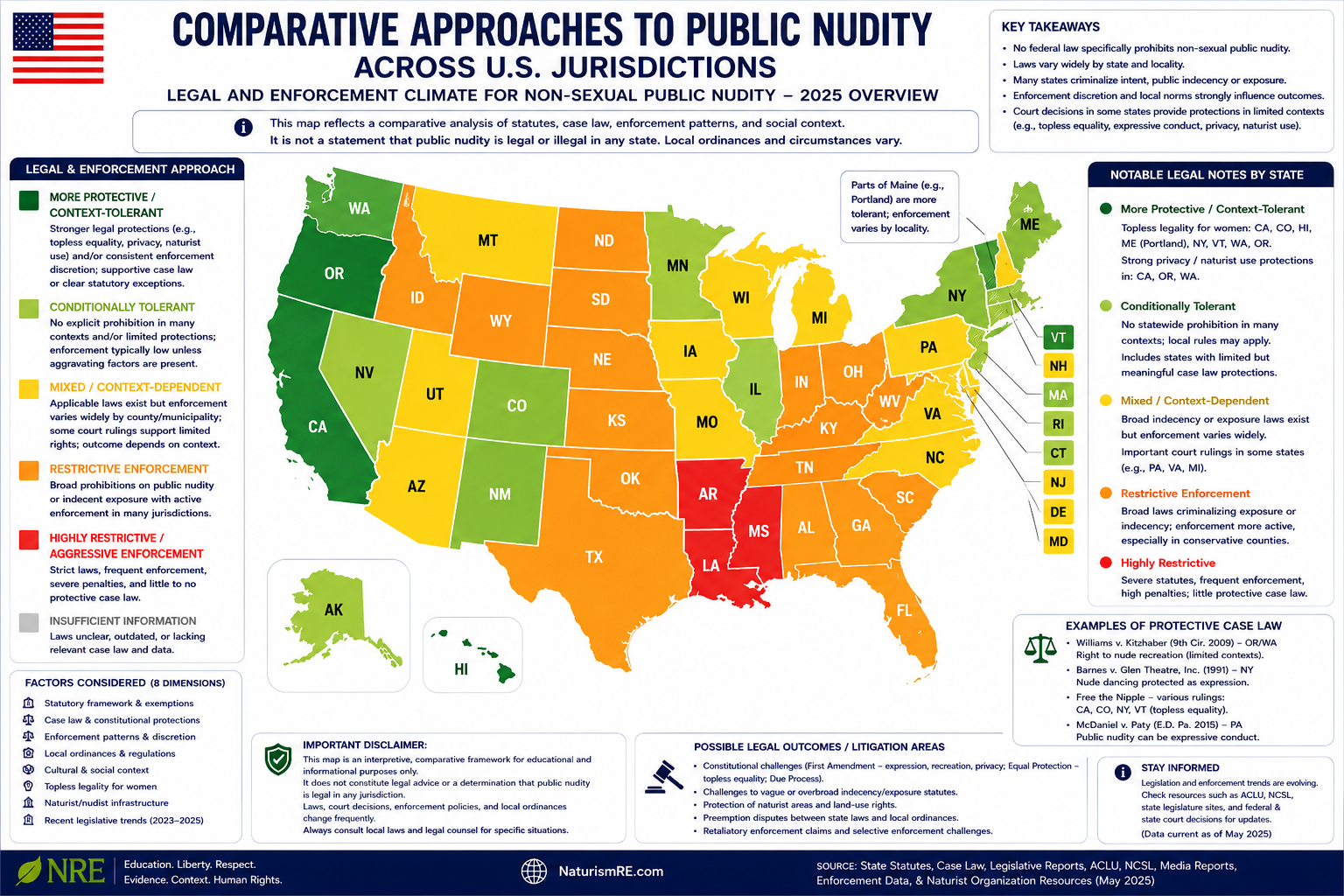
This map presents a comparative interpretative overview of legal and enforcement approaches toward non-sexual public nudity across U.S. jurisdictions as of 2025.
The colour categories do not represent definitive legal determinations or formal legal advice. Instead, they reflect broader observable trends derived from multiple factors, including:
• State statutes and indecency laws
• Court decisions and constitutional protections
• Enforcement patterns and police discretion
• Local ordinances and municipal practices
• Contextual tolerance and naturist infrastructure
• Topless equality rulings and related jurisprudence
• Public exposure thresholds and prosecutorial tendencies
The map uses a comparative colour scale:
• Dark Green = More protective or context-tolerant environments
• Light Green = Conditionally tolerant environments
• Yellow = Mixed or highly context-dependent environments
• Orange = Restrictive enforcement trends
• Red = Highly restrictive or aggressively enforced environments
• Grey = Insufficient or highly variable information
Legal outcomes in the United States remain highly dependent on context, location, behaviour, intent, visibility, local ordinances, and enforcement discretion. Conditions may vary significantly between municipalities, counties, courts, federal lands, and law enforcement agencies within the same state.
This visual is intended as an educational and analytical comparative framework only. It does not state that public nudity is universally legal or illegal in any jurisdiction and should not be interpreted as legal advice.