

Transition to Future-Oriented Naturist Systems
Examining how naturist systems evolve through long-horizon adaptation, innovation, and integration within changing social, technological, legal, and environmental conditions.
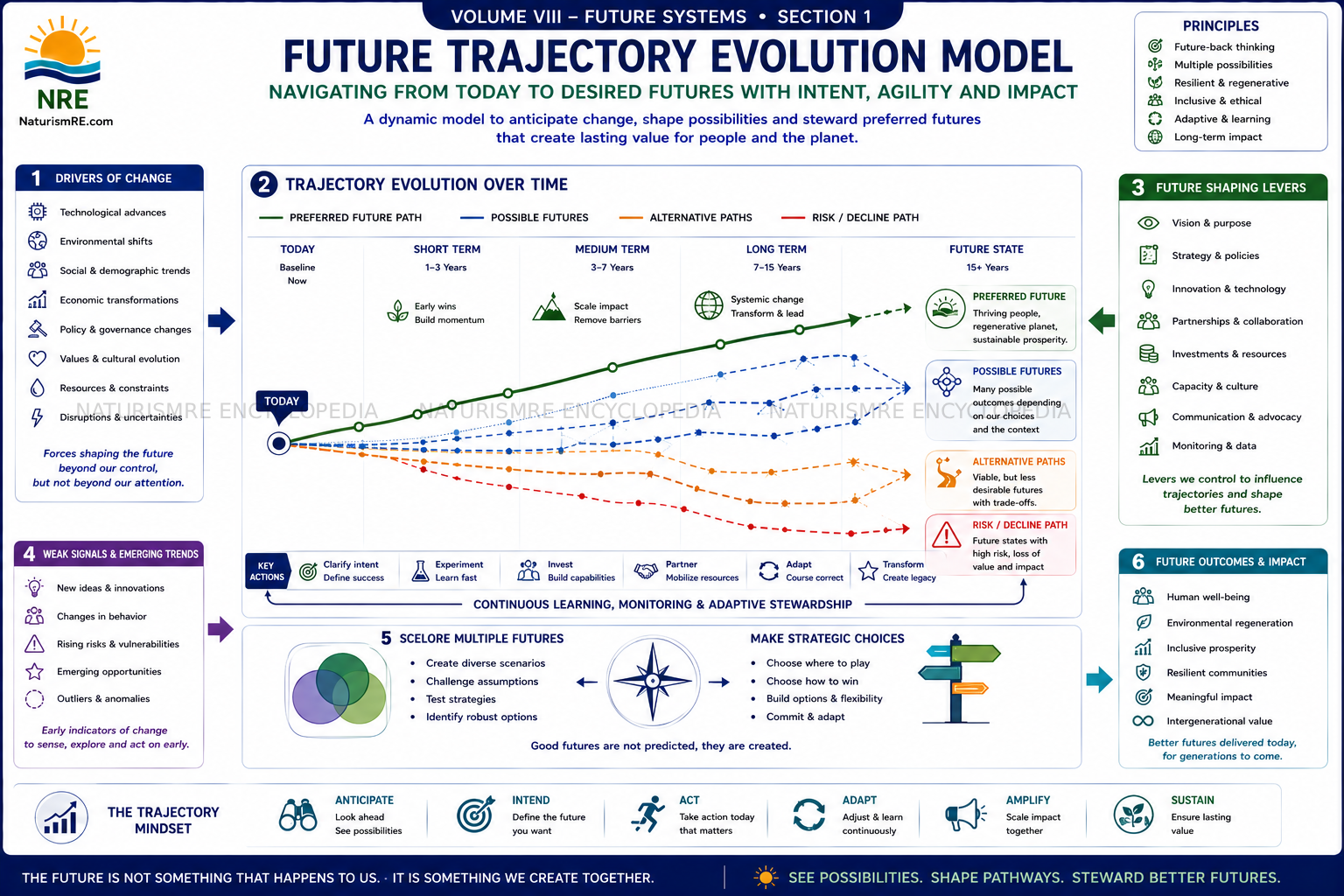
The long-term evolution of naturist systems depends on their ability to function as adaptive, forward-oriented frameworks that integrate innovation, respond to external drivers, and maintain structural coherence within increasingly complex societal environments.
1.1 From Operational Systems to Evolutionary Trajectories
Volumes I–VII establish naturism as a context-dependent system governed by behavioural, legal, and environmental constraints and deployable through structured implementation models.
Volume VIII shifts the focus from how systems operate to how they evolve over time.
This transition introduces a long-horizon analytical layer encompassing adaptation, innovation, and integration with emerging societal and technological conditions.
Naturism is therefore examined as an evolving system shaped by external change vectors rather than as a fixed framework.
1.2 Defining Future-Oriented Systems
Future-oriented naturist systems are characterised by adaptability to changing environments, integration with broader societal structures, and capacity for continuous refinement.
They differ from current operational models by anticipating change, incorporating feedback into long-term design, and aligning with evolving patterns in governance, technology, and social behaviour.
Dynamic Governance
Governance structures evolve in response to operational conditions, regulatory change, and stakeholder expectations.
Modular Design
Systems retain core principles while enabling reconfiguration across diverse operational contexts.
Data-Informed Adaptation
Monitoring and evaluation systems support evidence-based refinement and strategic adjustment.
1.3 External Drivers of System Evolution
The trajectory of naturist systems is shaped by interacting external drivers.
Urbanisation increases population density and reduces availability of informal spaces, reinforcing the need for structured environments.
Technological development expands digital communication, surveillance, and data environments, altering visibility and privacy conditions.
Legal and regulatory evolution shows a gradual shift toward context-based interpretation and potential development of more structured regulatory approaches.
Social perception dynamics reflect evolving attitudes toward body representation and public behaviour.
Health and wellbeing trends emphasise preventive approaches and integration of environmental factors.
These drivers interact to define the conditions within which naturist systems must evolve.
1.4 System Adaptation and Evolutionary Pathways
Future-oriented systems evolve through incremental adaptation, structural innovation, and contextual realignment.
Incremental adaptation involves gradual adjustment of governance, design, and communication in response to observed conditions.
Structural innovation introduces new models to address limitations in existing systems.
Contextual realignment enables systems to operate effectively within new legal, social, or environmental conditions.
Adaptation mechanisms include modification of governance frameworks, refinement of spatial and operational design, and adjustment of engagement strategies.
Systems that fail to adapt risk misalignment with external conditions and reduced operational viability.
1.5 Innovation as a Controlled Process
Innovation within naturist systems must be controlled and aligned with core principles.
Unstructured innovation may introduce legal ambiguity, behavioural inconsistency, and increased risk.
Effective innovation is characterised by alignment with system integrity, testing within controlled environments, and evaluation prior to broader adoption.
Innovation pathways may include developments in environmental design, governance models, and integration with digital or data systems.
However, innovation must not compromise behavioural clarity, legal interpretability, or system stability.
1.6 Temporal Dynamics and Long-Term Perspective
Naturist systems evolve over extended time horizons.
Short-term observations do not capture gradual shifts in perception, cumulative effects of repeated exposure, or long-term adaptation of legal and social frameworks.
Temporal dynamics include gradual progression toward acceptance, periodic disruption due to external change, and cycles of expansion and consolidation.
Understanding these dynamics requires long-term monitoring, historical comparison, and avoidance of short-term conclusions.
1.7 Integration with Broader Societal Systems
Future systems will increasingly intersect with urban planning, public health strategies, environmental management, and digital communication infrastructures.
Integration requires compatibility with existing systems, capacity to operate within multi-layered governance structures, and alignment with broader societal objectives.
Systems that remain isolated may face limitations in scalability and continued marginalisation.
Integration must occur without loss of core principles, maintaining behavioural integrity and contextual clarity.
1.8 Analytical Conclusion
The future of naturist systems is defined by their capacity to evolve within changing environmental, social, legal, and technological conditions.
Naturism must be understood as an evolving system. Future-oriented models prioritise adaptability, modularity, and data-informed refinement. External drivers shape system trajectories. Adaptation occurs through incremental and structural pathways. Innovation must remain controlled. Long-term dynamics require extended temporal analysis. Integration with broader systems is necessary for scalability.
Naturist systems that succeed will be those that anticipate change, adapt without losing structural coherence, and align with evolving conditions across multiple domains.
This establishes the foundational principle for Volume VIII:
The long-term evolution of naturist systems depends on their ability to function as adaptive, forward-oriented frameworks that integrate innovation, respond to external drivers, and maintain structural coherence within increasingly complex societal environments.
Primary Supporting Articles
Drivers of Structural Evolution, Behaviour, Context, and Governance as Interdependent System Forces
From Fragmentation to Recontextualisation, Naturism in the 21st Century
Naturism at a Structural Crossroads, From Fragmented Practice to Governed Systems
The Convergence Question, Can Naturism Ever Become a Unified System