


NRE stand out for not doing what others do…here in dark grey are
the most favorable countries while least favorable are in light grey!
NaturismRE Global Nudism & Naturism Index
A structured public index measuring how countries, territories, and regions approach nudism, naturism, body freedom, naturist rights, and non-sexual social nudity.
About the Index
The NaturismRE Global Nudism & Naturism Index is a transparent, publicly accessible reference tool created to support education, advocacy, travel awareness, policy discussion, and international comparison.
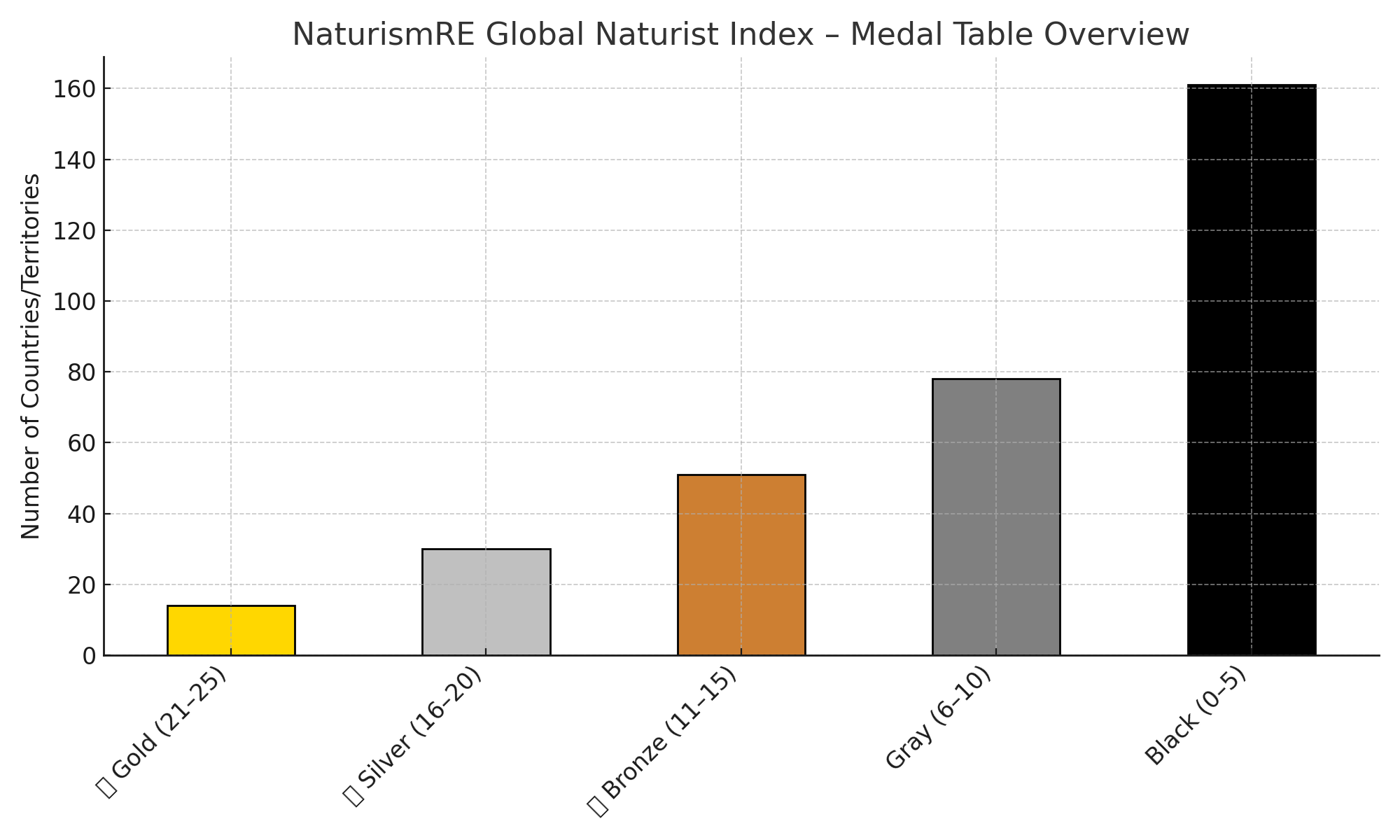
The index ranks more than 325 countries, territories, and regions according to their level of support, tolerance, infrastructure, and legal clarity surrounding nudism, naturism, and non-sexual nudity.
It is designed as an evolving framework. Scores may be reviewed, corrected, expanded, or refined as new information, legal developments, cultural changes, or regional feedback become available.
Assessment Categories
Each country, territory, or region is assessed across five core areas. Each area may receive up to five points, with five representing the most favourable position and zero representing the least favourable position.
Why This Index Matters
Nudists and naturists in many parts of the world continue to face stigma, censorship, inconsistent enforcement, legal uncertainty, or limited access to appropriate spaces.
This index provides a structured way to compare jurisdictions, identify areas of progress, highlight regions where legal or cultural ambiguity remains, and support evidence-aware advocacy.
It may assist travellers, researchers, educators, policymakers, advocacy groups, and community organisations seeking a clearer understanding of global conditions for non-sexual social nudity and clothing-optional recreation.
Transparent, Independent & Evolving
The NaturismRE Global Nudism & Naturism Index is publicly accessible and intended to remain open to review, feedback, and improvement.
The index is not presented as a final or legally determinative authority. It is an evolving public-interest tool based on available legal, cultural, social, and infrastructural information.
NaturismRE welcomes corrections, jurisdiction-specific feedback, updated legal references, and cultural context that may improve the accuracy and usefulness of future versions.
From Advocacy to Action
Version 1.0 provides a foundation for broader international analysis. Future versions may include expanded regional research, updated legal references, improved justification notes, and additional data-supported interpretation.
As NaturismRE continues to develop its research, policy, and education systems, the Global Nudism & Naturism Index will remain one of its core tools for measuring visibility, identifying barriers, and supporting lawful, respectful, non-sexual naturist and nudist practice.
Access the Index
Download the NaturismRE Global Nudism & Naturism Index dataset.
Download CSV IndexVisit Our Other Templates



Disclaimer: Methodology, Scope & Future Evolution
The NaturismRE™ Global Nudism & Naturism Index has been developed through an extended research and review process spanning approximately 18 months, assessing recognised countries, states, territories, and jurisdictions using a structured and publicly transparent framework.
The Index was developed through collaboration between NaturismRE™, human oversight processes, and Aletheos™, NaturismRE’s research and intelligence support system.
Research, categorisation, comparative review, and preliminary scoring were conducted using a multi-source assessment methodology designed to improve consistency, transparency, and global comparability across jurisdictions.
The Index currently evaluates jurisdictions across five core assessment pillars:
Each jurisdiction is currently scored out of a possible 25 points, with a maximum allocation of five points per category.
Scoring references may include publicly available legislation, government material, legal databases, policy documents, academic literature, journalism, travel guidance, historical records, organisational resources, and publicly accessible user-reported information where appropriate.
While substantial efforts have been made to improve accuracy and consistency, NaturismRE™ recognises that legal systems, enforcement practices, cultural attitudes, and local conditions are dynamic and may evolve over time.
The Index should therefore be understood as an evolving public-interest research framework rather than a definitive legal authority or guarantee of local conditions.
Version 2.0 Development
NaturismRE™ is currently preparing future versions of the Global Nudism & Naturism Index in order to improve analytical depth, regional accuracy, and comparative transparency.
Future versions may incorporate additional assessment categories including:
- religious and cultural tolerance toward naturism and non-sexual nudity
- digital censorship and platform moderation trends
- gender parity and equality considerations within naturist environments
- family participation and safeguarding governance structures
- recognition of naturism as a philosophy, lifestyle, belief system, or protected identity
- regional consistency and public-space governance models
NaturismRE™ intends for the Index to remain an evolving and reviewable framework, with future revisions, updates, corrections, and methodological refinements implemented progressively over time.
Quarterly review cycles may be introduced where operationally feasible.
Public Release & Collaboration
The NaturismRE™ Global Nudism & Naturism Index is released publicly as part of NaturismRE’s broader educational, research, governance, and public-interest mission.
The project is intended to support discussion surrounding body freedom, non-sexual social nudity, clothing-optional recreation, safeguarding-aware governance, and naturist visibility within contemporary society.
NaturismRE™ welcomes constructive feedback, jurisdictional corrections, updated legal references, and collaboration proposals intended to improve future versions of the Index.
For corrections, submissions, collaboration requests, or additional information, please contact:

Global Naturist Index 2025 Map Explanation
The NaturismRE Global Naturist Index 2025 heat map provides a comparative visual overview of how countries and territories approach naturism, nudism, non-sexual social nudity, and clothing-optional recreation.
The map uses a structured colour gradient to represent each jurisdiction’s overall score within the NaturismRE Global Naturist Index framework.
Colour Scale Interpretation
Purpose of the Index
The NaturismRE Global Naturist Index has been developed as a comparative public-interest framework intended to support naturist travellers, policy discussion, international visibility, and public understanding.
- support naturist travellers and international awareness
- encourage evidence-aware policy discussion and legal clarification
- highlight global disparities relating to body freedom and non-sexual nudity
- improve public understanding of naturism and clothing-optional recreation
- support dialogue surrounding lawful, respectful, and safeguarding-aware naturist integration
PDF Comparison Charts
Detailed country-to-country comparison charts and visual data summaries are available in PDF format.
View PDF ChartsDetailed Index Access
Expanded analytical datasets, detailed scoring breakdowns, and extended jurisdictional comparison material may be available upon request for research, institutional, educational, or professional review purposes.
For additional information, collaboration inquiries, or access requests, please contact:
Clause de non-responsabilité
Regional conditions within individual countries may differ substantially from national-level scoring due to local legislation, enforcement patterns, cultural variation, or municipal governance approaches.
This map represents a generalised national-level comparative overview rather than a definitive legal assessment of every local jurisdiction or community context.
The Index is not intended as legal advice, a travel guarantee, or a substitute for checking current local laws before engaging in naturist or clothing-optional activity.