

Compulsory Nudity and Child Safeguarding in Organised Naturism
A structured evidence review of whether mandatory nudity alters institutional child-sexual-abuse risk
Research cut-off: 17 September 2026
Geographic emphasis: Australia, United Kingdom and Europe, North America, with international evidence where relevant
Executive summary
Research question
This paper asks a narrower and more defensible question than whether naturism “causes paedophilia”:
Does a rule requiring minors to be nude in an organised naturist setting create additional institutional child-sexual-abuse safeguarding risk compared with a setting in which a child may freely remain clothed or cover themselves?
The answer from the available evidence is:
There is no direct empirical evidence showing that compulsory nudity in organised naturist settings increases the incidence of child sexual abuse, and no credible evidence that naturism or non-sexual nudity causes paedophilic sexual interests. However, there is sufficient indirect evidence to conclude that compulsory nudity applied to minors creates additional safeguarding considerations, particularly around bodily autonomy, adult authority, boundary-setting, photography or image misuse, and a child's practical ability to refuse or withdraw. These mechanisms are strongly supported by the general institutional-abuse literature, but their effect size within naturism has never been directly measured.
That distinction is critical. The strongest evidence does not identify nudity itself as a demonstrated causal risk factor for child sexual abuse. Longitudinal and cross-sectional research on childhood exposure to ordinary non-sexual nudity has generally failed to show adverse psychological or sexual-adjustment outcomes, although these studies are small, indirect and do not examine institutional abuse.
At the same time, the evidence cannot support the stronger naturist claim that children are necessarily safer because an environment is naturist. British Naturism, for example, publicly states that children are safer in naturism because of parental attendance, controlled entry and community oversight, but the public material reviewed does not provide comparative incident-rate data establishing that proposition.
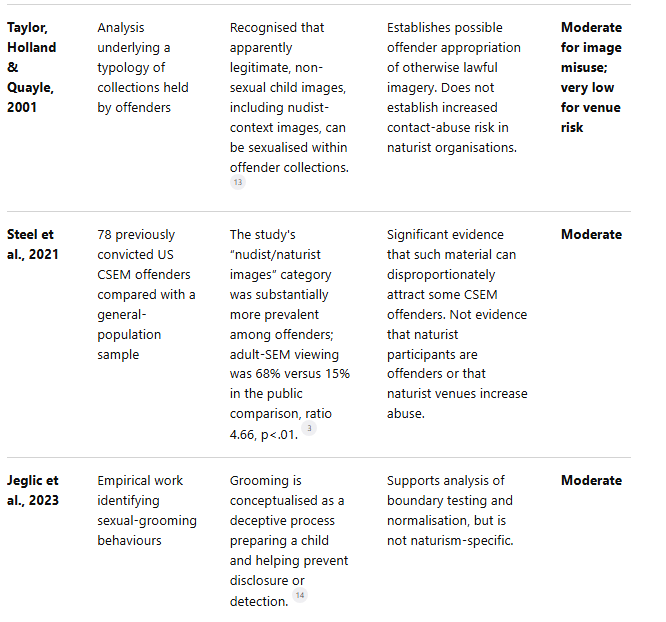
There is also evidence of particular relevance to image safeguarding. A 2021 peer-reviewed study comparing 78 previously convicted child-sexual-exploitation-material offenders with a general-population comparison group found markedly greater viewing of the study's “nudist/naturist images” category among offenders. For adult sexual-material viewing, the figures were 68 per cent of the offender group and 15 per cent of the public comparison group, an offender-to-public ratio of 4.66. The authors did not study naturist clubs, child safety at naturist venues, or causation. The correct conclusion is therefore that naturist imagery can be of disproportionate interest to some offenders, not that naturists are offenders or that naturist settings cause offending.
The broader institutional-abuse evidence is much stronger. The Australian Royal Commission identified four interacting dimensions of institutional child-sexual-abuse risk: situational risk, vulnerability risk, propensity risk and institutional risk. Opportunities increase where adults obtain private or poorly supervised access to children, environments contain isolated spaces, inappropriate one-to-one interactions are normalised, behavioural boundaries are ambiguous, reporting is weak, or institutional reputation is prioritised over child safety.
Changing rooms, showers, camps, overnight accommodation and analogous privacy-sensitive environments recur in safeguarding literature because they can combine bodily exposure with reduced supervision and unequal authority. The relevant risk mechanism is therefore not “nakedness equals abuse”. It is access + authority + vulnerability + opportunity + inadequate detection.
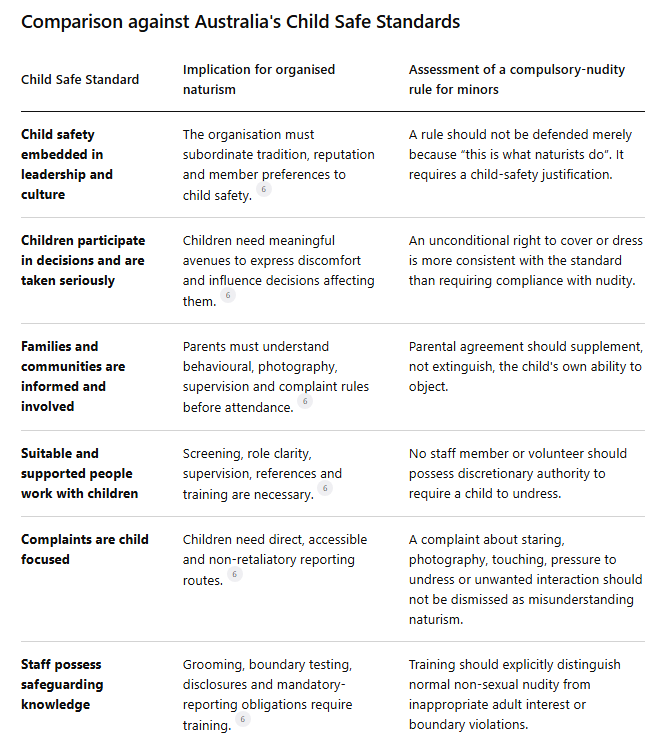
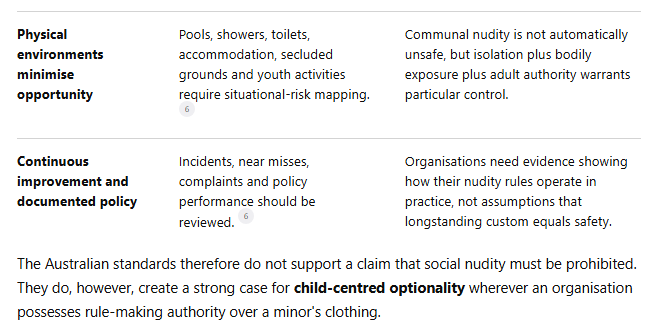
This produces a significant distinction between social nudity and compelled nudity. A child who voluntarily participates in a non-sexual nude environment while retaining an unconditional ability to dress, cover themselves, leave, complain or decline an interaction preserves a meaningful degree of bodily agency. A child whose participation is conditional upon undressing is in a different institutional position because an adult or organisation now has authority over that child's bodily exposure. The Australian Child Safe Standards' requirements that children participate in decisions affecting them and that physical environments minimise opportunities for abuse make this distinction safeguarding-relevant even though no study has yet quantified its effect on abuse incidence.
The Convention on the Rights of the Child reinforces the same direction of travel through the best interests principle, children's right to have their views given due weight, privacy protections, protection from violence and protection from sexual exploitation. These principles concern children's agency and protection; they should not be confused with legal sexual consent.
There are important countervailing factors. A well-run naturist environment can be highly observable, family-based and difficult for an offender to isolate a child within. Parent or guardian presence, membership controls, trained stewards, photography restrictions and open communal areas can reduce opportunity and increase detection. British Naturism describes several such measures. Australian venues reviewed also demonstrate that naturism does not require compulsory nudity for minors: Kiata Country Club states that its non-clothing-optional rule applies only to adults, while Sunseekers expressly exempts children under 18 from its no-clothing pool rule.
Accordingly, this paper rates the proposition “compulsory nudity for minors increases actual CSA incidence in naturist organisations” as unproven, with very low direct evidence. It rates the narrower proposition “compulsory nudity for minors introduces additional safeguarding risk mechanisms that should be controlled” as moderately supported overall, because it follows from high-quality general evidence on institutional opportunity, power, participation and reporting, combined with more limited evidence concerning offender interest in nudity-related imagery.
The most defensible child-safe policy is therefore not to prohibit family naturism. It is to separate adult naturist norms from children's bodily autonomy:
An organised naturist body should never make a minor's nudity a condition of participation. A child should have an unconditional right to dress, cover themselves or leave, without sanction, ridicule, explanation or loss of access, and no unrelated adult or organisational official should have authority to direct a child to undress.
That policy is precautionary rather than evidence of wrongdoing. It preserves naturism while removing a potentially exploitable institutional power.
Scope, definitions and evidential method
What this review does and does not assess
“Organised naturism” in this paper means clubs, resorts, camps, swimming sessions, associations and organised events in which an organisation exercises some degree of admission control, rule-making, supervision or authority and in which minors may participate.
“Compulsory nudity” means a policy, formal rule or practically enforced expectation under which a minor must be unclothed, either generally or within defined facilities, to participate. It does not include an adult-only nudity rule where children are expressly exempt. Nor does it include a family choosing social nudity where the child remains genuinely free to cover themselves.
“Child-sexual-abuse risk” is used in the institutional-prevention sense. It includes opportunity for contact abuse, grooming, non-contact sexual misconduct, sexualised observation or photography, barriers to disclosure and failures of institutional response. The Royal Commission's framework demonstrates that institutional risk is not reducible to an offender's underlying sexual preference.
This distinction also avoids conflating paedophilia, child sexual abuse, child sexual exploitation material and ordinary naturism. They are not interchangeable concepts. The evidence reviewed here does not establish that naturism creates paedophilic sexual interests, and research on CSEM offenders cannot be used to characterise ordinary naturists.
This is a structured evidence review, not a formal systematic review or meta-analysis. Priority was given to peer-reviewed research, Royal Commission materials, government and police sources, judicial decisions, international child-rights instruments and current official naturist-organisation materials. Publicly accessible policies were reviewed as of September 2026. Some organisation policies may exist behind member portals, be non-indexed or be unavailable publicly, so failure to locate a document is reported as such rather than treated as proof that the document does not exist.
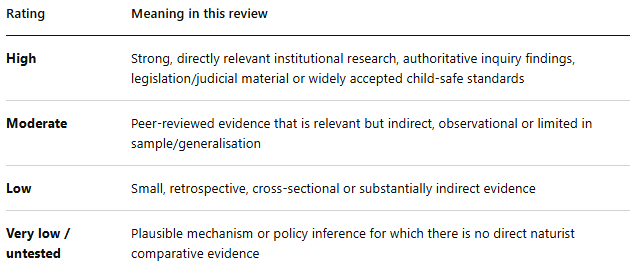
The following evidence scale is used throughout:
A further legal caution is warranted. Nothing in this review alleges misconduct by any named naturist organisation. Public policies are assessed as governance documents, not as evidence that abuse has or has not occurred. Likewise, an organisation's absence from the legal case material cannot establish that its safeguarding is effective. Institutional child sexual abuse is characteristically affected by delayed disclosure and incomplete reporting, which is one reason the Royal Commission emphasised recordkeeping and child-focused complaints systems.
Evidence timeline
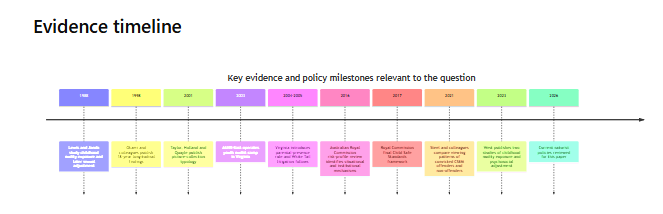
The chronology shows an important evidential asymmetry. Research has examined childhood nudity and later adjustment, institutional CSA risk, offender viewing behaviour and naturist policy separately, but no identified study connects all four by comparing abuse outcomes in compulsory-nudity versus voluntary-nudity naturist organisations.
Evidence on nudity, child safety, offending and grooming
Studies of childhood nudity
The best-known empirical studies are more reassuring about non-sexual nudity than is sometimes assumed, but they answer a different question from the one addressed in this paper.
Lewis and Janda's 1988 retrospective study examined adult sexual adjustment in relation to childhood exposure to nudity, parental-bed sleeping and parental sexual attitudes. It did not find childhood nudity exposure associated with poorer adult sexual adjustment and reported some modest positive associations. Its retrospective college-student design, however, makes causal interpretation weak. It did not examine compulsory nudity, institutional settings, grooming or child sexual abuse.
Okami and colleagues' 1998 study is methodologically stronger because it arose from an 18-year longitudinal project involving approximately 200 participants. Exposure to parental nudity and witnessing parental sexual activity was compared with later measures including self-acceptance, relationships, antisocial behaviour, substance use and sexual outcomes. No general harmful main effect of parental nudity emerged. Some sex-specific findings concerning other exposure variables caution against reducing the paper to “nudity is beneficial”, but it provides no support for a general proposition that ordinary childhood exposure to nudity produces later dysfunction. Again, however, household exposure is not equivalent to institutional compulsory nudity.
West's 2023 Children & Society paper conducted two preregistered studies. Study 1 involved 411 White British adults reporting retrospectively on childhood experiences; Study 2 involved 250 mother-child dyads, with participating children ranging from seven to 17 years old. The adult study found childhood nudity exposure associated with some positive body-image and self-esteem outcomes; the child study did not identify significant negative effects on body image, self-esteem or overall adjustment.
There are substantial limitations. The nudity-exposure measure had relatively weak reliability, particularly in the child sample, and the design cannot establish causality. West expressly cautions that the work does not directly investigate abuse and acknowledges that abusive people may misuse naturist contexts or images.
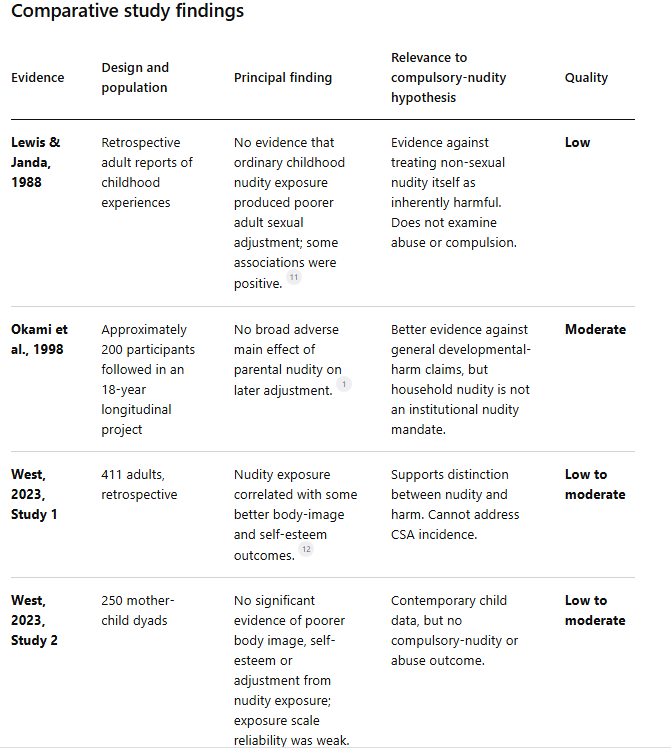
Taken together, the childhood-nudity literature weighs against a theory that nude environments are intrinsically psychologically damaging or intrinsically sexual. It does not, however, test whether an institution's power to require nudity changes abuse opportunities.
That is the central evidential gap.
Offender interest does not establish naturist causation
The Steel finding deserves particular care because it could easily be misrepresented. The research concerned convicted CSEM offenders' sexual-material viewing patterns. It did not compare naturists with non-naturists, did not study families at naturist resorts, and did not determine where “nudist/naturist” material came from.
It therefore supports only a narrower conclusion:
Some offenders may sexualise or seek material labelled as naturist, even though the originating nudity may be non-sexual.
That conclusion is consistent with earlier work on offender picture collections.
For safeguarding policy, this matters particularly to photography, live streaming, cameras, smartphones, publication of children's images and access by spectators. It is not a basis for characterising ordinary naturists as dangerous.
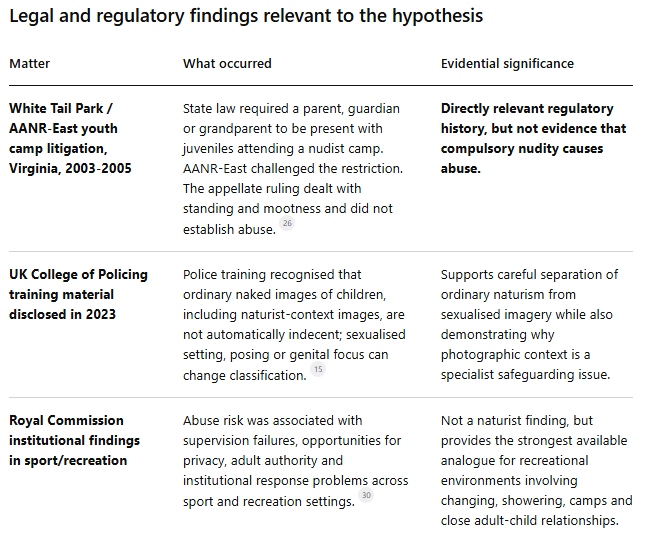
The United Kingdom's College of Policing provides a useful parallel legal distinction. Its training material released under freedom-of-information legislation states that photographs involving naked children are not automatically indecent, including photographs in legitimate naturist contexts; sexualised posing, genital focus and other contextual elements alter the assessment.
This demonstrates why legality and safeguarding are different thresholds. An image may be lawful in its original context yet still be undesirable for an organisation to create, retain or publish because of privacy, redistribution and misuse risks.
Situational and institutional risk pathways
What the institutional-abuse literature actually identifies as risk
The Australian Royal Commission's commissioned risk review is substantially more informative for this question than the small literature on childhood nudity. It conceptualises institutional CSA through interacting situational, vulnerability, propensity and institutional dimensions.
Situational prevention asks whether environments create opportunities for abuse and whether those opportunities can be changed. Examples identified in the Royal Commission material include isolated spaces, private one-to-one interaction, change rooms, camps, overnight activities and policy arrangements that permit adults unsupervised or difficult-to-observe access to children.
Research concerning organised sport is particularly relevant as an analogy because it includes changing, showering, travel, accommodation and relationships of trust between adults and minors. The Royal Commission's review found risk where close relationships, in loco parentis authority, poorly supervised facilities, one-to-one activity and private or isolated environments intersected. It also identified supervision, behavioural rules, monitoring and clear response procedures as protective factors.
None of those mechanisms makes showers, sport, swimming or nudity inherently abusive. They demonstrate instead that environmental design determines what a motivated offender can do without being detected.
The hypothesised pathway for compulsory nudity
The following diagram separates evidence-based institutional mechanisms from the naturism-specific hypothesis that remains untested.
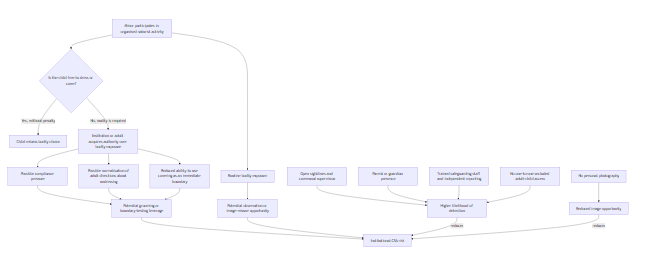
The left side of this pathway, involving authority, refusal and boundary ambiguity, is an inference from general institutional and grooming research rather than a demonstrated naturist-specific causal chain. The right side, involving visibility, supervision, photography controls and reporting, reflects established situational-prevention principles.
Where mandatory nudity could plausibly alter risk
The first mechanism is authority over bodily boundaries. A rule that permits an adult to tell a child that they must remove clothing as a condition of participation gives that adult legitimate organisational authority over an unusually personal boundary. There is no evidence demonstrating that naturist officials use such authority for grooming, but from a prevention perspective it is unnecessary authority to create if the aims of naturism can be achieved without applying the rule to children. The Child Safe Standards' emphasis on children's participation in decisions supports that interpretation.
The second is boundary ambiguity. Grooming often depends not upon an immediately obvious criminal act but on progressive testing, normalisation and conditions that make a child uncertain about what they can refuse or report. An organisation should therefore minimise the scope for any adult to defend a child's discomfort by saying that compliance is simply “the rule”. This is an inference, not evidence of misconduct within naturist organisations.
The third is observation and imagery. Naturist environments necessarily increase exposure to naked bodies. That does not itself create contact-abuse opportunity, but offender-viewing studies mean that image control warrants particularly strong safeguards where minors are involved.
The fourth is suppression of child signals. Clothing can function as an immediate practical boundary. A child who suddenly wants to cover themselves may be communicating embarrassment, developmental change, discomfort about a person, fear, menstruation, gender-related concerns, body-image distress, or simply a wish for privacy. Under a child-safe approach, the reason does not have to be established before the request is respected. The Royal Commission's child-safe framework specifically requires children's concerns and decisions to be taken seriously.
Factors that may reduce risk
There is also a credible counter-hypothesis.
A family naturist club in which interactions occur openly, parents remain present, access is controlled, members know one another, adults cannot isolate minors, photography is restricted and safeguarding personnel are visible may have less situational opportunity than many ordinary recreation settings. This follows from situational-prevention principles even though no comparative naturist incidence study has established it empirically.
British Naturism's current public material describes controlled admission, parental or guardian attendance for children, event stewards, identity and membership checks, venue-level safeguarding, restrictions on spectators and restrictions on personal photography. Those measures are conceptually consistent with situational prevention.
Parent presence, however, should not become a substitute for organisational safeguarding. Research on CSEM production and child abuse more broadly demonstrates that parental or parental-figure offenders exist, so “a parent was present” is not by itself an adequate institutional control.
The strongest model is therefore layered protection: child autonomy, parental involvement, environmental controls, trained independent staff, screening, observable interactions, image controls, external reporting and recordkeeping.
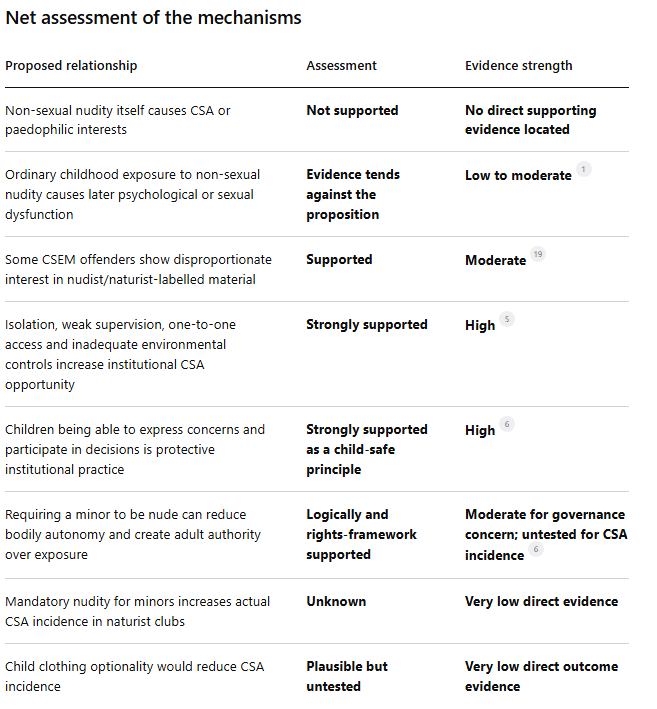
This is why the prudent conclusion is not “mandatory nudity has been proved dangerous”. It is that mandatory nudity creates a preventable governance exposure without an identified child-safety benefit that requires compulsion.
Autonomy, child-safe standards and naturist policy
Autonomy is not the same as sexual consent
Discussion of “consent” around children can become conceptually confused. A child's choice concerning clothing, bodily privacy or recreational participation is not equivalent to legal capacity to consent to sexual activity with an adult.
The relevant concepts here are participation, assent, refusal, privacy and evolving autonomy.
The Convention on the Rights of the Child requires the best interests of children to be a primary consideration, requires children's views to be given due weight according to age and maturity, protects children against arbitrary interference with privacy, requires protection from violence and abuse, and specifically requires protection against sexual exploitation and sexual abuse.
Australia's Royal Commission converted similar principles into institutional requirements. Its ten Child Safe Standards include child participation, family involvement, suitable and supported personnel, child-focused complaint mechanisms, staff education, environmental risk reduction, continuous review and documented policy.
Mainstream Australian sport safeguarding provides a useful comparator, although not a rule that can simply be transplanted into naturism. Sport Integrity Australia recommends obtaining parental consent and, where appropriate and possible, the child's agreement for overnight activities, protecting children's privacy when bathing, toileting and dressing, and preventing inappropriate sleeping or adult-nudity exposure.
Naturism necessarily differs on the adult-nudity component. But the underlying child-safety principles of privacy, choice and adult boundary discipline remain applicable.
Comparison with major and representative naturist policies
Public naturist policies are heterogeneous. Some demonstrate sophisticated safeguarding controls; others primarily contain etiquette or behaviour codes. The table should therefore be read as a comparison of publicly visible documentation, not a compliance ranking.
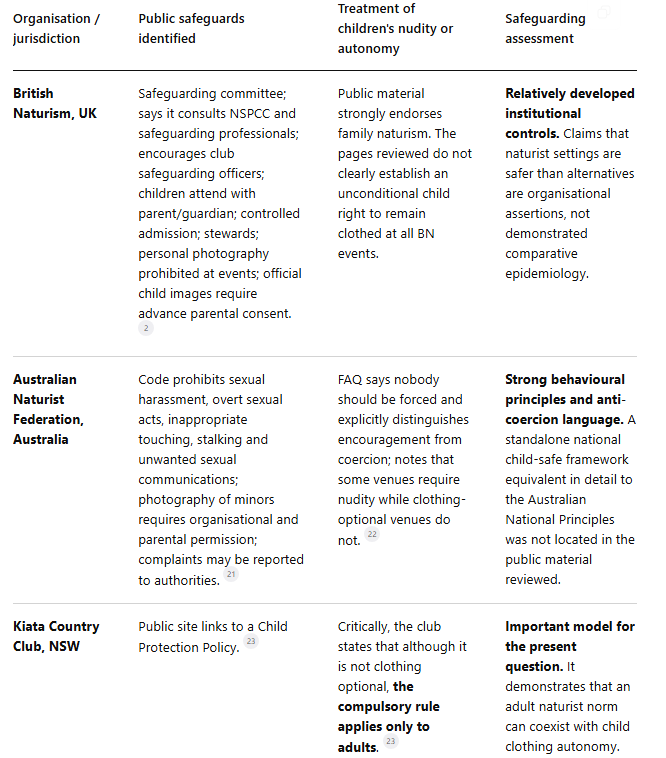
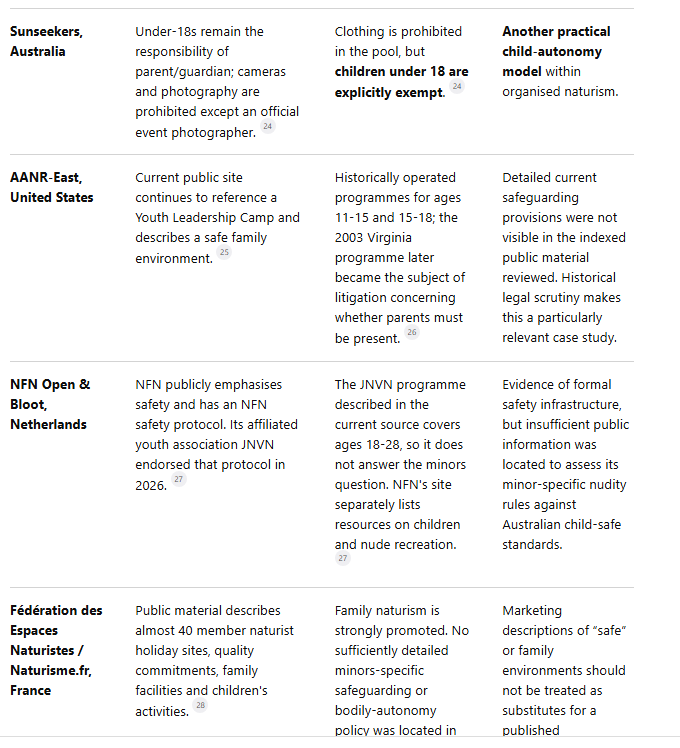
Two Australian examples are particularly significant to the research question. Both Kiata and Sunseekers preserve a naturist identity while exempting minors from rules that otherwise require adults to be nude.
That represents a potentially useful policy distinction:
Adult naturism may be normative. Child nudity should remain voluntary.
There is no obvious contradiction between those propositions.
Legal, regulatory and complaint evidence
The directly relevant judicial record is remarkably thin
The most directly relevant reported judicial case located is White Tail Park, Inc. v Stroube, decided by the United States Court of Appeals for the Fourth Circuit in 2005.
AANR-East had operated a week-long youth nudist camp at White Tail Park in Virginia in 2003. The programme included a Youth Camp for ages 11-15 and a Leadership Academy for ages 15-18, with 32 campers attending. Virginia subsequently amended its licensing legislation so that a juvenile attending a nudist camp had to have a parent, grandparent or legal guardian registered and present.
AANR-East and others challenged that requirement on constitutional grounds. The appellate decision largely concerned standing and mootness. It reinstated AANR-East's ability to pursue its First Amendment claim but expressly did not decide the underlying merits of that constitutional argument.
Most importantly for this paper, the case is not evidence that sexual abuse occurred at the camp. Nor did the appellate court find that parental presence was necessary because naturism itself endangered children. The case demonstrates government concern about unsupervised juvenile nudist camps and the resulting tension between child-regulation measures and associational rights. It does not provide an abuse-incidence study.
This review did not locate a reported court or regulator decision establishing that a compulsory-nudity policy at an organised naturist club or resort caused, facilitated or statistically increased CSA.
That is an important negative finding, but it should not be mistaken for proof of no risk. The absence of reported litigation can reflect low incidence, effective prevention, low reporting, delayed disclosure, private dispute resolution, classification under broader abuse categories or simply lack of research. The Royal Commission's recommendations on complaint handling and long-term recordkeeping were expressly designed around the problems of delayed disclosure and incomplete institutional memory.
Nor should unrelated cases in which offenders invoked “naturism”, possessed naturist-labelled imagery or happened to identify as naturists be counted as evidence about organised naturist institutions unless there is an actual institutional nexus. Doing otherwise creates a serious denominator problem and risks attributing individual criminality to a recreational community without evidence.
The image-law lesson
The legal treatment of child nudity also highlights why “legal” and “safe institutional policy” are distinct.
UK policing guidance recognises that an ordinary naturist photograph may be lawful depending upon its content and context. Yet offender research demonstrates that lawful or non-sexual images can nonetheless be collected or sexualised by offenders.
For an organisation, therefore, “the photograph is probably legal” is a lower standard than “creating this photograph is necessary, proportionate and in the child's best interests”.
A highly defensible safeguarding position is consequently to prohibit organisational creation or publication of identifiable nude images of minors even where parental consent might make the original photography lawful. This is a risk-management recommendation, not a statement of legal necessity in every jurisdiction.
Conclusions, policy recommendations and research agenda
Clear answer to the research question
On present evidence, three propositions should be distinguished.
First, naturism and non-sexual nudity have not been shown to cause paedophilia or child sexual abuse. The limited developmental research on ordinary childhood nudity largely points away from general psychological harm.
Second, there is no direct comparative evidence showing that children in compulsory-nudity naturist organisations suffer CSA at a higher rate than children in clothing-optional naturist organisations or other recreational institutions. The core causal hypothesis remains empirically untested.
Third, a rule compelling minors to be nude nevertheless introduces identifiable safeguarding mechanisms that do not arise, or arise less strongly, where nudity remains voluntary. The most important are institutional authority over bodily exposure, reduced practical ability to establish a clothing boundary, potential ambiguity around adult instructions concerning undressing, and heightened importance of observation and image controls. These concerns derive from strong general child-safe and institutional-risk evidence, but applying them specifically to naturism remains an inference.
The resulting evidence judgement is therefore:
Mandatory nudity for minors should be regarded as an avoidable safeguarding risk factor, but not as a proven cause of child sexual abuse.
That is the strongest conclusion the evidence currently permits.
It is also a materially different proposition from saying that naturism is dangerous.
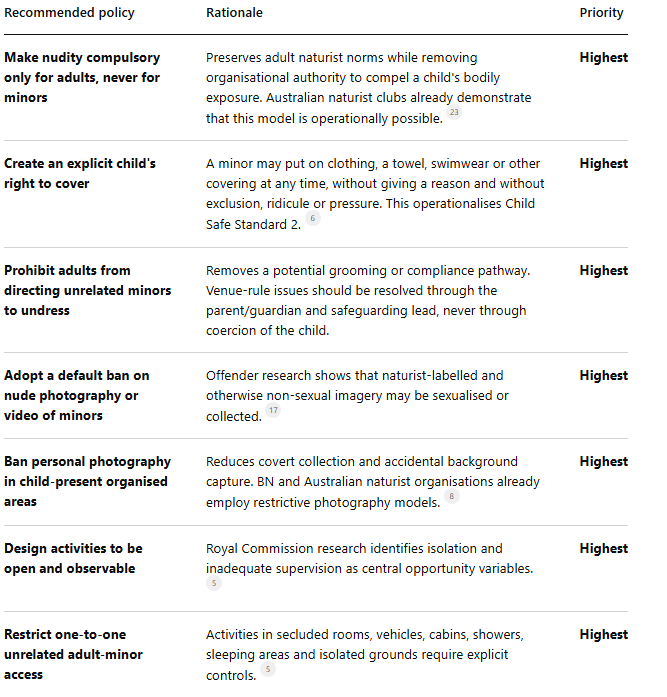
Recommended safeguarding model
A modern naturist organisation can preserve naturist practice while sharply reducing the areas most vulnerable to criticism or exploitation.
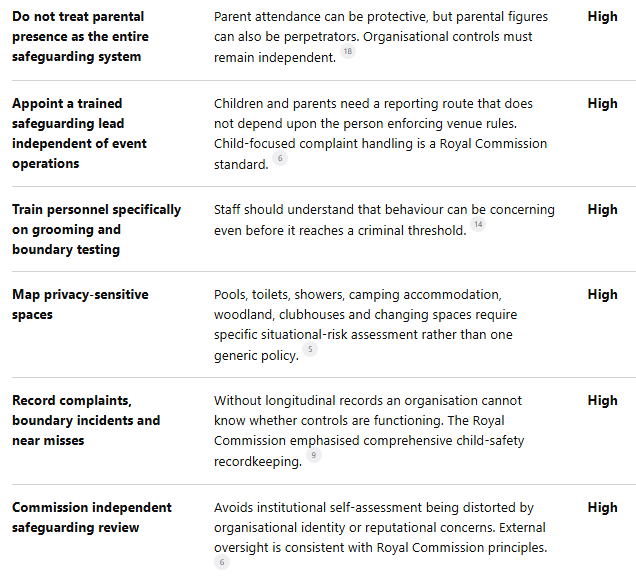
The recommended policy language should be explicit enough that there is no ambiguity:
No person under 18 is required to be nude as a condition of entry, participation or continued attendance. A child or young person may dress or cover themselves at any time without explanation. No member, volunteer, employee or official may direct, pressure, ridicule or discipline a minor for choosing to cover themselves.
That rule does not state that child nudity is harmful. It ensures that non-sexual nudity remains voluntary from the child's perspective.
A second provision should deal with safeguarding interpretation:
A child's complaint, discomfort or refusal must never be dismissed on the ground that nudity is normal within naturism. Naturist context may explain ordinary nudity; it does not excuse inappropriate observation, photography, touching, communication, coercion or boundary violations.
This formulation protects both children and legitimate naturism because it distinguishes context from conduct.
Organisational culture matters as much as written rules
The Royal Commission's institutional work repeatedly demonstrates that child safety depends on culture, not only policy documents.
That is particularly important for organisations whose identity is sometimes publicly misunderstood. There is a foreseeable temptation for members to interpret safeguarding concerns as attacks on naturism itself. An effective governance model should resist that reaction.
A child saying “I want to wear something” is not rejecting naturism.
A parent asking about photography is not accusing members of sexual motives.
A safeguarding officer documenting an uncomfortable interaction is not damaging the movement.
A report to police or a statutory authority is not a betrayal of the organisation where the legal threshold for reporting is met.
Institutions become safer when protecting their identity is never allowed to outrank examining a concern. That principle is directly consistent with the Royal Commission's emphasis on leadership, complaints, external oversight and continuous review.
Evidence gaps and testable hypotheses
The central research gap is unusually large. Despite decades of public argument about children and naturism, the located empirical literature largely asks whether exposure to nudity affects psychological development. It has barely examined institutional design.
Several hypotheses are therefore researchable without presupposing the answer.
Autonomy hypothesis: children at clothing-optional naturist venues will report greater perceived control, willingness to communicate discomfort and confidence in refusing adult requests than children subject to compulsory-nudity rules.
Opportunity hypothesis: rates of safeguarding incidents will be explained more strongly by supervision, one-to-one contact, overnight arrangements, photography access and reporting culture than by nudity itself.
Boundary-clarity hypothesis: organisations with explicit child clothing optionality will produce fewer complaints concerning pressure, embarrassment or ambiguous adult-child interactions than organisations requiring nudity.
Detection hypothesis: highly communal, parent-present naturist environments with controlled admission may produce equal or lower opportunities for covert contact abuse than less supervised recreational contexts, despite greater bodily exposure.
Image-risk hypothesis: camera restrictions and bans on publishing nude images of minors will materially reduce privacy and exploitation risks independent of contact-abuse rates.
Institutional-culture hypothesis: disclosure confidence will be higher where safeguarding personnel are organisationally independent and policies explicitly state that protecting naturism's reputation must never affect complaint handling.
None of these hypotheses has been adequately tested by the studies located for this review. That is a genuine research opportunity.
Recommended next research and data collection
The strongest next step would be a multi-country, independent prospective safeguarding study, rather than another attitude survey about whether people believe naturism is good or bad.
The sample should deliberately include four institutional models: naturist organisations in which minors are always clothing optional; organisations with partial nudity requirements such as pools; organisations where nudity is broadly expected or compulsory for minors; and comparable non-naturist recreation or camping organisations.
The primary outcomes should not begin with confirmed CSA alone, because serious abuse is uncommon enough that very large samples would be required. More sensitive institutional indicators should include child-reported autonomy, ability to refuse, unwanted observation, pressure concerning clothing, unwanted photography, boundary incidents, one-to-one adult access, complaints, near misses, disclosure confidence, staff responses and external referrals.
Incident data should be collected using common definitions and independent case coding. Organisations should provide denominator data such as child-attendance days so that raw complaint numbers are not misleading. Anonymous child and parent surveys should be separated from organisational management, and children's participation should be age-appropriate and independently ethically reviewed.
A second research stream should conduct policy content analysis across national naturist federations and representative clubs, coding whether each policy includes child clothing choice, photography rules, one-to-one interaction rules, overnight arrangements, staff screening, mandatory reporting, independent complaint routes, record retention and safeguarding review.
A third stream should involve confidential interviews with adults who grew up in organised naturism, explicitly sampling both positive and negative experiences. Existing literature disproportionately asks about general body image and adjustment; it does not adequately investigate whether children ever experienced pressure to remain nude, how puberty changed their comfort, whether they knew they could refuse, or whether organisational norms affected disclosure.
A fourth stream should analyse historical complaints and insurance or regulator data where lawful access can be obtained. Importantly, the research should compare incident rates with appropriate denominators rather than searching for sensational individual cases.
Final executive finding
The evidence supports neither alarmism nor complacency.
There is no evidence that organised naturism, ordinary social nudity or childhood exposure to non-sexual nudity causes paedophilia. There is also no direct evidence establishing that compulsory nudity at naturist venues increases the incidence of child sexual abuse. The available developmental studies tend to find neutral or positive rather than harmful outcomes from ordinary non-sexual nudity, although they do not study institutional abuse.
There is, however, credible evidence that some sexual offenders can sexualise naturist-labelled imagery and strong evidence from institutional-abuse research that adult authority, opportunity, privacy-sensitive environments, weak supervision, ambiguous boundaries and poor reporting systems can facilitate abuse.
When those bodies of evidence are combined with children's participation and privacy rights, a compulsory-nudity rule applied to minors becomes difficult to justify as child-safe governance. Its specific effect on CSA incidence is unproven, but it gives the institution authority over an intimate bodily boundary while offering no demonstrated safeguarding advantage over voluntary child participation.
The strongest evidence-based distinction is therefore:
Nudity is not the identified safeguarding problem. Compulsion is the preventable governance variable.
A contemporary organised naturist model can consequently be both authentically naturist and more defensible under modern child-safe standards by maintaining adult naturist expectations while making all nudity by minors genuinely voluntary, backed by an unconditional right to cover, stringent photography restrictions, open and observable environments, limited unrelated adult-minor access, trained safeguarding personnel, independent complaints and external reporting.
That approach is consistent with the Royal Commission's central lesson: child safety is achieved not by assuming that a community is either inherently safe or inherently dangerous, but by systematically reducing opportunities for abuse, strengthening children's agency, making concerning behaviour visible and ensuring that institutional interests never outrank the welfare of the child.