

Ethics, Boundaries, and Safeguards: Structural Conditions for Legitimacy
Establishing the ethical framework, safeguarding conditions, and behavioural boundaries required for legitimate, defensible, and non-exploitative naturist systems.
Nudity is not inherently acceptable or unacceptable. It becomes acceptable only within structured, safeguarded, and non-exploitative systems.
9.1 Purpose
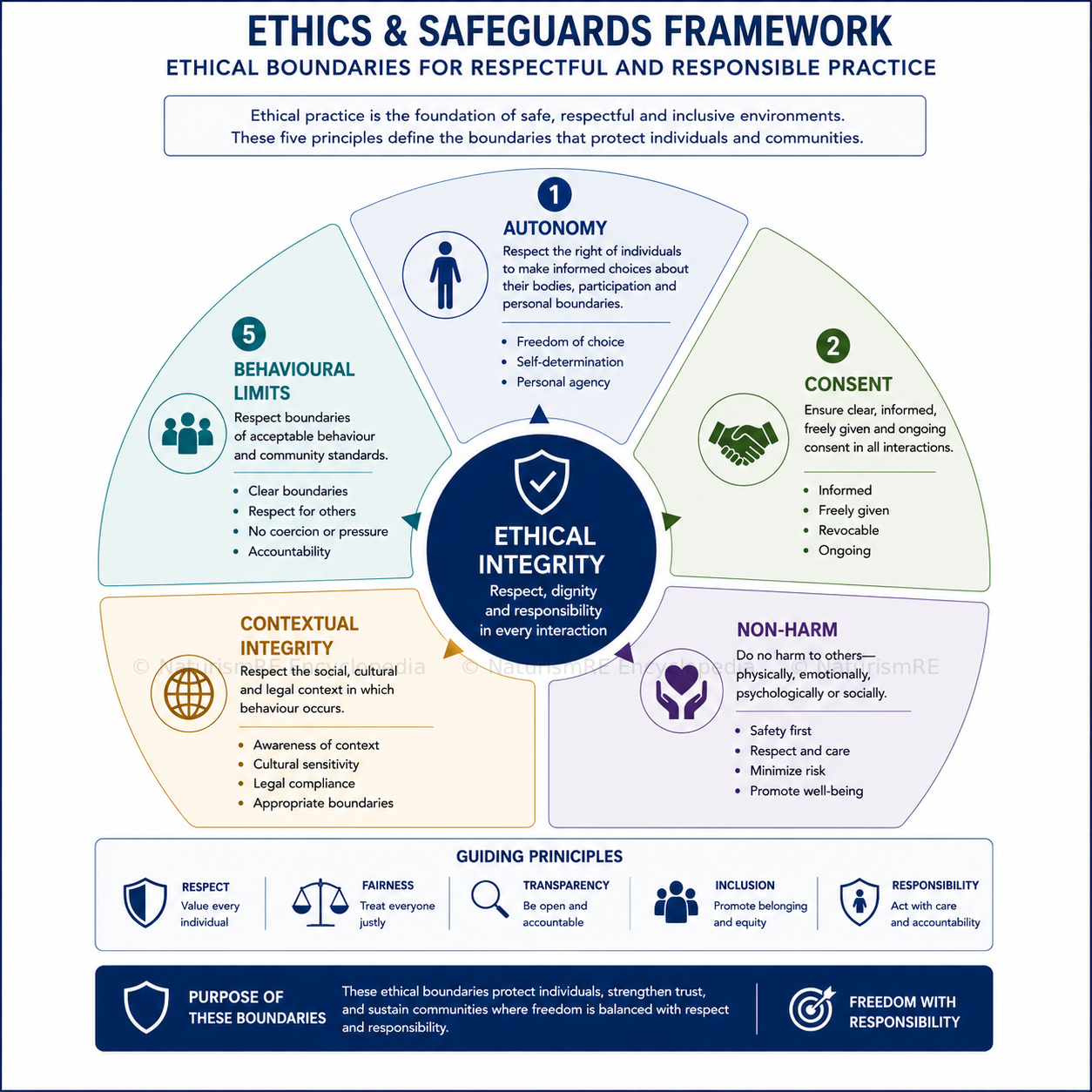
This section defines the ethical framework, behavioural boundaries, and safeguarding requirements governing all contexts involving nudity, nudism, and naturism within this encyclopedia.
Its purpose is to establish non-negotiable conditions of legitimacy, to define the parameters that distinguish acceptable from unacceptable environments, and to ensure alignment with legal, social, and safeguarding standards.
This section functions as a control layer, ensuring that all analysis and application remain ethically and structurally defensible.
9.2 Foundational Ethical Position
The analytical framework is grounded in a core principle: nudity, as a physical condition, is ethically neutral.
Ethical evaluation arises not from the presence of the unclothed body, but from behaviour, context, consent, and impact. This ensures that ethical judgement is applied to actions, interactions, and conditions rather than to physical appearance.
9.3 Core Safeguarding Principles
All legitimate contexts involving non-sexual nudity must satisfy a defined set of safeguarding conditions.
Voluntary Participation
Participation must remain informed, voluntary, and continuous, with the ability to enter or leave environments freely.
Non-Sexual Behaviour
Legitimate environments require strict behavioural neutrality and prohibition of sexual or suggestive conduct.
Respect for Boundaries
Personal boundaries, comfort levels, and participant dignity must be respected at all times.
Protection of Minors
Contexts involving minors require elevated safeguarding standards and zero tolerance for ambiguity or exploitation.
Privacy Protection
Photography, recording, and image distribution require explicit consent and respect for anonymity.
Governance and Enforcement
Legitimate systems require enforceable rules, behavioural oversight, and authority to intervene where necessary.
9.4 Boundary Definition and Classification
Ethical boundaries define the distinction between legitimate environments and unacceptable or high-risk contexts.
Acceptable environments are characterised by voluntary participation, non-sexual conduct, clearly defined rules and oversight, and mutual awareness of conditions.
Unacceptable environments include those involving coercion or pressure, sexualised or suggestive contexts, voyeuristic or exploitative behaviour, and the absence of defined boundaries or governance.
These distinctions are structural and non-negotiable.
9.5 Behavioural Standardisation
Ethical environments rely on predictable behavioural norms. These include neutral interaction, appropriate spatial awareness, avoidance of intrusive behaviour, and respect for participant diversity.
Such standards reduce ambiguity, support stability, and reinforce legitimacy. They enable participants to operate within consistent expectations rather than relying on individual interpretation.
9.6 Power Dynamics and Structural Vulnerability
Ethical evaluation must account for power asymmetry. Risk increases where authority imbalances exist, where dependency relationships are present, or where individuals have reduced ability to withdraw.
Examples include workplace environments, institutional settings, and authority-led contexts. In such situations, additional safeguards are required, or participation must be restricted to maintain ethical integrity.
9.7 Misinterpretation as a System Risk
Misinterpretation represents both an internal and external system risk. Internally, it may arise from behavioural deviation. Externally, it may result from observer perception influenced by cultural bias or incomplete context.
Even environments that comply with all safeguarding conditions may be subject to misinterpretation. This requires clarity of structure, consistency of behaviour, and alignment between actual conditions and perceived meaning.
9.8 Structured vs Unstructured Environments
Ethical stability differs significantly between structured and unstructured environments.
Structured environments operate through defined rules, controlled access, and enforceable standards. These conditions minimise ambiguity, support consistent interpretation, and reduce risk.
Unstructured environments lack formal rules and rely on participant self-regulation. This introduces variability, increases interpretative risk, and reduces stability.
The distinction is not incidental. It determines whether ethical conditions can be sustained over time.
9.9 Participant Responsibility
Ethical systems depend on collective responsibility. Participants must adhere to behavioural standards, respect boundaries, respond appropriately to discomfort or concern, and support enforcement mechanisms.
Formal governance alone is insufficient without participant alignment. Ethical stability requires consistent behaviour across all levels of participation.
9.10 Alignment with Legal Frameworks
Ethical principles align directly with legal frameworks. Both systems evaluate intent, behaviour, and impact when determining acceptability.
Ethical breaches may correspond to legal violations, enforcement action, or removal from environments. This alignment reinforces the principle that ethical integrity is a prerequisite for legal defensibility.
9.11 Institutional Integrity and System Legitimacy
For naturism to function as a legitimate system, it must demonstrate consistent safeguarding, enforceable boundaries, and transparent governance.
Failure in these areas undermines credibility, public trust, and legal standing. Ethical integrity is therefore not optional. It is foundational.
9.12 Integration with the Conceptual Framework
This section operationalises the analytical model established earlier in the encyclopedia. Ethical evaluation depends on the alignment of context, intent, behaviour, consent, governance, and perception.
Without alignment across these variables, ethical stability cannot be maintained.
9.13 Functional Role Within the Encyclopedia
This section governs all subsequent analysis. It provides the ethical baseline for legal interpretation, social systems analysis, and implementation and policy frameworks.
It functions as a classification filter, ensuring that all contexts are evaluated consistently and within defined boundaries.
9.14 Conclusion
Ethical legitimacy in contexts involving nudity is not determined by the presence of the unclothed body. It is determined by the conditions under which that body is encountered.
These conditions include voluntary participation, non-sexual behaviour, respect for boundaries, protection of vulnerable individuals, and effective governance.
This establishes a defining principle:
Nudity is not inherently acceptable or unacceptable. It becomes acceptable only within structured, safeguarded, and non-exploitative systems.
Where these conditions are present, environments are stable, participation is defensible, and systems can operate legitimately. Where they are absent, the same condition becomes ethically unacceptable regardless of stated intent.
This section defines the non-negotiable boundary of legitimacy. It ensures that all analysis and application within this encyclopedia remains ethically consistent, socially defensible, and structurally controlled.
It establishes that the sustainability of naturist systems depends not on the presence of nudity, but on the integrity of the systems that govern it.
Primary Supporting Articles
Why Safeguarding Strengthens With Structure Rather Than Restriction
Why Boundary Enforcement Determines System Credibility
Why Risk Is Lower in Structured Environments Than in Unregulated Contexts
Why Systems Without Defined Exposure Conditions Remain Vulnerable to Conflict
Why Legal Definitions Do Not Produce Safety Without Environmental Control
Secondary Supporting Articles
Boundary Precision and Its Effect on System Stability
Controlled Entry Systems and Their Role in Stabilisation
Governance Without Constant Intervention, Passive Control Systems in Naturist Contexts
How Behavioural Standards Become Self-Enforcing Within Defined Environments
Why Systems Without Defined Governance Layers Remain Operationally Fragile