

Cross-Jurisdictional Comparison, Harmonisation Challenges, and Transferability Limits
Examining how legal variability, cultural interpretation, and regulatory fragmentation influence the transferability and scalability of naturist systems across jurisdictions.
The scalability of naturist systems across jurisdictions depends on their ability to adapt core operational principles to local legal, cultural, and regulatory conditions, using modular frameworks that maintain consistency while accommodating variability and limiting transferability risk.
7.1 The Absence of a Unified Legal Standard
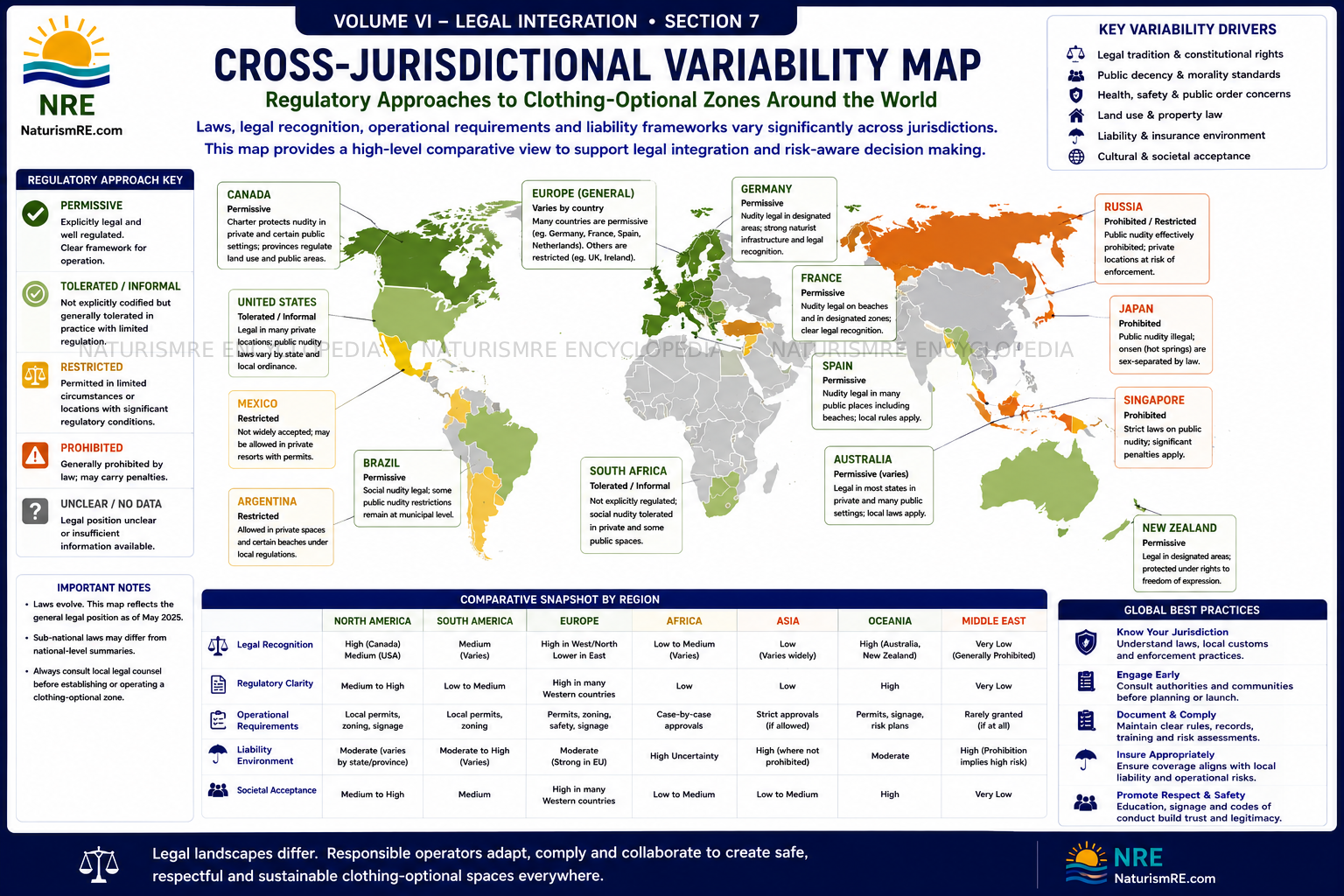
Naturist practice is governed globally through non-uniform legal frameworks, with no harmonised international standard.
Across jurisdictions, legal treatment of nudity varies due to differences in statutory definitions, cultural norms influencing interpretation, historical precedent, and enforcement priorities.
This produces a fragmented legal landscape in which similar conduct may be lawful in one jurisdiction and unlawful in another, tolerance levels vary significantly, and enforcement practices differ even within similar legal systems.
The absence of a unified standard limits the applicability of single-model approaches across jurisdictions.
7.2 Comparative Patterns in Legal Approaches
Despite variability, several broad regulatory patterns can be identified.
Context-Tolerant Models
Allow nudity within defined environments while emphasising behaviour, non-disruption, and contextual clarity.
Conditional Restriction Models
Permit naturist activity only under specified conditions such as permits, designation, or administrative authorisation.
Prohibition-Oriented Models
Restrict nudity broadly with limited or no formal recognition of naturist environments.
Hybrid Regulatory Systems
Combine multiple approaches depending on local context, enforcement priorities, and historical precedent.
These patterns provide a comparative framework, but do not eliminate jurisdiction-specific nuance.
7.3 Cultural and Social Determinants of Legal Interpretation
Legal frameworks are shaped not only by statutory design but by cultural and social context.
Interpretation of indecency or offensiveness is influenced by historical exposure to naturist practices, societal attitudes toward the body, and prevailing moral or religious considerations.
As a result, similar legal provisions may be interpreted differently across regions, and enforcement thresholds may vary even under comparable statutory language.
This confirms that legal analysis must consider social context alongside formal legal structure.
7.4 Transferability of Models and Structural Constraints
Replication of naturist systems across jurisdictions encounters structural limitations.
Challenges include incompatibility with local legal frameworks, differences in enforcement practices, variation in public acceptance, and absence of supporting regulatory mechanisms.
A model effective in one jurisdiction may fail in another due to misalignment with local norms, lack of legal recognition, or heightened perception of risk.
Transferability therefore requires adaptation rather than direct replication, alignment with local legal and social conditions, and modification of operational frameworks.
7.5 Harmonisation Efforts and Their Limitations
Efforts to harmonise legal treatment of naturism face structural constraints.
There are no international legal instruments specifically addressing the issue, and diversity in cultural and legal systems limits standardisation. Regulatory prioritisation of the issue remains low in most jurisdictions.
General principles such as personal autonomy or freedom of expression may influence interpretation, but their application to nudity is inconsistent and subject to competing legal considerations.
Harmonisation is therefore limited to incremental alignment through shared practices, comparative legal reasoning, and gradual evolution of norms.
A unified global framework remains unlikely in the near term.
7.6 Cross-Jurisdictional Risk Assessment
Operating across jurisdictions requires context-specific risk assessment.
This includes identification of applicable statutes and bylaws, understanding enforcement practices, assessment of local tolerance thresholds, and evaluation of potential legal exposure.
Risk assessment must be jurisdiction-specific, regularly updated, and aligned with operational design.
Failure to account for jurisdictional differences may result in unintended legal breaches, inconsistent participant expectations, and increased enforcement action.
7.7 Strategic Adaptation and Modular Framework Design
Given the constraints of variability and limited harmonisation, effective naturist systems adopt modular frameworks.
Modular design maintains core principles such as behavioural integrity and contextual clarity, while adapting implementation details to local conditions.
This enables systems to operate across diverse jurisdictions, maintain internal coherence, and respond to legal and cultural variation.
Modular frameworks provide flexibility without fragmentation, consistency without rigidity, and scalability within defined constraints.
7.8 Analytical Conclusion
Cross-jurisdictional analysis demonstrates that naturist practice operates within a highly variable and non-harmonised legal environment.
There is no unified legal standard, and while jurisdictions exhibit identifiable patterns, significant variability remains. Cultural and social norms influence interpretation and enforcement. Transferability of systems requires adaptation to local conditions. Harmonisation efforts are constrained by structural and cultural factors. Jurisdiction-specific risk assessment is essential, and modular frameworks provide a practical approach to managing variability.
Naturist systems cannot rely on uniform legal assumptions. They must operate within diverse legal structures, evolving social contexts, and variable enforcement conditions.
This establishes a defining principle for Volume VI:
The scalability of naturist systems across jurisdictions depends on their ability to adapt core operational principles to local legal, cultural, and regulatory conditions, using modular frameworks that maintain consistency while accommodating variability and limiting transferability risk.
Primary Supporting Articles
Interoperability Between Jurisdictions, Structural Conditions and Limits
Why Jurisdictional Variation Prevents System-Level Scaling
Why Standardisation Fails Without Transferable Context
From Legal Diversity to Structural Convergence, A Global Synthesis of Naturist Regulation