

Social Normalisation Pathways, Cultural Integration, and Long-Term Perception Shift
Examining how naturist systems evolve from conditional acceptance toward long-term social integration through structured exposure, perception stability, and cultural adaptation.
The long-term integration of naturist systems depends on their ability to facilitate gradual, threshold-based perception shifts through structured, consistent environments that reduce ambiguity, manage resistance, and align with diverse cultural contexts over extended timeframes.
6.1 From Acceptance to Normalisation
Acceptance and normalisation represent distinct stages in social evolution.
Acceptance implies tolerance under defined conditions. Normalisation implies integration into recognised and expected societal patterns.
Naturist systems in most jurisdictions currently operate within conditional acceptance, characterised by limited designated environments, sensitivity to context, and reliance on behavioural clarity.
Future development depends on progression toward situational normalisation, where defined environments are understood without requiring continuous justification, interpretation becomes predictable across stakeholders, and the presence of such environments is not inherently contested.
This transition is gradual and dependent on consistent system performance over time.
6.2 Mechanisms of Social Normalisation
Social normalisation occurs through cumulative processes based on repeated, consistent exposure under controlled conditions.
Familiarity Development
Repeated observation reduces novelty and lowers perceived uncertainty or risk.
Behavioural Consistency
Stable and non-disruptive conduct reinforces predictable interpretation and builds trust.
Contextual Framing
Alignment with recognised societal functions supports integration into existing systems.
Narrative Stabilisation
Perception progressively aligns with operational reality as extreme or conflicting narratives diminish.
These mechanisms operate collectively and progressively rather than through isolated events.
6.3 Threshold Effects and Perception Shift
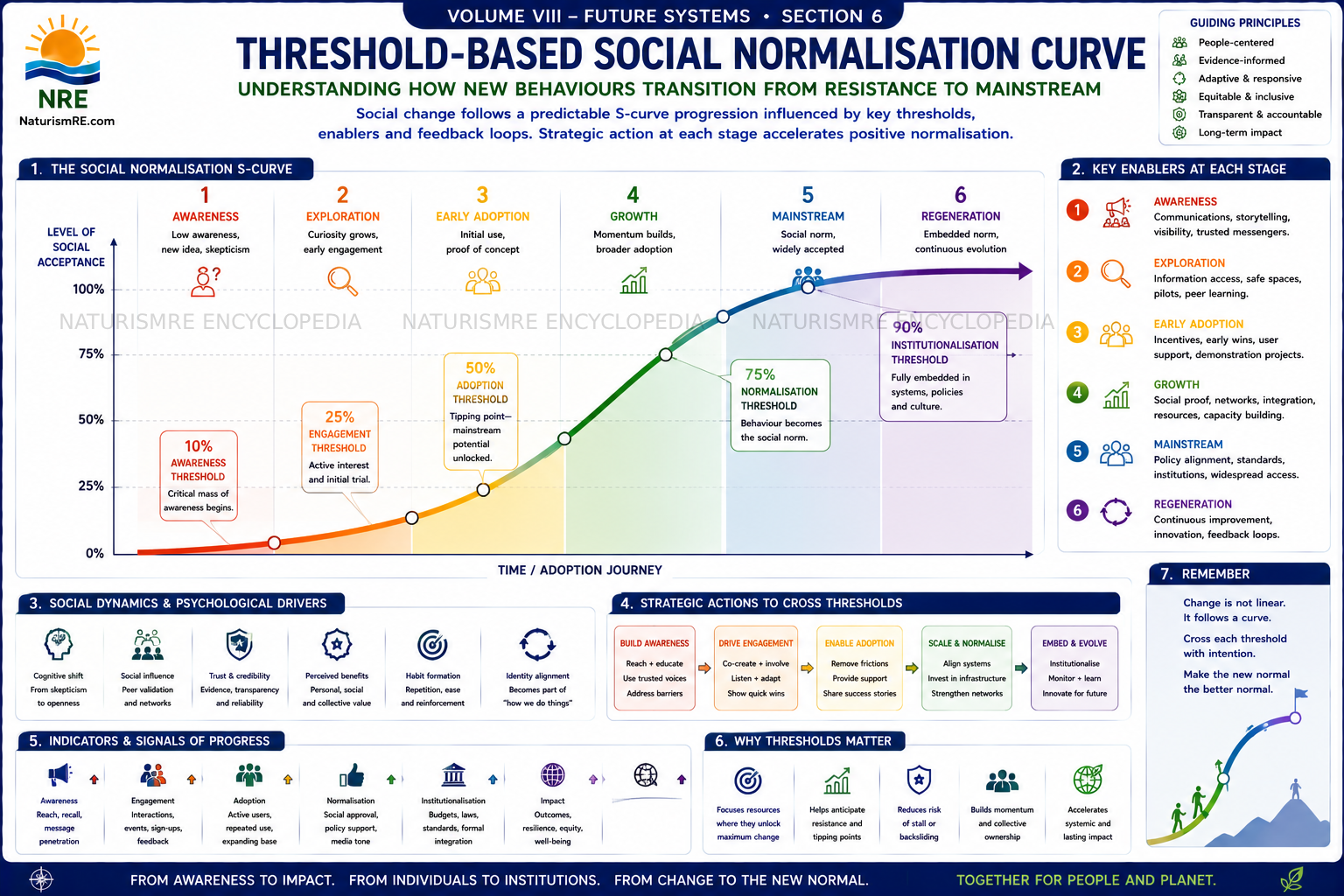
Social perception evolves through threshold-based dynamics rather than linear progression.
Characteristics include extended periods of minimal visible change followed by more rapid shifts once familiarity reaches a critical level.
For naturist systems, progression toward such thresholds depends on consistent operation, absence of high-impact negative events, and alignment with established societal frameworks.
When thresholds are reached in one context, they may influence adjacent contexts and reduce resistance to similar implementations.
6.4 Cultural Variability and Differential Adoption
Cultural context significantly affects the rate and form of normalisation.
Variables include historical exposure to naturist practices, prevailing norms regarding the body, religious or moral frameworks, and patterns of media representation.
As a result, progression toward normalisation is uneven across regions. Some contexts may evolve more rapidly, while others remain within restricted or conditional acceptance.
Future systems must therefore accommodate asynchronous development across cultural environments rather than assume uniform progression.
6.5 The Role of Structured Environments in Perception Stability
Unstructured exposure increases ambiguity, variability in interpretation, and the risk of negative perception.
Structured environments provide defined context, reduce interpretative uncertainty, and reinforce consistent behavioural expectations.
These conditions enable stable perception formation, gradual reduction of perceived risk, and alignment between expectation and experience.
Structured systems therefore function as stabilising anchors for perception and are central to long-term normalisation processes.
6.6 Resistance, Regression, and Perception Volatility
Social normalisation is not irreversible.
Systems may encounter resistance from specific stakeholders, regression following negative incidents, and volatility in perception driven by media amplification or external events.
Contributing factors include high-visibility behavioural deviations, rapid or uncontrolled expansion, and misalignment with local cultural conditions.
Resilient systems mitigate regression through consistent behavioural governance, controlled scaling, and alignment with tolerance thresholds.
6.7 Long-Term Cultural Integration
Over extended timeframes, naturist systems may become integrated into broader societal frameworks, including recreational norms, urban planning systems, and health or wellbeing initiatives.
Integration does not imply universal adoption. It reflects recognition of naturist environments as legitimate within defined contexts, reduced need for ongoing justification, and predictable interpretation across stakeholders.
Cultural integration is achieved when systems operate consistently, perception aligns with operational reality, and environments coexist without conflict.
6.8 Analytical Conclusion
Social normalisation of naturist systems is a cumulative and long-term process shaped by consistency, context, and perception dynamics.
Progression from acceptance to normalisation depends on sustained and predictable operation. Normalisation emerges through repeated exposure under controlled conditions. Perception shifts occur through threshold-based dynamics rather than linear change. Cultural variability results in uneven adoption across regions. Structured environments stabilise perception and reduce ambiguity. Resistance and regression remain possible and must be managed. Long-term integration depends on alignment with broader societal systems.
Naturist systems that achieve normalisation are those that maintain behavioural and contextual clarity, operate consistently over time, and align with evolving social expectations.
This establishes a defining principle for Volume VIII:
The long-term integration of naturist systems depends on their ability to facilitate gradual, threshold-based perception shifts through structured, consistent environments that reduce ambiguity, manage resistance, and align with diverse cultural contexts over extended timeframes.
Primary Supporting Articles
The Normalisation Threshold, When Acceptance Actually Shifts
Why Visibility Without Structure Reinforces the Problem
Visibility Management and Its Role in Perception Stability
Why Context Fragmentation Prevents Consistent Interpretation
Social Alignment and Misalignment, Why Naturist Systems Stabilise or Fragment