

War, Suppression, and System Stress: Structural Disruption and Adaptive Survival (1914–1945)
Examining the period from 1914 to 1945 as a structural stress phase in which naturist systems faced disruption, suppression, adaptive restructuring, and survival under external constraint.
Naturism does not persist because it is inherently accepted. It persists because it can be structured, regulated, and adapted within external constraints.
5.1 Purpose
This section examines the period from 1914 to 1945 as a phase of system disruption, constraint, and adaptive survival in the development of naturism.
Its purpose is to analyse how early naturist systems responded to large-scale external disruption, to identify the mechanisms through which continuity was maintained under constraint, and to define the structural conditions required for system survival.
This section positions the war period as a stress test of system viability rather than as a simple interruption of development.
5.2 Naturism as an Emerging System at the Onset of Disruption
By the early twentieth century, naturism had begun to establish itself as a structured but fragile system characterised by organised clubs and associations, defined behavioural frameworks, controlled environments, and emerging participation networks.
At the same time, the system remained legally exposed, socially contested, and institutionally incomplete. These conditions made it highly sensitive to political disruption, social instability, and regulatory pressure.
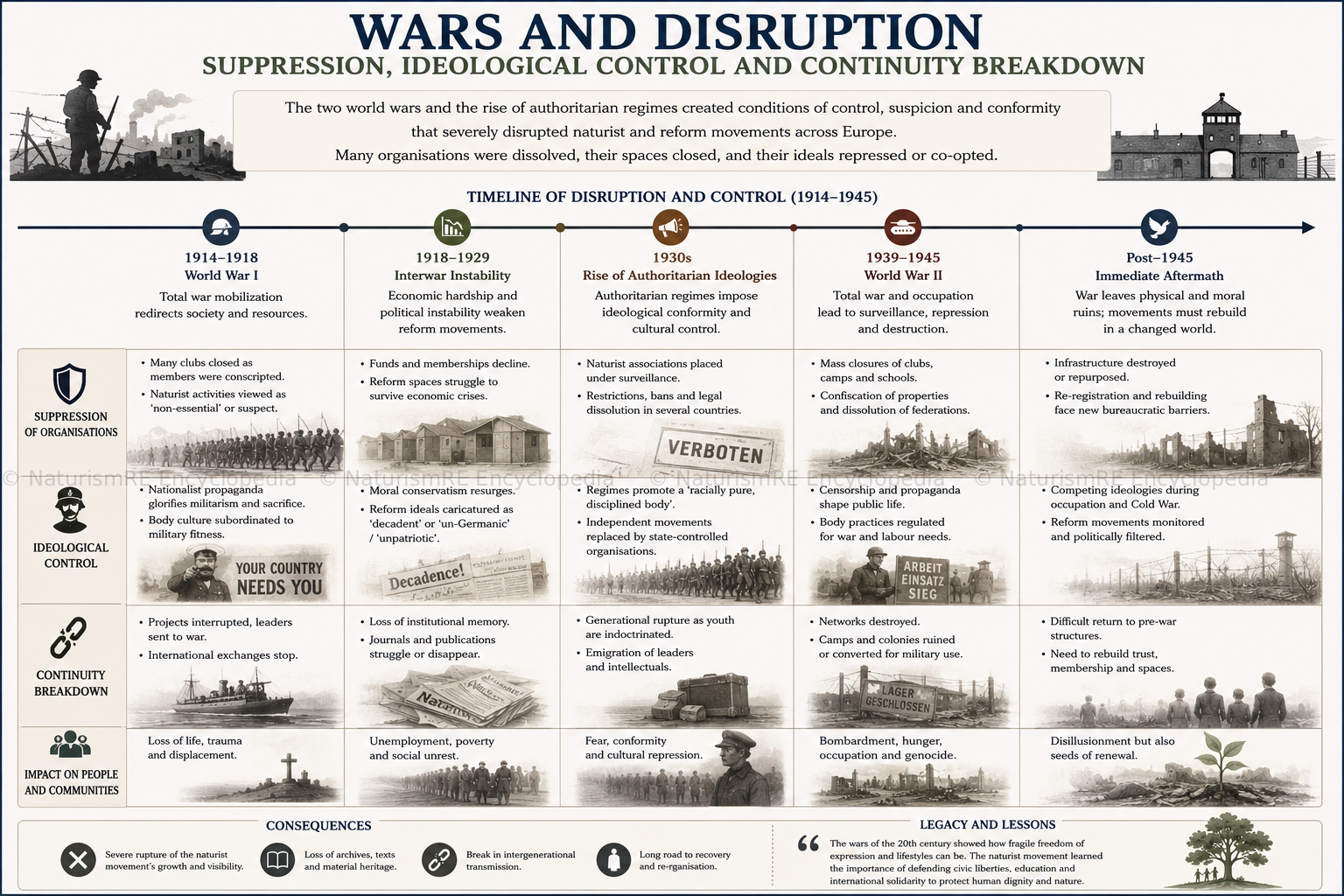
5.3 System Disruption During the First World War (1914–1918)
The First World War introduced large-scale disruption across all social systems.
Recreational and social activities were suspended, resources were redirected toward national priorities, and civilian infrastructure was fragmented. Naturist systems experienced cessation of organised activity, decline in participation, and loss or repurposing of infrastructure.
This period demonstrates that early-stage systems are highly vulnerable to external disruption.
5.4 Secondary Effects of Wartime Social Conditions
Despite disruption, wartime conditions produced indirect effects relevant to system evolution.
Mass mobilisation exposed individuals to communal living environments, reduced privacy norms, and shared physical conditions. These experiences contributed to shifts in perception of the body, increased tolerance of shared physical presence, and altered expectations of personal space.
However, these effects were indirect, variable, and insufficient to sustain system continuity.
5.5 Interwar Reconstitution and Structural Expansion
The interwar period between 1918 and 1939 saw partial system reconstitution and expansion.
This was driven by renewed focus on physical and mental recovery, expansion of leisure and recreational activity, and reactivation of social networks.
Naturism during this period became associated with physical regeneration, alternative lifestyle models, and social reform movements. However, expansion occurred within unstable political environments, variable legal conditions, and contested social acceptance.
5.6 Ideological Interaction and System Exposure
Naturism became increasingly entangled with broader ideological frameworks.
In some contexts, it was associated with social equality and reformist movements. In others, it was perceived as morally questionable, socially destabilising, or politically sensitive.
This dual perception created a condition of system exposure in which naturist systems were vulnerable to reinterpretation based on prevailing ideological frameworks.
5.7 Authoritarian Regulation and Structural Reconfiguration
The rise of authoritarian regimes introduced direct intervention in naturist systems.
In affected jurisdictions, independent organisations were restricted or dissolved, activities were subject to state control, and participation was restructured under imposed frameworks.
Naturism was not necessarily eliminated, but its autonomy was reduced, its structure altered, and its operation made conditional on external authority.
This demonstrates a key principle:
Naturist systems can persist under constraint only through structural adaptation.
5.8 Legal and Social Suppression Mechanisms
Beyond authoritarian systems, naturism faced broader suppression through stricter application of public decency laws, increased regulation of social behaviour, and heightened scrutiny by media and institutions.
Operationally, this resulted in restriction to private or controlled environments, reduced public visibility, and increased reliance on discretion.
This reinforced dependence on defined environments, legal tolerance, and controlled participation.
5.9 System Collapse Conditions During the Second World War (1939–1945)
The Second World War produced near-total disruption of social systems.
Organisational activity was suspended, infrastructure was destroyed, populations were displaced, and survival priorities replaced social engagement.
Naturist systems experienced widespread inactivity, dissolution of organised structures, and loss of operational continuity.
This represents a full-system interruption rather than partial disruption.
5.10 Structural Consequences of System Disruption
The combined impact of both wars resulted in fragmentation of networks, loss of infrastructure, and interruption of institutional development.
At the same time, these disruptions contributed to consolidation of core principles, increased awareness of structural vulnerabilities, and a stronger emphasis on governance and control.
Naturism emerged from this period reduced in scale but more clearly defined as a structured system.
5.11 Adaptive Survival Mechanisms
Naturism persisted through restriction to controlled environments, alignment with legal and social constraints, and reinforcement of behavioural discipline.
This adaptive process strengthened internal governance, clarified operational boundaries, and reinforced differentiation from unacceptable conduct.
This confirms a defining characteristic:
Naturism survives through adaptation rather than resistance to external systems.
5.12 Analytical Implications
The war period establishes several system-level principles.
System Vulnerability
Naturist systems remain highly sensitive to political instability, social disruption, and regulatory pressure.
Institutional Dependence
Organisational structure and governance are essential for continuity under external constraint.
Adaptive Survival
Long-term persistence depends on alignment with legal and social systems rather than confrontation with them.
Behavioural Clarity
Clearly defined behavioural expectations become critical for resilience and legitimacy.
These principles define naturism as a condition-dependent system requiring alignment with external frameworks.
5.13 Conclusion
The period from 1914 to 1945 represents a structural stress test of naturism as a system.
War, political control, and social restriction demonstrated that naturism cannot operate independently of legal, social, and political environments. Continuity depends on alignment with those systems, and legitimacy must be actively maintained.
This leads to a defining principle:
Naturism does not persist because it is inherently accepted. It persists because it can be structured, regulated, and adapted within external constraints.
The suppression and restructuring of this period demonstrate that expansion without governance is unsustainable, that acceptance is conditional rather than permanent, and that institutional structure is required for survival.
At the same time, the continued presence of naturist principles under constraint demonstrates system resilience, capacity for adaptation, and structural persistence.
The legacy of this period is not disruption alone, but the consolidation of the conditions required for long-term viability. These conditions form the foundation for the post-war expansion and institutional scaling examined in the subsequent section.
Primary Supporting Articles
Disruption, Suppression, and System Fragility, Naturist Development Under Conflict (1914-1945)
War, Disruption, and the Breakdown of Continuity in Naturist Systems (1914-1945)
Ideological Control and the Reinterpretation of the Body Under Authoritarian Systems (1914-1945)
Why Systems Without Continuity Cannot Accumulate Legitimacy
Why Systems Without Defined Governance Layers Remain Operationally Fragile