

Liability Structures, Duty of Care, and Legal Risk Allocation
Examining how liability, duty of care, foreseeability, and responsibility allocation shape the legal sustainability of structured naturist systems.
The legal sustainability of naturist systems depends on their ability to define, distribute, and manage liability through clear duty of care structures, ensuring that foreseeable risks are addressed within a framework of reasonable and demonstrable operational conduct.
5.1 The Centrality of Liability in Naturist System Design
As naturist environments transition into structured, semi-public, or publicly visible systems, liability becomes a defining legal constraint.
Unlike informal or private participation, structured environments introduce identifiable organisers or operators, foreseeable interaction between participants, measurable environmental risks, and potential impact on third parties.
These conditions engage duty of care considerations regardless of whether a formal organisation exists.
Liability is therefore not incidental. It is a core determinant of operational viability.
5.2 Defining Duty of Care in Contextual Environments
Duty of care refers to the obligation to take reasonable steps to prevent foreseeable harm, provide conditions that do not expose individuals to unnecessary risk, and respond appropriately to known hazards.
In naturist environments, duty of care may apply to organisers of events or structured activities, operators of designated areas or facilities, and authorities responsible for land or regulatory oversight.
The scope of this duty depends on the level of control over the environment, the degree of organisation or coordination, and the foreseeability of potential harm.
Duty of care does not require elimination of risk. It requires reasonable management of identifiable risks.
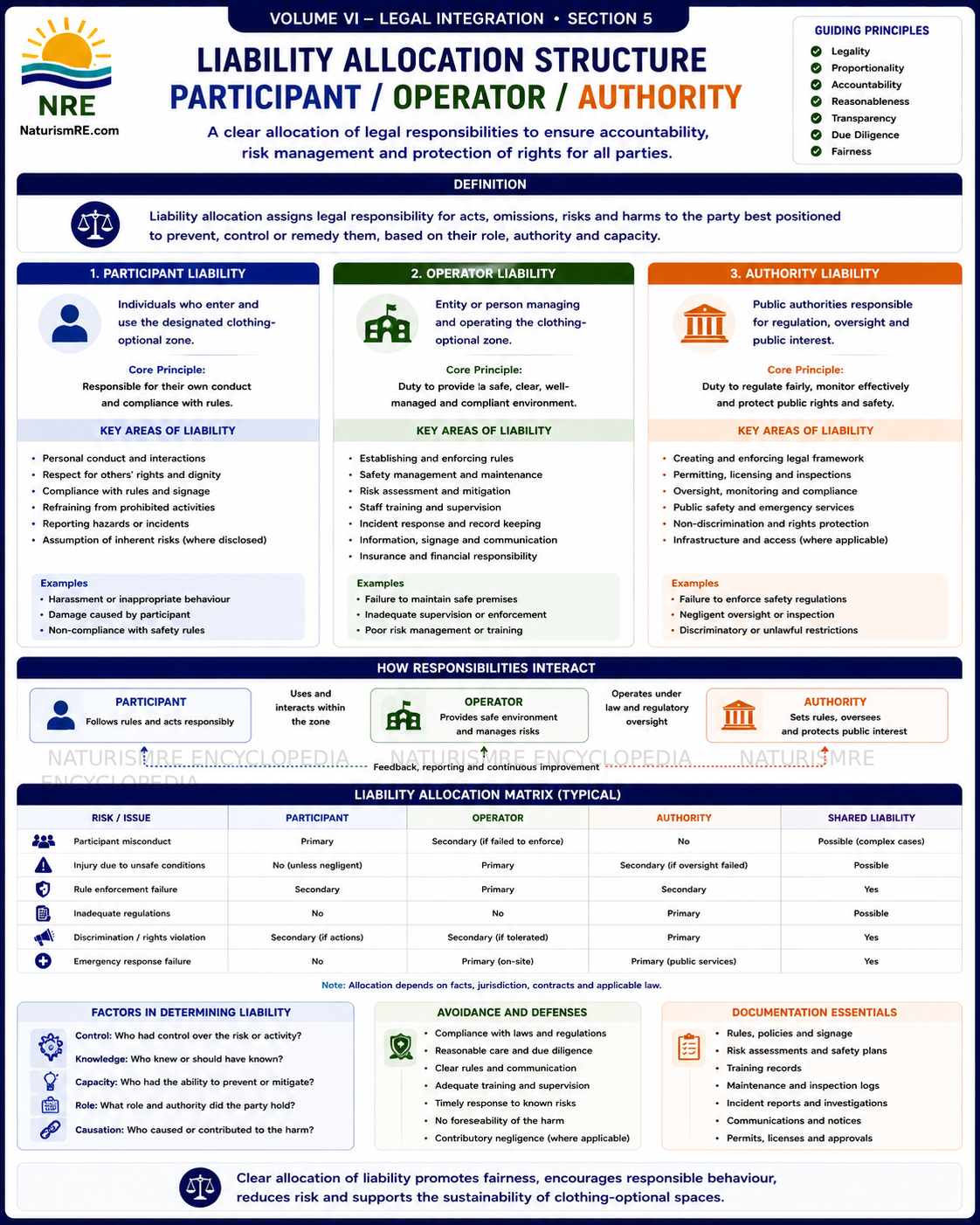
5.3 Allocation of Responsibility Across Actors
Liability within naturist systems is typically distributed across multiple actors.
Organisers and Operators
Responsible for environmental conditions, behavioural frameworks, and implementation of safety measures.
Participants
Responsible for individual conduct, adherence to behavioural expectations, and management of personal exposure and tolerance.
Landowners and Authorities
Responsible for baseline environmental safety, applicable regulations, and infrastructure conditions where relevant.
Shared Responsibility Structures
Liability often overlaps between actors, requiring clear operational delineation and communication.
Effective systems aim to clarify these roles to reduce ambiguity and improve legal defensibility.
5.4 Foreseeability and Risk Identification
A key principle in liability assessment is foreseeability.
Courts and regulatory bodies evaluate whether a risk could reasonably have been anticipated and whether appropriate steps were taken to mitigate it.
In naturist environments, foreseeable risks may include environmental exposure, behavioural deviation, interaction with non-participants, and perception-driven escalation.
Failure to identify or address such risks may increase legal exposure, weaken defensibility, and lead to enforcement or civil claims.
Structured systems therefore incorporate risk identification as a foundational design element.
5.5 Standard of Care and Reasonableness
Liability is typically assessed against a standard of care defined by what is considered reasonable under the circumstances.
Factors influencing this standard include the nature of the environment, level of organisation or control, expectations of participants, and prevailing practices in comparable settings.
In naturist systems, higher levels of organisation may increase expectations of care, clearly defined environments may support arguments of reasonableness, and absence of structure may increase perceived negligence.
The standard of care is therefore context-dependent and reinforces the importance of clearly defined operational frameworks.
5.6 Documentation, Communication, and Evidence of Compliance
Effective liability management requires the ability to demonstrate that risks were identified, participants were informed, and reasonable measures were implemented.
This may involve clear communication of behavioural expectations, visible indicators of environmental conditions, and documented protocols for safety and response.
Documentation does not eliminate liability, but it provides evidence of due diligence, supports claims of reasonable conduct, and establishes a basis for defence in legal proceedings.
Structured systems benefit from transparent and consistent communication, even in low-formality environments.
5.7 Insurance and Risk Transfer Mechanisms
Where formal organisation exists, liability may be partially managed through insurance mechanisms.
This may include public liability coverage, event-specific insurance, and coverage for operators or facilities.
However, challenges include difficulty in assessing risk within non-traditional environments, variability in insurer acceptance, and potential limitations in coverage scope.
Insurance does not replace risk management. It functions as a risk transfer mechanism that complements governance structures, safety protocols, and behavioural frameworks.
5.8 Analytical Conclusion
Liability within naturist systems is a multi-layered construct shaped by duty of care, foreseeability, and allocation of responsibility.
Structured environments engage duty of care obligations across multiple actors. Responsibility is distributed among organisers, participants, and authorities. Foreseeability is central to legal assessment. The standard of care is determined by context and level of control. Communication and documentation support legal defensibility. Insurance provides partial risk transfer but does not eliminate exposure.
Naturist environments, when structured, must operate within a framework where risks are identifiable, responsibilities are clearly defined, and mitigation measures are demonstrable.
This establishes a defining principle for Volume VI:
The legal sustainability of naturist systems depends on their ability to define, distribute, and manage liability through clear duty of care structures, ensuring that foreseeable risks are addressed within a framework of reasonable and demonstrable operational conduct.
Primary Supporting Articles
Liability as a Structural Constraint, Why Risk Allocation Will Shape the Future of Naturist Systems
Why Liability Exposure Scales Faster Than System Capacity
Risk Exposure as a System Variable, From Environmental Interaction to Managed Conditions
Protective Mechanisms and Adaptive Safeguards in Structured Naturist Environments
Incident Response, System Resilience, and Recovery Protocols in Structured Naturist Environments