

Legal Foundations: Interpretative Structure and Regulatory Logic
Establishing the legal principles through which nudity, nudism, and naturism are interpreted, classified, and regulated across jurisdictions.
The body is not the offence. The interpretation of its exposure determines legality.
5.1 Purpose
This section establishes the foundational legal principles governing nudity, nudism, and naturism across jurisdictions.
Its purpose is to define how legal systems interpret and regulate bodily exposure, to identify the structural logic underlying legal classification, and to establish a consistent analytical framework for all subsequent legal, policy, and social evaluation.
This section does not catalogue laws. It defines the mechanisms through which law assigns meaning to nudity.
5.2 The Structural Legal Problem of Nudity
Nudity presents a distinct challenge within legal systems. It is immediately visible and socially sensitive, yet it does not constitute an action in itself.
Legal systems regulate actions, consequences, and harm. As a result, nudity cannot be regulated as a standalone condition. It must be interpreted through associated conduct, contextual conditions, and perceived or actual impact.
This creates a structural tension. The body remains constant, while the meaning of its exposure is variable. Legal systems resolve this tension through interpretation rather than through absolute classification.
5.3 Distinction Between Condition and Offence
A consistent principle across legal systems is the distinction between nudity as a passive physical condition and indecency as a conduct-based classification.
In most jurisdictions, nudity becomes legally relevant only when combined with demonstrable intent, qualifying behaviour, contextual factors, or impact on others.
This establishes a core legal principle:
Nudity alone does not meet the threshold of criminal liability.
5.4 Core Determinants of Legal Interpretation
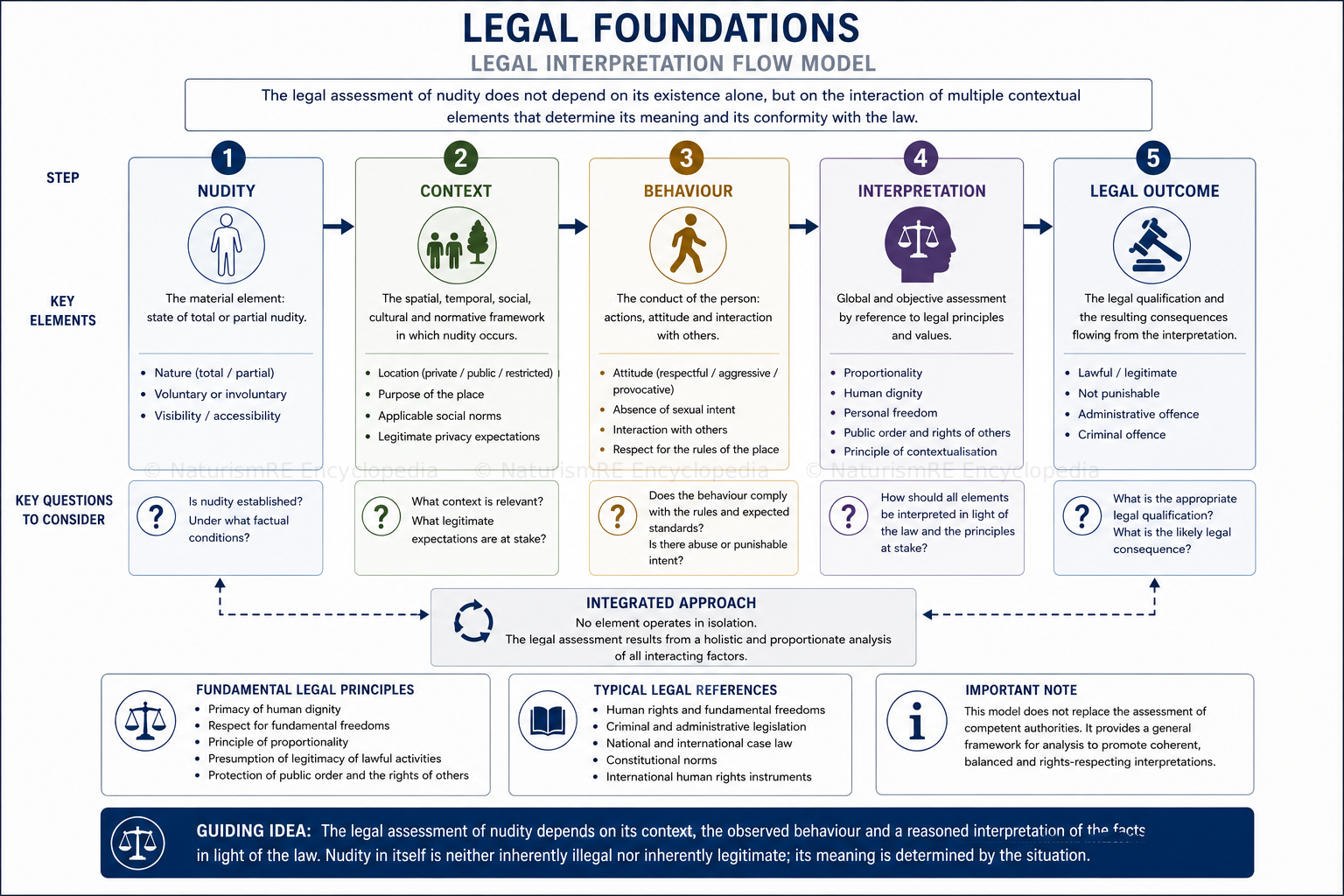
Legal systems evaluate nudity through a set of interacting determinants that align with the conceptual framework established in Section 4.
Intent
Defines the purpose behind exposure, distinguishing between non-sexual presence, provocative intent, and harmful intent.
Behaviour
Defines the actions accompanying exposure, including whether conduct remains passive or becomes coercive or escalatory.
Context
Defines whether exposure occurs within private or public, controlled or uncontrolled, expected or unexpected environments.
Audience Impact
Defines the effect on others, including involuntary exposure, distress, disruption, or perceived harm.
These determinants collectively form the operational logic of legal assessment.
5.5 Normative Tension Within Legal Systems
Legal regulation reflects an inherent tension between individual autonomy and collective expectations of order.
Legal systems must balance the freedom of bodily presence with the need to protect individuals from unwanted or disruptive exposure. This tension is not resolved in absolute terms. It is managed through conditional rules, contextual interpretation, and evolving standards.
This explains both variability across jurisdictions and the capacity of legal systems to adapt over time.
5.6 Regulatory Models of Legal Classification
Despite variation, legal systems tend to operate within identifiable structural models.
Some systems adopt broad restriction of nudity with limited contextual differentiation, prioritising predictability over flexibility.
Others rely on intent-based interpretation, where nudity is not inherently unlawful but becomes legally relevant depending on behaviour, purpose, and impact.
A third model involves conditional tolerance within defined contexts, where acceptance is supported by boundaries, governance, and behavioural consistency.
These models represent different responses to the same underlying problem: how to regulate a condition that is not inherently actionable.
5.7 Public Decency as a Flexible Regulatory Mechanism
Most legal systems rely on broad regulatory categories such as public decency, public order, nuisance, or disorderly conduct.
These categories are intentionally flexible. They allow adaptation to cultural norms, case-specific interpretation, and discretionary enforcement. However, this flexibility introduces variability in outcomes and limits predictability.
Legal systems therefore prioritise adaptability over uniform application.
5.8 Enforcement as the Practical Determinant
In practice, enforcement is not purely rule-based. Authorities assess situations based on the presence of complaint or harm, the behaviour of the individual, the likelihood of escalation, and the surrounding context.
This produces a consistent operational condition:
Law defines the framework. Enforcement determines its application.
5.9 Structured Environments and Legal Stability
Legal stability increases significantly within structured environments such as naturist clubs, designated beaches, and regulated events.
These environments provide defined behavioural standards, consent-based participation, and governance mechanisms capable of maintaining consistency.
As a result, ambiguity is reduced, misinterpretation is limited, and enforcement risk is lowered.
This establishes a core principle:
Legal tolerance is strongest where conditions are controlled.
5.10 Safeguarding Thresholds and Non-Negotiable Limits
All legal systems apply strict thresholds where vulnerability is present, particularly in relation to minors, coercion, exploitation, and non-consensual exposure.
In such cases, intent becomes less relevant, thresholds are lowered, and enforcement becomes more stringent.
This confirms that legal concern is directed toward harm and power imbalance rather than nudity itself.
5.11 Legal Risk and Interpretative Uncertainty
Legal risk arises where context is unclear, exposure is unavoidable, or behaviour is ambiguous.
Even within tolerant systems, such conditions may lead to complaints, enforcement action, or legal scrutiny.
This reflects a structural condition:
Legal outcomes are interpretative and context-dependent, not absolute.
5.12 Interaction with Social Perception
Legal frameworks operate in continuous interaction with social perception.
Public attitudes influence legislative design, enforcement priorities, and judicial interpretation. Where nudity is normalised, tolerance increases. Where it is stigmatised, restriction becomes more likely.
This interaction reinforces the interpretative nature of legal systems.
5.13 Functional Role Within the Encyclopedia
This section provides the legal foundation for Volume III, for policy and regulatory analysis, and for risk and compliance interpretation.
It ensures that all legal analysis throughout the encyclopedia remains grounded in context, behaviour, and intent rather than in assumption or appearance.
5.14 Conclusion
Legal systems do not regulate the human body as an isolated condition. They regulate the meaning assigned to its exposure through behaviour, intent, context, and impact.
This establishes a defining principle:
The body is not the offence. The interpretation of its exposure determines legality.
This principle ensures that legal classification remains conditional, interpretation remains structured, and analysis remains defensible.
Without this distinction, legal reasoning collapses into assumption and outcomes become inconsistent. With it, nudity can be understood as a regulated variable within a structured legal system rather than as a prohibited condition.
Primary Supporting Articles
Legal Definition and the Limits of Regulation: Why Law Alone Cannot Stabilise Naturist Systems
From Legal Principle to Operational Reality, Why Law Requires Structured Environments to Function
From Legal Permission to Operational Legitimacy, Why Recognition Requires Defined Conditions
Secondary Supporting Articles
Behavioural Thresholds and Legal Trigger Points in Structured Naturist Environments
Judicial Threshold Formation, How Courts Define Offensiveness and Acceptability in Naturist Contexts
Why Intent Cannot Protect Behaviour Without Defined Context
Why Enforcement Is Driven by Perception Rather Than Legal Principle
Why Legal Clarity Without Operational Context Fails in Practice