

Social Behavioural Systems, Interpersonal Dynamics, and Group Regulation Mechanisms
Examining naturist environments as behaviourally regulated social systems in which stability, trust, and participant interaction are shaped through structured collective dynamics.
The long-term viability of naturist environments depends on their capacity to function as self-regulating social systems in which behaviour is structured, observable, and resilient to disruption across both low and high-density conditions.
4.1 Social Behaviour as a System Variable
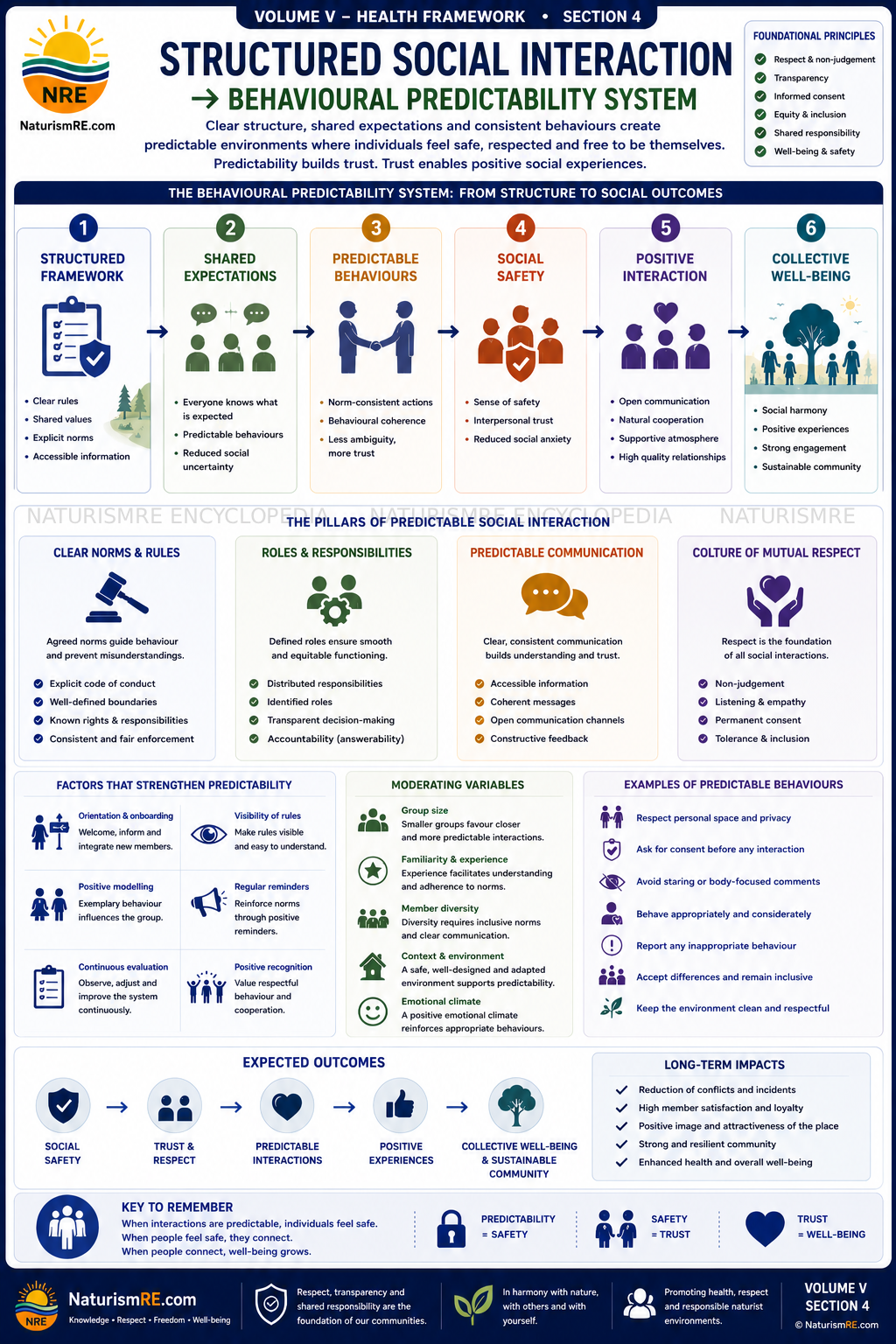
Naturist environments do not operate solely at the individual level. They function as social systems in which outcomes are shaped by interaction patterns between participants.
Behaviour within these systems is influenced by shared expectations, environmental context, perceived norms, and group dynamics.
In structured naturist environments, behaviour becomes a primary regulatory mechanism, compensating for the absence of clothing-based social signalling. This elevates the importance of observable conduct, consistency of interaction, and alignment with defined purpose.
Social behaviour is therefore not incidental. It is a core operational variable that determines system stability.
4.2 Norm Formation and Reinforcement Processes
Social norms within naturist environments are established through a combination of explicit communication, observation, and reinforcement.
Behavioural standards are introduced through governance frameworks or environmental cues. Participants observe and interpret expected conduct based on visible behaviour. Norms are then reinforced through conformity or correction, with consistent behaviour strengthening expectations and deviation prompting response.
In structured environments, norms are established more rapidly, applied more consistently, and more easily interpreted by new participants.
In unstructured environments, norms may develop slowly, vary between individuals, and introduce ambiguity.
Effective norm formation is essential for reducing variability and maintaining predictability within the system.
4.3 Interpersonal Dynamics Without Conventional Social Signals
Clothing functions as a primary system of social signalling, conveying identity, status, and cultural affiliation.
In its absence, interpersonal dynamics shift toward behavioural cues, verbal communication, and non-verbal interaction patterns.
This shift reduces reliance on status signalling based on appearance, increases emphasis on conduct and interaction style, and may initially introduce uncertainty in interpreting social cues.
Over time, structured environments support the development of stable interaction patterns, reduced ambiguity, and consistent behavioural expectations.
Interpersonal dynamics therefore become behaviour-centric rather than appearance-centric.
4.4 Group Cohesion and Collective Behaviour
Group cohesion refers to the degree to which participants align with shared norms, perceive themselves as part of a coherent environment, and maintain consistent behaviour.
Environmental Clarity
Clearly defined purpose and behavioural expectations support alignment and predictability.
Behavioural Consistency
Stable conduct patterns reduce variability and reinforce collective trust.
Perceived Safety
Psychological and social safety strengthen cohesion and reduce behavioural disruption.
Intervention Reduction
High-cohesion systems require less external correction due to strong internal alignment.
Low-cohesion environments may experience increased variability, higher likelihood of misunderstanding, and greater reliance on external regulation.
Cohesion functions as a stabilising factor, contributing to both participant experience and system resilience.
4.5 Boundary Behaviour and Respect for Non-Participants
Structured naturist systems often exist within broader social contexts that include non-participating individuals.
This requires boundary-aware behaviour, respect for differing comfort levels, and management of shared space dynamics.
Key behavioural considerations include avoidance of intrusive conduct, maintenance of spatial boundaries, and alignment with the defined purpose of the environment.
Failure to manage boundary behaviour may result in increased social friction, complaints, or regulatory intervention.
Effective systems ensure that participation remains voluntary, does not impose on non-participants, and operates within clearly defined limits.
This supports coexistence within shared environments.
4.6 Deviance, Correction, and Enforcement Mechanisms
All social systems are subject to behavioural deviation.
In naturist environments, deviation may include conduct inconsistent with the non-sexual context, actions that introduce ambiguity or discomfort, or disregard for established norms.
Structured systems address deviation through informal correction, such as peer feedback or visible disapproval, and formal intervention through designated stewards or supervisory roles. In persistent cases, removal or restriction of participation may be required.
The effectiveness of these mechanisms depends on clarity of standards, visibility of enforcement, and consistency of application.
Systems that fail to address deviation risk erosion of norms, increased variability, and loss of credibility.
Behavioural correction is therefore a maintenance function essential to system integrity.
4.7 Trust, Predictability, and Social Stability
Trust is a critical component of social systems, particularly in environments involving increased personal exposure.
Trust is established through consistent behaviour, reliability of governance mechanisms, and absence of unexpected or ambiguous conduct.
Predictability supports trust by reducing uncertainty, enabling participants to anticipate interaction patterns, and reinforcing environmental stability.
In high-trust environments, participants experience reduced cognitive load, social interaction becomes more fluid, and system resilience increases.
In low-trust environments, vigilance increases, participation may decline, and perceived risk is elevated.
Trust and predictability are therefore interdependent variables that underpin social stability.
4.8 Analytical Conclusion
Naturist environments function as high-sensitivity social behavioural systems in which stability is determined by collective behavioural alignment within defined conditions.
Behaviour replaces clothing as the primary regulatory signal. Norm formation must be explicit, visible, and consistently reinforced. Interpersonal dynamics shift toward conduct-based interpretation. Group cohesion directly influences system resilience. Boundary management is essential for coexistence with non-participants and for legal defensibility. Behavioural deviation must be addressed promptly to prevent systemic instability. Trust and predictability form the foundation of sustained participation.
These systems exhibit asymmetrical risk profiles, in which isolated deviations may produce disproportionate consequences. Stability depends on continuous behavioural integrity rather than intermittent compliance.
Naturism, at the social systems level, is not defined by the absence of clothing, but by the presence of a consistently regulated behavioural environment capable of maintaining clarity, trust, and stability under varying conditions.
This establishes a defining principle for Volume V:
The long-term viability of naturist environments depends on their capacity to function as self-regulating social systems in which behaviour is structured, observable, and resilient to disruption across both low and high-density conditions.
Primary Supporting Articles
From Social Interaction to Social Order, How Structured Environments Produce Predictable Behaviour
Social Alignment and Misalignment, Why Naturist Systems Stabilise or Fragment
How Behavioural Standards Become Self-Enforcing Within Defined Environments
Behaviour Stabilisation in Open vs Controlled Access Environments
Why Behavioural Standards Function as Operational Infrastructure