

Policy Innovation, Regulatory Evolution, and Adaptive Legal Models
Examining how naturist systems evolve through adaptive policy models, context-responsive regulation, and incremental integration within existing legal frameworks.
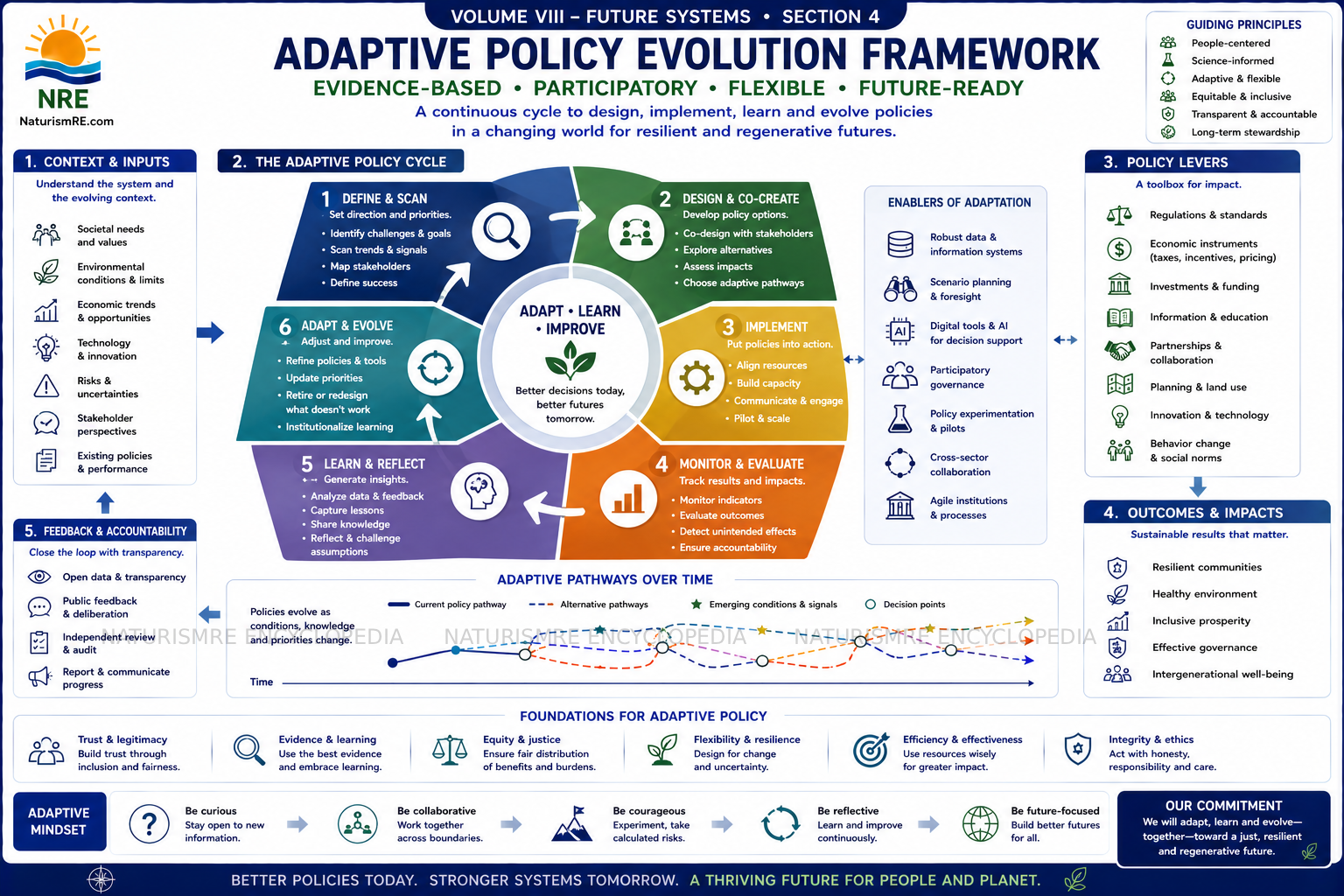
The future regulatory environment for naturist systems depends on the development of adaptive policy models that integrate behavioural, environmental, and contextual variables, enabling structured environments to operate within evolving legal frameworks while maintaining predictability and control.
4.1 From Static Regulation to Adaptive Policy Systems
Traditional legal frameworks governing nudity are predominantly static, characterised by fixed statutory definitions, broad offence-based constructs, and limited contextual differentiation.
As demonstrated in prior volumes, such frameworks frequently produce ambiguity, inconsistent enforcement, and reliance on interpretation rather than clarity.
Future-oriented naturist systems require a transition toward adaptive policy models in which regulation reflects contextual variability, incorporates behavioural and environmental factors, and evolves in response to observed outcomes.
This represents a shift from rule-based restriction toward condition-based governance.
4.2 The Concept of Context-Responsive Regulation
Context-responsive regulation is based on the principle that legality is determined by the interaction between environment, behaviour, and impact rather than by the physical condition of nudity alone.
Context-Defined Environments
Recognition of designated environments supports clearer interpretation and reduced ambiguity.
Behavioural Differentiation
Regulatory models distinguish passive presence from disruptive or ambiguous conduct.
Integrated Behavioural Standards
Behavioural expectations are incorporated directly into operational and regulatory frameworks.
Interpretative Stability
Structured regulation reduces dependence on discretionary enforcement and inconsistent interpretation.
Implementation depends on institutional willingness to adapt, availability of evidence supporting structured environments, and compatibility with existing legal systems.
4.3 Pilot-Based Policy Development
Given the sensitivity of the subject, policy evolution is most likely to occur through pilot-based mechanisms.
Pilot approaches involve controlled, limited implementation of environments under predefined conditions, combined with structured monitoring and evaluation.
These approaches reduce perceived risk for regulators, generate empirical data, and allow adjustment of operational parameters before broader adoption.
Pilot environments function as testing mechanisms for policy rather than as permanent solutions.
Successful pilots may lead to formal recognition of designated zones, integration into regulatory frameworks, and replication across jurisdictions.
4.4 Regulatory Instruments for Adaptive Models
Adaptive policy systems may utilise a range of regulatory instruments, including conditional permits or licences, designated use classifications within planning systems, administrative guidelines for enforcement bodies, and integration with public health or recreational policies.
These instruments provide flexibility, allow alignment with local conditions, and support incremental evolution of regulatory approaches.
Effective use of these instruments requires clear operational definitions, consistent enforcement practices, and ongoing evaluation mechanisms.
4.5 Balancing Flexibility and Legal Certainty
A central challenge in adaptive regulation is balancing flexibility with legal certainty.
Flexibility allows context-sensitive application but may lead to inconsistency if not bounded. Rigidity provides predictability but may prevent adaptation to diverse conditions.
Effective models achieve balance by defining clear baseline conditions, allowing controlled variation within those conditions, and maintaining alignment with broader legal principles.
This balance is essential for ensuring both interpretability and operational viability.
4.6 Institutional Constraints on Policy Innovation
Policy evolution is constrained by political sensitivity, competing regulatory priorities, institutional risk aversion, and limited precedent for structured naturist environments.
These constraints result in gradual progression, reliance on existing frameworks, and cautious adoption of new models.
Policy innovation is therefore more likely to follow demonstrated operational success and to emerge incrementally rather than through comprehensive reform.
4.7 Long-Term Trajectories of Regulatory Evolution
Over extended timeframes, regulatory systems may evolve toward greater recognition of context-defined environments, clearer differentiation between nudity and disruptive conduct, and integration within planning and recreational frameworks.
This evolution is influenced by accumulation of operational evidence, gradual shifts in social perception, and consistent system performance.
However, change is likely to remain uneven across jurisdictions, dependent on local conditions, and subject to periodic regression.
4.8 Analytical Conclusion
Policy innovation in relation to naturist systems is characterised by incremental adaptation within existing legal frameworks.
Static models create ambiguity and inconsistency. Context-responsive regulation provides greater precision. Pilot-based mechanisms offer viable pathways for development. Flexible regulatory instruments support gradual integration. Balance between flexibility and certainty is required. Institutional constraints limit rapid or uniform reform. Long-term evolution depends on accumulated evidence and system stability.
Naturist systems are unlikely to be governed by entirely new legal structures in the near term. Instead, they will be integrated through refinement of existing frameworks, gradual recognition of context-defined environments, and alignment with broader regulatory systems.
This establishes a defining principle for Volume VIII:
The future regulatory environment for naturist systems depends on the development of adaptive policy models that integrate behavioural, environmental, and contextual variables, enabling structured environments to operate within evolving legal frameworks while maintaining predictability and control.
Primary Supporting Articles
From Policy Avoidance to Policy Design, The Case for Structured Clothing-Optional Zones
From Risk to Regulation, The Structural Logic Behind Controlled Clothing-Optional Environments
From Zones to Systems, How Structured Environments Scale Across Jurisdictions
Why Policy Without Structure Produces Control Instead of Clarity