

Economic Structures, Incentives, and Sustainability Constraints in Naturist Systems
Examining the economic conditions that determine whether structured naturist systems can operate sustainably, scale effectively, and maintain long-term operational viability.
The scalability of naturism is not limited by participation interest, but by the capacity to develop economically viable systems capable of operating within real-world constraints.
4.1 The Economic Dimension of Naturist System Development
The evolution of naturist systems into structured, context-defined environments introduces a critical but often underexamined variable: economic viability.
While naturism has historically been framed as a cultural, philosophical, or lifestyle practice, its expansion into scalable environments requires resource allocation, infrastructure development, operational management, and investment in risk mitigation.
These elements place naturism within an economic framework regardless of its philosophical positioning.
The absence of a viable economic structure results in limited scalability, dependence on informal or volunteer systems, inconsistent quality and governance, and increased exposure to unmanaged risk.
Economic structuring is therefore not optional. It is a precondition for sustained system operation.
4.2 Traditional Revenue Models and Their Structural Limitations
Historically, naturist environments have relied on membership-based and facility-driven revenue models, including club memberships, entry fees, accommodation and resort services, and event-based income.
These models provide predictable revenue streams, controlled participation environments, and defined governance structures.
However, they also introduce structural limitations.
Controlled Access Dependency
Revenue structures tied to access control reduce scalability into open or semi-public environments.
Exclusivity Incentives
Financial sustainability may become linked to exclusivity rather than broad accessibility or integration.
Operational Rigidity
Infrastructure and staffing costs reduce adaptability and increase long-term operational dependency.
Perception Constraints
Association with private or commercial environments may limit alignment with public health or social integration models.
These limitations do not invalidate traditional models. They define their operational scope.
4.3 Economic Barriers to Public or Semi-Public Naturist Systems
The development of structured naturist environments in public or semi-public contexts introduces distinct economic challenges.
Unlike private facilities, such environments may not generate direct revenue, require shared or public resource allocation, and involve broader stakeholder engagement.
Key constraints include uncertainty in funding responsibility between authorities, private actors, or community groups, difficulty in justifying costs relative to other public priorities, perceived reputational or political risk that reduces investment willingness, and ongoing maintenance and oversight requirements.
These factors contribute to slow adoption of structured public naturist environments even where participation demand exists.
4.4 Incentive Structures and Institutional Behaviour
Economic incentives shape the behaviour of stakeholders within the naturist ecosystem.
Traditional organisations are typically driven by membership-based revenue and facility utilisation, encouraging controlled environments but limiting expansion into broader contexts.
Public authorities prioritise risk minimisation, policy justification, and responsiveness to public perception, often leading to cautious engagement.
Private sector actors evaluate opportunities through profitability and risk exposure, limiting participation where returns are uncertain.
Individuals and communities face low barriers to participation but limited capacity to develop structured environments.
These divergent incentives create a fragmented economic landscape in which alignment between stakeholders is not guaranteed. System development requires mechanisms capable of reconciling these differences.
4.5 Alternative Economic Models and Emerging Approaches
In response to these limitations, alternative economic models are emerging.
Hybrid Public-Private Models
Shared operational structures distribute financial risk and governance responsibility across stakeholders.
Framework-Driven Systems
Behavioural governance and operational frameworks reduce dependence on expensive infrastructure.
Event-Based Activation
Temporary or seasonal models allow controlled testing of participation and operational viability.
Indirect Value Integration
Naturism integrates into tourism, wellness, recreation, and destination economies without relying solely on direct participation fees.
These approaches reflect a transition from facility-based economics toward system-oriented value generation.
4.6 Sustainability and Long-Term Operational Viability
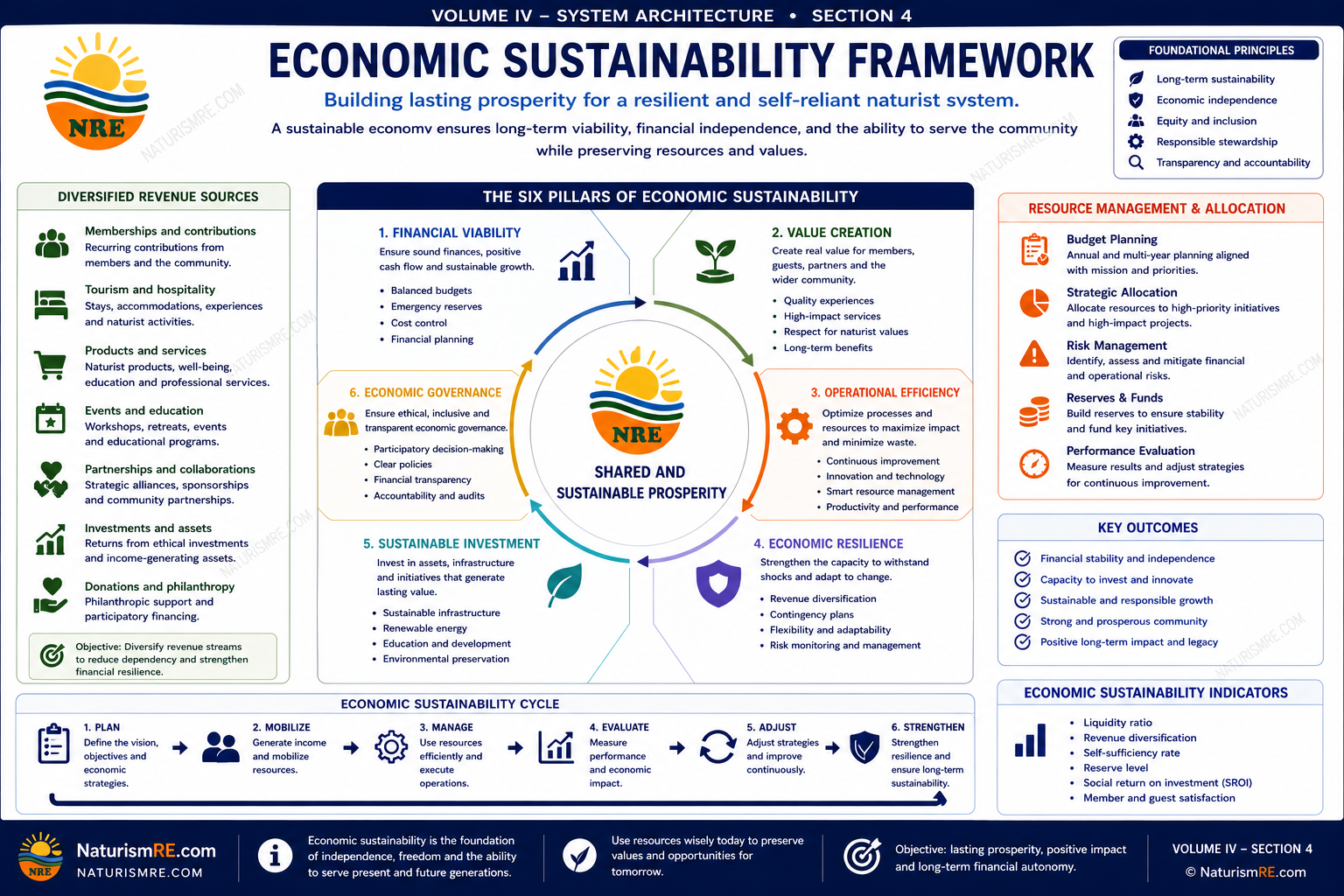
Economic sustainability in naturist systems depends on the balance between operational costs, risk exposure, stakeholder support, and perceived value.
Sustainable systems demonstrate alignment between purpose and funding structure, predictable cost profiles, scalable governance, and resilience to fluctuations in participation and perception.
Unsustainable systems tend to rely on a single revenue source, maintain high fixed costs relative to usage, or remain vulnerable to reputational and regulatory disruption.
Long-term viability therefore requires adaptive economic models capable of responding to changing structural conditions.
4.7 The Role of Economic Legitimacy in System Acceptance
Economic factors also influence perceived legitimacy.
Environments that demonstrate responsible resource use, clear benefits to participants or communities, and transparent operational models are more likely to gain acceptance from authorities, local communities, and stakeholders.
Conversely, environments perceived as financially unjustified, exclusively commercial, or disconnected from broader societal value may encounter resistance regardless of operational quality.
Economic legitimacy is therefore both a functional requirement and a perception-driven factor.
4.8 Analytical Conclusion
The expansion of naturist systems into structured, context-defined environments is shaped by economic realities.
Traditional revenue models provide stability but limit scalability. Public and semi-public environments face funding and justification challenges. Incentive structures across stakeholders are often misaligned. Emerging models seek to balance accessibility, cost, and risk. Long-term sustainability depends on adaptive and context-appropriate economic frameworks.
Naturism in its structured form cannot rely solely on cultural or philosophical positioning. It must demonstrate operational feasibility, economic coherence, and value within broader societal systems.
The future trajectory of naturist systems depends on the integration of governance, risk management, and economic sustainability into a cohesive operational model.
This establishes a defining principle:
The scalability of naturism is not limited by participation interest, but by the capacity to develop economically viable systems capable of operating within real-world constraints.
Primary Supporting Articles
Infrastructure Requirements for Sustained Expansion
Why Infrastructure Investment Requires Structural Certainty
Why Investment Does Not Flow Into Naturist Systems Despite Demonstrable Demand
Why Economic Activity Does Not Translate Into Structural Power