

Psychological Pathways, Body Image Dynamics, and Cognitive-Emotional Modulation
Examining how naturist environments influence body perception, social comparison, cognitive adaptation, emotional response, and psychological safety through structured contextual interaction.
The psychological implications of naturist practice arise not from nudity itself, but from the interaction between individual cognitive-emotional processes and the structure, predictability, and behavioural integrity of the environment in which participation occurs.
3.1 Defining Psychological Interaction in Naturist Contexts
Psychological responses within naturist environments arise from the interaction between individual cognition, social context, and perceived self-representation.
Unlike physiological mechanisms, which are primarily adaptive and measurable, psychological processes are interpretative, context-sensitive, and influenced by prior conditioning.
Naturist environments modify several baseline conditions, including reduction of clothing-based identity signals, increased visibility of the human body, and altered norms of comparison and evaluation.
These changes activate cognitive-emotional pathways associated with body perception, self-consciousness, social evaluation, and the experience of comfort or vulnerability.
Psychological outcomes are not predetermined. They are shaped by the interaction between environmental conditions and individual response profiles.
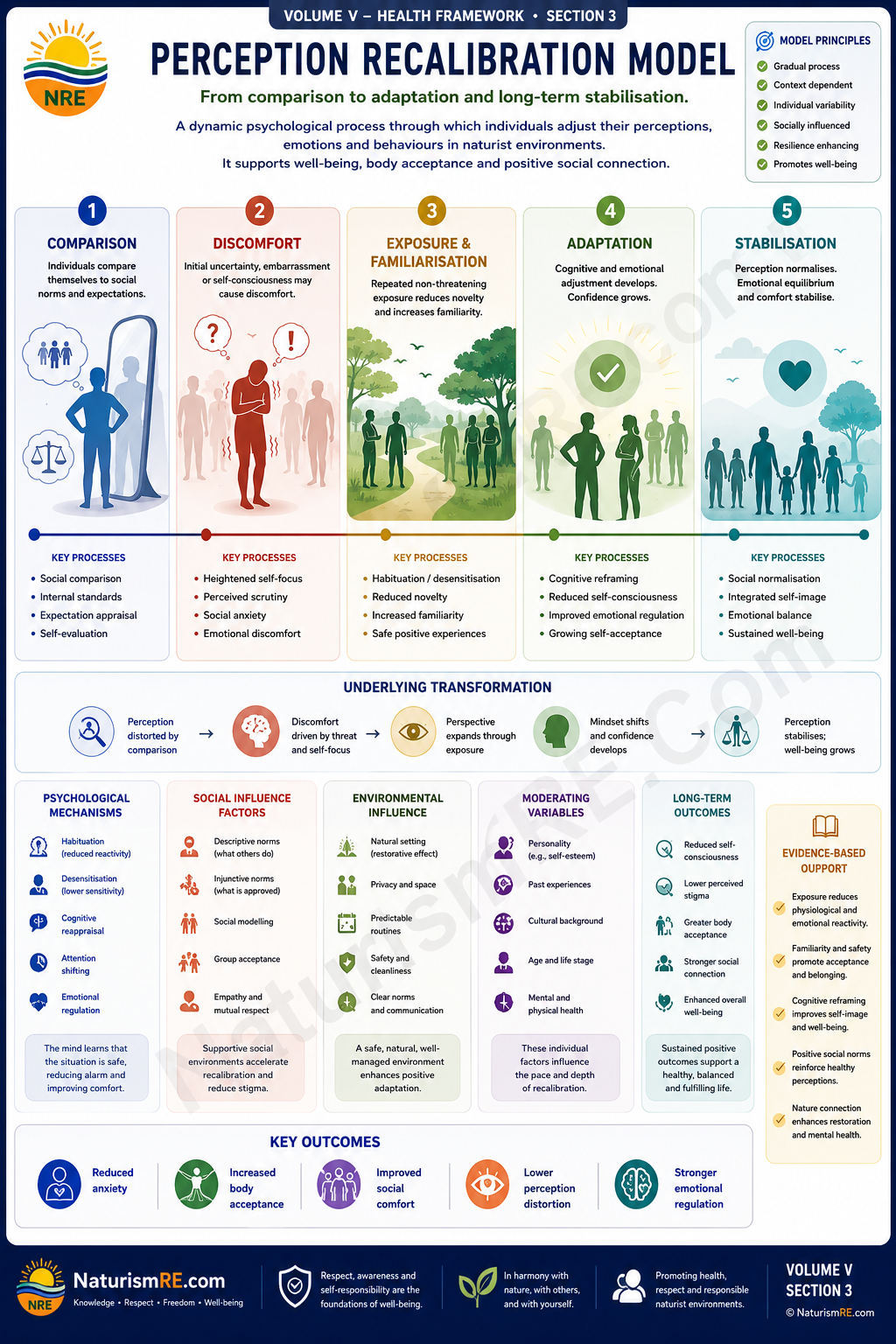
3.2 Body Image Frameworks and Perceptual Recalibration
Body image is a central psychological construct influenced by societal norms, media representations, peer comparison, and personal experience.
In many contemporary contexts, body image is characterised by idealised standards, selective representation, and comparison-driven evaluation.
Naturist environments introduce a different perceptual field in which a wider range of body types is visible, clothing no longer functions as a primary modifier of appearance, and comparison criteria may shift from presentation to presence.
This can initiate a process of perceptual recalibration. Exposure to diversity may reduce reliance on narrow standards, repeated interaction may normalise variation, and evaluative intensity may decrease over time.
However, recalibration is not immediate. Initial exposure may increase self-awareness or discomfort, and adaptation typically occurs progressively through repeated and consistent experience.
Perceptual change is therefore gradual and dependent on environmental stability.
3.3 Social Comparison and Evaluation Dynamics
Social comparison is a fundamental cognitive process through which individuals assess themselves relative to others.
Clothed Comparison Systems
Comparison in conventional environments is influenced by fashion, socioeconomic signals, and curated presentation.
Reduced External Modifiers
Naturist environments reduce clothing-based signalling and alter comparison reference points.
Divergent Initial Responses
Participants may experience either reduced status-based comparison or heightened bodily self-focus during early exposure.
Behavioural Reorientation
Stable environments may gradually shift emphasis from appearance evaluation toward neutral behavioural interaction.
The trajectory of comparison dynamics is therefore time-dependent and influenced by environmental predictability.
3.4 Cognitive Load, Self-Awareness, and Adaptation
Cognitive load provides a useful framework for understanding initial psychological responses to naturist environments.
New participants may experience heightened self-monitoring, increased awareness of body exposure, and concern about external evaluation.
This results in elevated cognitive load, with attention directed toward self-perception, reduced focus on external activities, and potential discomfort or hesitation.
As exposure becomes familiar, cognitive load may decrease through habituation to environmental conditions, reduced novelty of body exposure, and increased predictability of social interaction.
This transition reflects a movement from conscious self-monitoring toward background normalisation.
The rate and extent of this adaptation vary significantly across individuals.
3.5 Emotional Responses and Affective Modulation
Naturist environments can influence affective states, including experiences of comfort or discomfort, relaxation or tension, and confidence or vulnerability.
These responses are shaped by environmental conditions, perceived safety, social dynamics, and individual predisposition.
In structured and behaviourally consistent environments, some individuals may experience reduced anxiety associated with appearance, increased comfort in non-evaluative settings, and a closer alignment between internal and external self-representation.
In contrast, ambiguous or poorly defined environments may produce increased anxiety, heightened vigilance, and reluctance to engage.
Emotional outcomes are therefore environment-dependent and reinforce the importance of structured context.
3.6 Identity, Authenticity, and Self-Representation
Clothing functions as a primary mechanism for identity expression and modulation.
Its absence alters the ability to signal identity through external markers and reduces the distinction between public and private self-presentation.
In naturist environments, individuals may experience reduced reliance on external identity signalling and increased dependence on behaviour and interaction for self-representation.
This may lead to perceptions of increased authenticity for some individuals, while others may experience a sense of exposure or reduced control.
Identity dynamics are therefore not eliminated but reconfigured, shifting from visual signalling toward behavioural expression.
3.7 Psychological Safety and Environmental Predictability
A critical determinant of psychological response is perceived safety.
Psychological safety within naturist environments depends on clarity of behavioural expectations, consistency of participant conduct, and absence of ambiguity regarding intent.
Structured environments contribute to psychological safety by reducing uncertainty, establishing predictable interaction patterns, and reinforcing non-sexual context.
When psychological safety is established, cognitive load decreases, emotional responses stabilise, and participation becomes more sustainable.
In its absence, individuals may disengage, experience persistent discomfort, or interpret the environment as unpredictable or unsafe.
Psychological safety is therefore a precondition for stable and sustainable participation.
3.8 Analytical Conclusion
Psychological responses in naturist environments are shaped by complex interactions between perception, cognition, emotion, and social context.
Naturist environments alter body image frameworks and comparison dynamics, initiate gradual perceptual recalibration, and influence cognitive load and emotional responses.
Identity expression shifts from external signalling to behavioural interaction, and psychological safety becomes essential for sustained engagement.
These processes are not uniform. They vary according to individual predisposition and environmental conditions.
Naturism does not produce inherent psychological outcomes. It modifies the conditions under which psychological processes operate.
This establishes a defining principle for Volume V:
The psychological implications of naturist practice arise not from nudity itself, but from the interaction between individual cognitive-emotional processes and the structure, predictability, and behavioural integrity of the environment in which participation occurs.
Primary Supporting Articles
Body Perception as a Dynamic Construct in Contextualised Exposure Environments
Social Comparison and Perceptual Recalibration in Exposure-Based Contexts
Transitional Psychological States, Discomfort, Adaptation, and Perceptual Stabilisation
Health as Contextual Interaction, The Biopsychosocial Basis of Naturist Environments
Secondary Supporting Articles
From Social Interaction to Social Order, How Structured Environments Produce Predictable Behaviour
Why Behaviour Remains Interpreted as Exception Rather Than Norm
Social Alignment and Misalignment, Why Naturist Systems Stabilise or Fragment
Interpretation, Variability, and Structural Stabilisation in Health Outcomes